

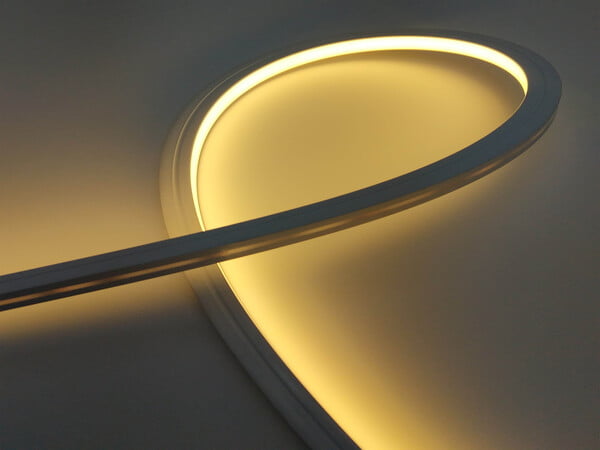
Many customers have experienced their LED strips burning out1 or blackening at the cut ends, despite being told they were "free-cuttable". This common but dangerous issue can lead to project delays and safety hazards.
Free-cut LED strips can be safely installed when proper cutting tools, sealant, and installation methods are used. The key is preventing short circuits by maintaining clean cuts and proper insulation at the cut points.
Let me share our decade of experience in LED manufacturing to help you understand why this happens and how to prevent it. As someone who has investigated hundreds of LED failure cases, I've developed a comprehensive solution.
Why Do Cut LED Strip Ends Burn Out?
Traditional LED strips can only be cut at marked intervals, while "free-cut" versions contain a continuous conductive layer. When these are cut improperly, it creates serious safety risks.
Cut-end burnout occurs when the positive and negative conductors make micro-contact at the cut point due to rough edges or compression, causing gradual heat buildup and eventual failure.

Let's dive deeper into the three main factors that contribute to LED strip burnout at cut points:
1. Cutting Tool Quality Impact
Poor quality or dull cutting tools can create several problems:
- Jagged edges that pierce insulation
- Conductor layer deformation
- Micro-tears in the silicone housing
Using the wrong cutting angle can compress the conductors, creating potential short circuit points that may not be immediately visible.
2. End Cap Installation Issues
| The end cap installation2 process is critical: | Common Mistakes | Potential Consequences |
|---|---|---|
| Over-compression | Conductor layer damage | |
| Insufficient sealant | Moisture ingress | |
| Misalignment | Uneven pressure points |
3. Conductive Layer Design
The original design spacing between positive and negative conductors plays a crucial role:
- Traditional 0.5mm spacing is too narrow for safe free-cutting
- Wider spacing provides better short circuit protection
- Material choice affects cut edge quality
What's The Solution for Safe Free-Cut LED Installation?
Years of field testing and customer feedback have shown that proper tools and techniques are essential for successful installation.
The solution combines three elements: specialized vertical cutting tools, insulating sealant gel, and optimized conductor spacing. This system approach prevents short circuits and ensures long-term reliability.
Let me break down our comprehensive solution that has been proven effective across thousands of installations:
1. Specialized Cutting Tools
We've developed custom vertical cutting tools that provide:
- Perfect 90-degree cuts
- Clean conductor separation
- No silicone deformation
- Consistent results
The design prevents the twisting motion that often creates conductor contact points.
2. Advanced Sealant Technology
| Our innovative sealant system offers multiple benefits: | Feature | Benefit |
|---|---|---|
| Self-leveling | Automatic void filling | |
| High adhesion | Permanent seal | |
| Quick curing | Faster installation | |
| UV resistant | Long-term protection |
3. Enhanced Circuit Design
Our redesigned conductor layout provides:
- 1.2mm minimum spacing
- Reinforced insulation layers
- Optimized current paths
- Better heat dissipation
Conclusion
Successful free-cut LED strip installation requires the right tools, materials, and techniques. By following our system approach, you can achieve reliable, long-lasting installations without the risk of burnout.