

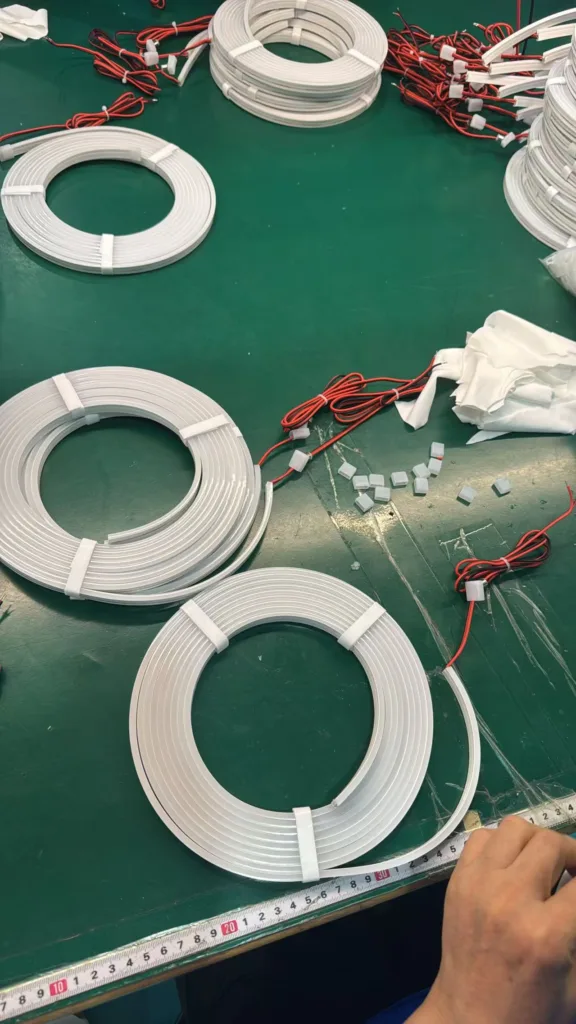
Identifying the type of LED strip sounds simple — until you're 2,400 meters into a commercial installation and realize the product doesn't match the design. LED strip misidentification is one of the most common causes of project rework, procurement disputes, and verification failures in large lighting projects. This guide shows you how to get it right.
Identifying an LED strip type means building a complete product identity, not just reading the LED package number. A strip labeled "SMD 5050" tells you the chip footprint — nothing more. A complete identification covers voltage, wattage, LED density, PCB width, color temperature, CRI, IP rating, control method, cutting unit, and installation environment. Without all of these, your project specification is incomplete.

Most procurement teams stop at the chip designation. The real risk begins there. The sections below break down exactly what you need to identify, why each parameter matters, and how incomplete identification leads to rework — with case studies from real project logic.
Why Is "SMD 5050" Not a Complete LED Strip Type?
You may have a procurement document that reads:
SMD 5050 LED Strip
And assumed your product was fully specified. It isn't.
The LED package designation — 5050, 2835, 3528 — identifies the physical chip footprint only. It does not define the system or performance of the strip. Two products can share identical chip designations and differ in every parameter that matters to your project.
Here is what "SMD 5050" does not tell you:
| Parameter | Why It Matters |
|---|---|
| Voltage (12V / 24V) | Determines power supply, wiring, voltage drop calculation |
| Power (W/m) | Determines thermal load, driver sizing, and performance |
| LED density (LEDs/m) | Determines optical continuity and visible dot spacing |
| PCB width | Determines fit in aluminum profiles and installation channels |
| Color temperature (CCT) | Determines visual output and design compliance |
| CRI | Determines color rendering for retail, hospitality, or display |
| IP rating | Determines suitability for wet, outdoor, or damp environments |
| Control method | Determines whether standard dimming or addressable control is needed |
| Cutting unit | Determines field cutting flexibility |
| Protection structure | Determines whether silicone coating, sleeve, or bare PCB applies |
The Three Roles Most Likely to Make This Mistake
In my experience reviewing project procurement processes, the misidentification problem originates in three places:
1. Procurement teams issuing RFQs with only a chip designation. Different suppliers return wildly different products — and different prices. The buyer then suspects price manipulation when the real problem is an undefined specification.
2. Project managers who see "5050 LED Strip" in the design file and consider the technical parameter complete. They focus on quantity, lead time, and cost. The identification gap survives through to installation.
3. Design teams who specify a visual intent — a continuous, soft linear light — without translating that intent into a purchasable product definition. Design intent is not a procurement specification.
The product name being the same does not mean the product is the same.
What Are the Correct Identification Layers for an LED Strip?
Incomplete identification creates procurement ambiguity. A structured, layered approach eliminates it.
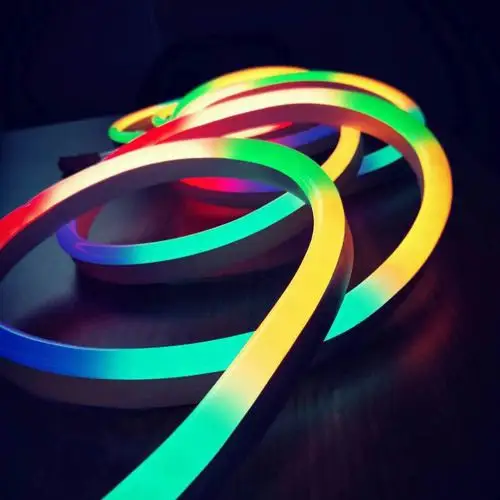
A complete LED strip identification requires seven sequential layers: LED package type, voltage, wattage per meter, LED density, color and control method, PCB and mechanical structure, and protection/IP rating. Each layer narrows the product identity. Skipping any layer leaves a specification gap that suppliers will fill differently.
Here is each layer in practical detail:
Layer 1 — LED Package Type
Examples: 2835, 3528, 5050, 5630, COB
This layer answers: What is the physical chip format?
It is the most commonly identified layer — and the only one many teams record. On its own, it is insufficient for any procurement decision.
Layer 2 — Voltage
- 5V
- 12V
- 24V
- Higher-voltage systems (48V, 120V AC, 230V AC)
Voltage is a system-level parameter. If you identify it incorrectly, every downstream decision — power supply selection, wire sizing, run length calculation, voltage drop compensation, and controller compatibility — is affected. A 12V strip specified where 24V was required will appear to work in a sample test. It will cause system failures at scale.
Layer 3 — Power (W/m)
Do not write "high power LED strip." Write the number:
- 5 W/m
- 10 W/m
- 15 W/m
- 20 W/m
Power drives thermal management, driver sizing, and energy compliance calculations. The same 5050 package exists across a wide wattage range. Wattage and package type must be specified together.
Layer 4 — LED Density (LEDs/m)
Common values:
- 30 LEDs/m
- 60 LEDs/m
- 120 LEDs/m
- 144 LEDs/m
- 240 LEDs/m (COB)
Density determines the dot pitch — the visible spacing between individual light sources. This directly controls:
- Whether the strip looks continuous at viewing distance
- How the strip performs behind a diffuser lens
- Whether the product matches a specified optical effect in the design
Two strips with identical chip types but different densities will produce visually distinct outputs. In hospitality and high-end retail environments, this difference is immediately visible and rarely acceptable after installation.
Layer 5 — Color and Control Method
Confirm one of the following:
- Single color (specify CCT: 2700K, 3000K, 4000K, etc.)
- Tunable white (CCT range, e.g., 2700K–6500K)
- RGB
- RGBW
- Digital / Addressable (SPI, DMX, etc.)
This is the most consequential identification error in dynamic lighting projects. Substituting a standard RGB strip for an addressable strip does not require replacing the strip only. It requires redesigning the entire control architecture — wiring topology, controller hardware, and software logic.
Layer 6 — PCB and Mechanical Structure
Confirm:
- PCB width (8mm, 10mm, 12mm are common)
- Copper weight (1oz, 2oz)
- Flexible or rigid
- Connector type
PCB width determines whether the strip physically fits inside the specified aluminum profile or installation channel. Discovering a width mismatch during installation is a significant scheduling problem in large projects.
Layer 7 — Protection Structure and IP Rating
Confirm the actual structure, not just the IP classification:
| Structure | Description | Typical IP |
|---|---|---|
| Bare PCB | No protection | IP20 |
| Conformal coat | Resin coating on components | IP44–IP54 |
| Sleeve / tube | PVC or silicone tube over strip | IP65–IP67 |
| Silicone extrusion | Fully encapsulated in silicone | IP67–IP68 |
"Waterproof LED strip" is not an identification. The actual protective structure — and the continuity of that protection at end caps and connectors — must be confirmed.
What Does a Correct LED Strip Identification Sheet Look Like?
Most project failures can be traced to the absence of a formal identification document before procurement begins.
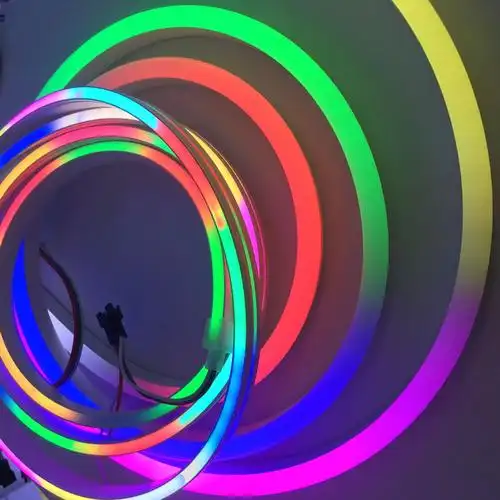
An LED Strip Identification Sheet is a pre-procurement document that records every parameter needed to define the product as a unique, verifiable specification. It serves as the reference point for supplier quotes, sample approval, batch verification, and site acceptance. Without it, all parties are comparing different products using the same name.
Here is a baseline identification sheet structure:
| Field | Required Entry |
|---|---|
| LED Package Type | e.g., SMD 2835, SMD 5050, COB |
| Voltage | e.g., 24V DC |
| Power | e.g., 14.4 W/m |
| LED Density | e.g., 120 LEDs/m |
| CCT / Color | e.g., 3000K, CRI ≥ 90 |
| PCB Width | e.g., 10mm |
| Protection Structure | e.g., Silicone extrusion, fully encapsulated |
| IP Rating | e.g., IP67 |
| Control Method | e.g., Single color, 0–10V dimmable |
| Cutting Unit | e.g., Every 50mm (3 LEDs) |
| Installation Method | e.g., Aluminum profile, recessed |
| Connection Type | e.g., Solderless clip connector |
| Application Zone | e.g., Indoor retail ceiling, dry location |
| Approved Sample ID | e.g., [Sample reference number] |
| Approved Supplier | e.g., [Supplier name and contact] |
Why This Document Changes How Suppliers Quote
When you send three suppliers an RFQ with a complete identification sheet, you receive three quotes for the same product. Price differences then reflect genuine manufacturing cost variation — not specification differences.
Without this document, three suppliers quoting "24V SMD 5050 LED Strip" may deliver:
- Different densities (60 vs. 120 LEDs/m)
- Different PCB widths (8mm vs. 12mm)
- Different wattages (10 W/m vs. 14.4 W/m)
- Different protection structures (coating vs. full silicone encapsulation)
These are different products. Comparing their prices is meaningless.
How Does Incomplete LED Strip Identification Cause Rework?
The failure mode is predictable. It follows the same sequence in almost every affected project.
When LED strip identification stops at the chip designation, specification gaps pass silently through procurement, survive sample approval, and surface during installation — at the point where remediation is most expensive. The cost of incomplete identification is not the cost of re-specifying. It is the cost of rework on an installed system.
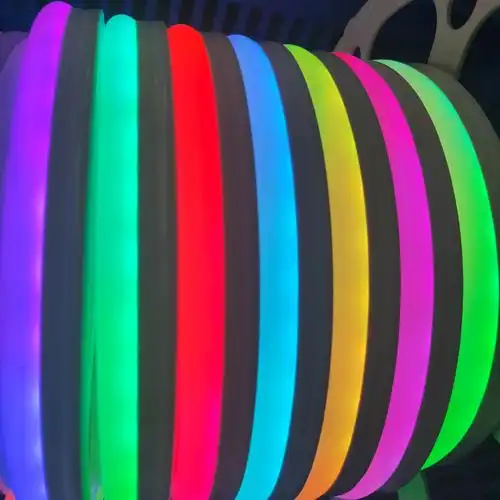
The following case is constructed from common project failure patterns in large-scale commercial lighting installations. It illustrates the sequential nature of the risk.
Project Scenario: 3,600m Commercial Retrofit
Week 1 — Design file issued:
24V LED Strip, SMD 5050
No density, no W/m, no CRI, no PCB width, no CCT, no control method specified.
Week 3 — Procurement RFQ sent:
24V 5050 LED Strip
Three suppliers respond. Significant price variation. Lowest-price supplier is selected on the basis that the product name matches.
Week 5 — Sample approval:
A 2-meter sample is reviewed. It lights up. The project manager notes:
"Looks close to the render."
Sample approved. No parameter verification performed.
Week 8 — Installation begins:
Installers note visible dot spacing at close range. The design intent was a continuous light line. The installed product shows discrete point sources.
Week 9 — Investigation:
The specification required high-density strip (120 LEDs/m minimum). The purchased product was standard density (60 LEDs/m). Both were correctly described as "SMD 5050."
Week 10 — Scope of problem:
2,400 meters already installed. Options:
- Continue installing — full 3,600m becomes potential rework
- Stop — creates scheduling cascade affecting ceiling trades, FF&E, and opening date
Dispute outcome:
- Supplier: "We delivered 5050. The PO doesn't specify density."
- Procurement: "The spec said 5050."
- Installer: "We installed what we received."
- Designer: "This doesn't match the design intent."
No party delivered a defective product. Every party operated within their stated information. The failure was the missing identification.
The rework cost was not a manufacturing problem. It was a specification problem that became a manufacturing cost.
What Are the Most Dangerous LED Strip Specification Mistakes in Tender Documents?
Procurement documents and tender specifications concentrate risk. When the errors below appear, they become binding commitments to an underspecified product.
The five most dangerous LED strip specification errors in tender documents are: specifying only the LED package type, specifying only W/m, specifying only the IP rating, issuing samples without identification records, and accepting "equivalent" substitutions without defining equivalence criteria. Each creates a gap that suppliers and contractors will interpret differently.
Mistake 1 — Specifying Only the LED Package
SMD 5050 LED Strip
Why it survives undetected: Everyone recognizes the name. Everyone assumes it is sufficient.
What it leaves undefined: Voltage, power, density, width, CCT, CRI, IP, control — every parameter that determines whether the product works in the application.
Fix: Add a minimum of: Voltage + W/m + LEDs/m + PCB width + CCT + CRI + IP + control type.
Mistake 2 — Specifying Only W/m
10W/m LED Strip
The same wattage can be delivered by different chip types at different densities with different optical profiles. Power consumption is a performance envelope parameter, not a product identity.
Fix: Power must be specified alongside chip type, density, and voltage.
Mistake 3 — Specifying Only IP Rating
IP67 LED Strip
IP67 defines a protection test result — immersion to 1m for 30 minutes. It does not define:
- The structure that achieves it (sleeve vs. full encapsulation)
- Whether end caps and field joints maintain that rating
- Any electrical or optical parameter
An IP67 designation can apply to products with completely different construction methods, cost profiles, and long-term reliability.
Mistake 4 — Samples Without Identification Records
A sample approved without a recorded Sample ID and complete parameter sheet is effectively anonymous. Three months later, nobody can confirm whether the product delivered matches the approved sample.
Minimum sample record:
Sample ID + Full specification + Supplier + Date approved + Reference photos
Mistake 5 — "Equivalent" Without Defined Equivalence Criteria
Equivalent products may be accepted.
This is one of the most dangerous phrases in a lighting specification. It transfers product identity decisions to the supplier — with no defined boundaries.
Does "equivalent" mean:
- Same optical output?
- Same electrical parameters?
- Same physical dimensions?
- Same IP structure?
- All of the above?
If the document does not define equivalence, every supplier defines it differently. The result is a tender where products cannot be compared and substitutions cannot be controlled.
Fix: Either remove the equivalent clause or define it precisely:
Equivalent products must match the approved reference in: LED package type, voltage, W/m (±5%), LEDs/m, PCB width (±0.5mm), CCT (±150K), CRI, IP rating structure, and control compatibility. Equivalence requires written technical approval before submission.
Frequently Asked Questions
Can I identify an LED strip type by looking at it?
Visual inspection identifies the LED package type and strip width. It cannot confirm voltage, wattage, density (without counting), CRI, CCT, or IP rating. Physical appearance is a starting point, not a complete identification. Always verify electrical and optical parameters against documentation.
Why do two LED strips with the same name have very different prices?
The same LED package designation — such as 5050 or 2835 — covers a wide range of specifications. Two "24V 5050 LED Strips" may differ in LED density, copper weight, CCT accuracy, CRI, protection structure, and LED bin quality. Price differences reflect these real specification differences. Comparing prices without a complete specification is comparing different products.
What is the minimum specification needed to get comparable quotes from multiple suppliers?
At minimum: LED package type, voltage, W/m, LEDs/m, CCT, CRI minimum, PCB width, IP rating structure, control type, and cutting unit. Adding a reference sample or an approved reference part number eliminates ambiguity further. Without these, supplier quotes are not directly comparable.
How do I verify that delivered batches match the approved sample?
Establish a Sample ID system at approval stage. At delivery, check: LED type, voltage marking, density (count a fixed length), PCB width, CCT under controlled conditions, IP structure, and packaging labeling. Where quantities are large