

Numbers and LEDs: What does 2835, 3528 and 5050 mean?
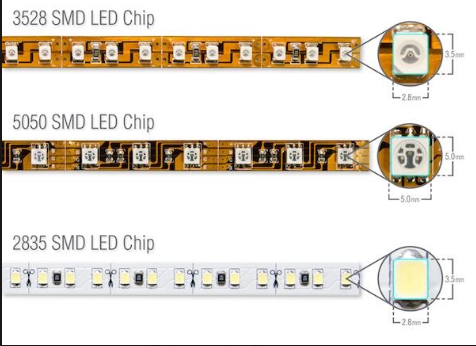
If you've ever browsed LED product catalogs or specs, you've likely encountered terms like 2835, 3528, and 5050. These numbers refer to popular SMD (Surface Mounted Device) LED chip sizes widely used in lighting today. Understanding what these numbers mean — and the advantages they offer — is key when selecting the right LED tape, strip, or module for your projects.
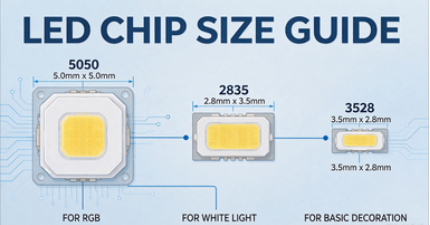
The numbers "2835," "3528," and "5050" denote the physical dimensions of SMD LED chips, measured in millimeters, and each size has distinct performance attributes suited for specific applications. In this article, I'll break down the features, typical uses, and technical considerations of these LED chips to help you make informed purchasing decisions.
Let’s go beyond the numbers and dive deeper into the design differences and practical implications.
What does 3528 mean?
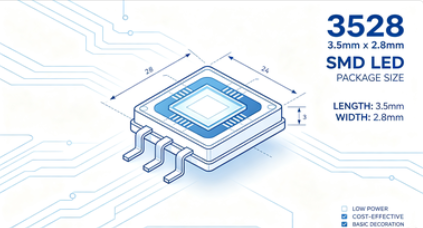
The term "3528" refers to an industry-standard SMD LED chip. It’s named for its dimensions: 3.5 mm × 2.8 mm. This compact size has historically made it a go-to for basic lighting applications.
The main traits of 3528 chips include:
- Lower brightness compared to newer chips
- Wide beam angle (~120°) for ambient lighting
- Budget-friendly pricing due to mature technology
- Ideal for decorative or indicative lighting rather than high-output tasks
This LED chip works best for applications where soft, diffused light is needed. For example, think simple LED tape lights for decorating a room or accent lighting in retail displays.
Dive deeper: Where do 3528 chips shine today?
Although 3528 LEDs are considered older technology, they remain popular due to their affordability and versatility. They’ve been a staple in economical LED strips, single-layer PCB designs, and low-load power configurations. Some benefits include:
- Cost-effective ambient lighting: If the goal is simple mood lighting or low-output illumination, the 3528 provides reliable light without the expense of higher-output chips.
- Ease of installation: Older lighting systems and basic DIY projects benefit from its compatibility with 12V setups and broad availability.
- Wide-angle lighting: A diffuse beam makes it ideal for places where concentrated brightness isn’t necessary — think night lights, signage indications, or under-shelf illumination.
Keep in mind, however, that 3528 chips have limitations for professional-grade applications. Their low light intensity (usually under 6 lumens per chip) and limited power make them unsuitable for tasks requiring uniform brightness across longer distances.
What does 2835 mean?
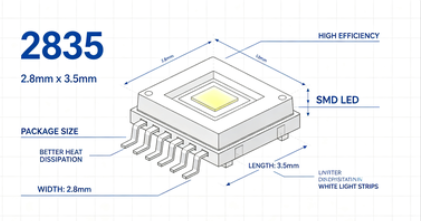
The "2835" chip represents an upgraded generation of SMD LEDs designed for higher efficiency and better heat dissipation. It measures 2.8 mm × 3.5 mm, similar to 3528 but with entirely modern engineering.
2835 chips are optimized for:
- Higher light output per watt
- Excellent thermal management
- Applications requiring uniform light diffusion
- Compatibility with high-density layouts for seamless illumination
This chip has become the go-to for modern white LED applications in both residential and commercial spaces, thanks to its high performance and reliability.
Dive deeper: Why has 2835 become the gold standard?
Let’s look at its key strengths and evolving use cases:
Features and Specifications:
- Brightness: 2835 chips offer significantly higher lumens per watt compared to 3528 — often exceeding 20 lumens for white-light versions.
- Energy efficiency: Their advanced circuit design reduces power waste and extends operational life.
- Heat dissipation: Improved thermal conductivity ensures sustained performance for longer durations.
- Versatility: Available in multiple power configurations (0.1W, 0.2W, 0.5W), allowing usage in dimmable or non-dimmable systems as needed.
Applications:
Due to its high output and versatility, 2835 chips dominate in modern lighting products:
- High-efficiency white light strips: If you're installing cabinet lights or linear architectural accents, 2835 is an ideal choice.
- Flex neon solutions: Seamless light diffusion with no visible hot spots makes these popular in professional-grade curved neon designs.
- Primary illumination: Suitable for settings where balanced brightness is crucial — retail, restaurants, or home task lighting.
Performance Tip:
Always check the LED tape density when purchasing strips based on 2835 chips. A higher chips-per-meter configuration ensures uniform light diffusion without any gaps, making it perfect for clean applications like backlighting panels or wall washers.
What does 5050 mean?
The largest chip in this trio is the "5050," which measures 5.0 mm × 5.0 mm. Unlike 2835 or 3528, the 5050 chip incorporates three separate LED diodes in one housing, enabling mixed colors, especially for RGB lighting.
5050 chips excel in:
- RGB (Red, Green, Blue) multi-chip lighting
- Decorative and event illumination
- Applications requiring dynamic color-changing effects
This chip design facilitates vibrant, customizable color displays for signage, entertainment zones, and architectural accents.
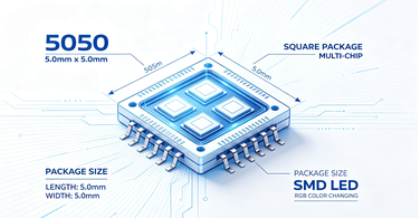
Dive deeper: Where 5050 chips create magic
Unique Design Features:
- Tri-diode setup: Each chip can independently emit red, green, and blue light. When combined, this allows infinite color combinations through color mixing.
- High color output: Great for creating saturated hues and dynamic effects.
- Larger physical footprint: This makes them less suitable for compact designs but perfect for large-scale neon or flexible RGB setups.
Applications:
5050 chips dominate settings where visual impact is key:
- RGB neon strips: Ideal for gaming setups, KTV venues, or festival lighting.
- Architectural color accents: Often used as outdoor perimeter lighting where colors shift dynamically.
- Event and entertainment lighting: If you’re thinking of creating immersive environments or vibrant stage designs, this chip offers unmatched versatility.
However, power consumption is higher compared to 2835/3528 chips because you’re essentially driving three diodes per chip. Proper voltage regulation and heat management solutions are critical for optimal performance.
Frequently Asked Questions
Are 2835 chips brighter than 3528 chips?
Yes, 2835 chips provide significantly higher brightness than 3528, thanks to advancements in energy efficiency and light output per watt. Where 3528 chips are basic emitters, 2835 excels for high-intensity applications.
Can 2835 LEDs be used for RGB lighting?
No, 2835 chips are primarily used for white light applications, whereas RGB functionality requires multi-chip housings like the 5050 SMD design.
What’s the lifespan of these LED chips?
The lifespan depends on usage conditions, but 2835 chips often boast up to 50,000 hours due to their excellent thermal performance. 3528 and 5050 chips generally average 35,000 hours under standard conditions.
Are higher-power chips always better?
Not necessarily. Chip selection depends on application. For example, 5050 chips are ideal for RGB dynamic lighting but may need heat regulation systems for extended use. Evaluate density, brightness, and power consumption based on your project type.
Which chip is best for flexible neon applications?
2835 chips are ideal for flexible white neon solutions, while 5050 chips are better suited for RGB flexible strips, especially where dynamic color-changing effects are desired.
Conclusion
Understanding what 2835, 3528, and 5050 stand for — their dimensions, efficiency, brightness, and application focus — is central to selecting the right SMD LED for your project. Whether you are seeking budget-friendly ambient lighting (3528), high-efficiency white output (2835), or dynamic RGB effects (5050), there’s a chip tailored to your needs.
Need OEM/ODM silicone neon lighting built with tailored SMD LED configurations? Reach out to us at AlisterTech — we specialize in custom LED solutions for global lighting professionals.