

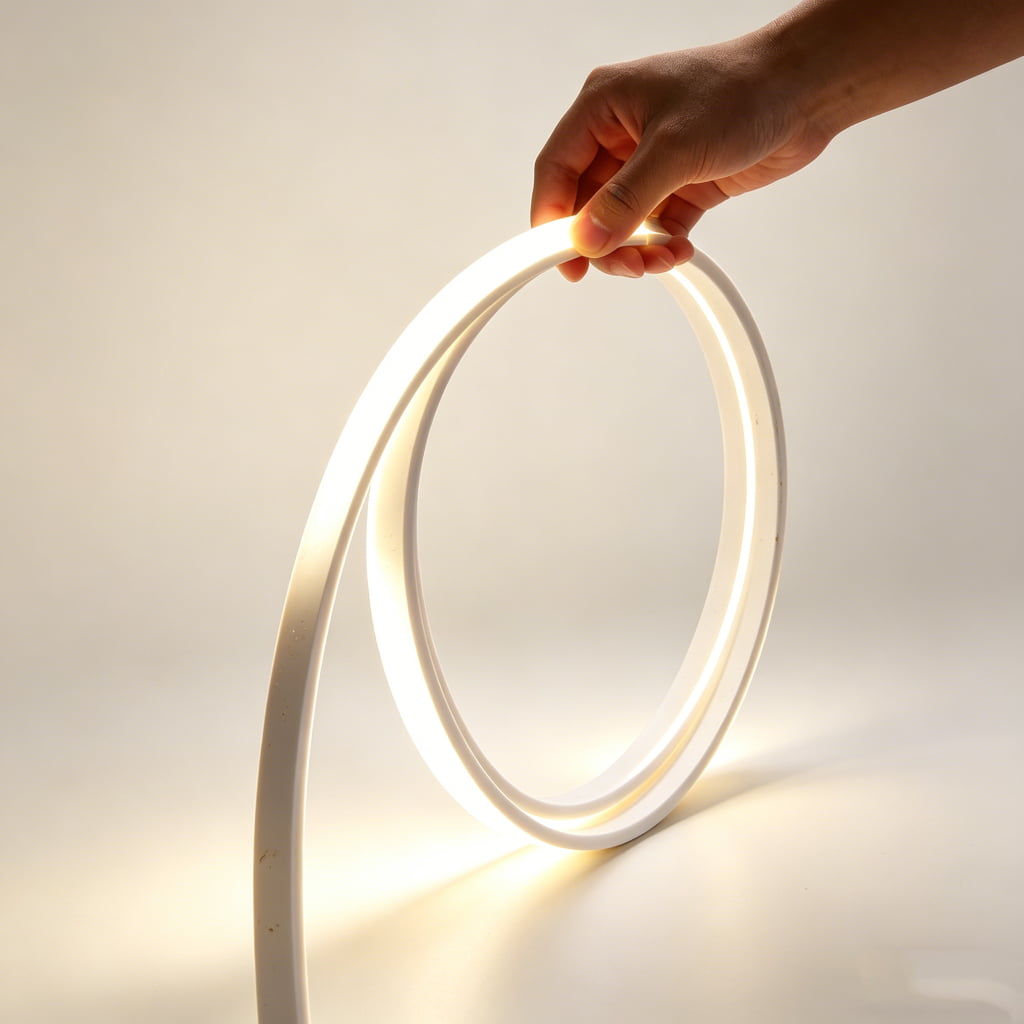
I spent 15 years working with rubber sealing components. When I started supporting 360° Neon Rope Lights projects, I noticed something strange. The biggest problem was not bad design. It was this: the lights worked perfectly in the lab, but failed quickly on site.
Here is what really causes 360° neon rope lights to fail after installation: dynamic environmental stress breaks down sealing integrity over time, even when static lab tests pass. The root cause is not the light itself—it is the gap between controlled testing conditions and real-world cyclic exposure to temperature shifts, UV radiation, moisture penetration, and localized mechanical stress.

If you are a contractor, distributor, or lighting designer, you have probably seen this pattern before. You receive samples. You run IP tests. Everything looks good. Then three months later, you get complaints. Let me show you why this happens and how to prevent it.
What Are the Most Common Failure Modes You Will Actually See in 360° Neon Rope Lights?
I have reviewed hundreds of failure reports. The pattern is almost always the same. The timeline is predictable too.
Most 360° neon rope light failures happen between 1 and 3 months after installation, not during testing. The most common failure modes are water ingress, localized dead zones, seal degradation, silicone swelling or hardening, and premature complete failure of entire sections.
Breaking Down the Five Real-World Failure Patterns
Let me walk you through what actually happens on site. I am not talking about theory. I am talking about what I see when clients send back failed units.
| Failure Type | Visible Symptom | Root Cause | Typical Timeline |
|---|---|---|---|
| Water Ingress | Condensation inside tube | Seal compression set under thermal cycling | 1–2 months |
| Dead Zones | Section stops emitting light | Solder joint corrosion from moisture | 2–3 months |
| Seal Degradation | Visible gaps at connection points | Material incompatibility with cleaning agents | 1–4 months |
| Silicone Swelling | Tube becomes soft or sticky | Plasticizer migration or chemical exposure | 3–6 months |
| Complete Failure | Entire section goes dark | Cumulative stress from all above factors | 3–12 months |
The first failure mode is water ingress. You will see small droplets inside the silicone tube. This happens because the seal material experiences compression set. What is compression set? It means the rubber loses its ability to bounce back after being compressed. This happens when the material goes through heating and cooling cycles every single day.
The second mode is dead zones. A section of the rope stops lighting up. When I open these units, I always find the same thing: corrosion at the solder joints. Moisture got in, reacted with the metal, and broke the electrical connection.
The third problem is seal degradation. You will see visible gaps where the end caps meet the silicone tube. This does not happen because of poor assembly. It happens because someone used a cleaning agent that was not compatible with the seal material. The chemical slowly dissolves the rubber.
The fourth issue is silicone swelling. The tube becomes soft or sticky to touch. This is caused by plasticizer migration. Some manufacturers add plasticizers to make the silicone easier to extrude. Over time, these chemicals migrate to the surface and react with environmental contaminants.
The fifth and final mode is complete failure. The entire section goes dark. This is the result of all the other problems combining over time. It is not one single cause. It is cumulative stress.
Why Do Lab Tests Pass But Real Installations Fail So Quickly?
This is the question I get asked most often. You followed the spec sheet. You checked the IP rating. You verified the material certifications. Everything looked perfect on paper. So why did it fail?
Lab tests pass because they measure static conditions, but real installations fail because they operate in dynamic environments. The gap between controlled testing and actual deployment is where most 360° neon rope light failures originate.

The Three Hidden Variables That Destroy Your Installation
Let me explain what I mean by dynamic versus static. When you test a seal in the lab, you typically do this: you submerge it in water at room temperature for a fixed period. You check if water got in. If it did not, you pass the test.
But that is not what happens on a building facade or a landscape installation. Here is what actually happens:
Variable One: Cyclic Environmental Exposure
The temperature does not stay constant. It changes every single day. In the morning, the temperature might be 15°C. By afternoon, the surface temperature of the neon rope can reach 45°C because of direct sunlight. At night, it drops back down to 20°C.
This creates a breathing effect. The silicone expands when hot and contracts when cold. The seal does the same thing. But they do not expand and contract at the same rate. This creates tiny gaps. Water vapor gets in during the hot phase. It condenses during the cold phase. Over 30 days, you have 30 cycles of this. Over 90 days, you have 90 cycles.
No lab test simulates this because it takes too long and costs too much.
Variable Two: Chemical Accumulation
You might think the environment is just air and water. It is not. There are trace amounts of cleaning agents, pollutants, salt spray in coastal areas, and organic residues from plants or insects.
Each of these chemicals is present in very small amounts. But they accumulate over time. A seal that is compatible with water might not be compatible with a mixture of water plus detergent residue plus salt spray.
I have seen seals that passed all standard chemical resistance tests fail within two months because someone washed the building facade with a chlorine-based cleaner. The spec sheet said the seal was resistant to water and mild acids. It did not mention chlorine compounds.
Variable Three: Transient Stress Events
Most testing assumes constant conditions. But real installations experience sudden stress events. These include:
- Thermal shock when rain hits a hot surface
- Mechanical impact from maintenance workers or debris
- Voltage spikes during lightning storms or grid fluctuations
- Localized overheating from poor heat dissipation
Each event might only last a few seconds. But it can permanently damage the seal structure. Once the seal is damaged, all the other problems accelerate.
What Are the Three Real Risk Factors You Should Actually Monitor?
If you want to prevent failures, you need to shift your focus. Stop looking only at material names and spec sheets. Start looking at these three factors instead.
The three real risk factors that determine 360° neon rope light longevity are: environmental cycling intensity, cumulative chemical exposure, and transient stress frequency. These factors are almost never included in standard product specifications.

How to Assess Each Risk Factor in Your Specific Project
Let me give you a practical framework. I use this for every project I consult on.
Risk Factor One: Environmental Cycling Intensity
You need to measure how extreme the temperature swings are at your installation site. Do not use average temperatures. Use the maximum and minimum values. If your site sees a 30°C daily temperature swing, you are in a high-risk category.
You also need to measure UV exposure. Use a UV index meter or check historical weather data for your location. If your site gets more than 6 hours of direct sunlight per day with a UV index above 8, you need UV-stabilized materials.
Finally, check humidity cycling. Coastal areas and tropical climates see rapid humidity changes. This accelerates moisture penetration.
Risk Factor Two: Cumulative Chemical Exposure
Make a list of every chemical that might contact the neon rope. This includes:
- Rainwater (which is slightly acidic)
- Building cleaning agents
- Salt spray in coastal areas
- Industrial pollutants in urban areas
- Pesticides or fertilizers in landscape applications
Now check if your seal material is compatible with the combination of these chemicals. Individual compatibility is not enough. You need compatibility with the mixture.
I once worked on a project where the seal material was rated for both acids and alkalis. But it failed when exposed to a mixture of acidic rainwater and alkaline cleaning residue. The combination created a chemical reaction that neither test covered.
Risk Factor Three: Transient Stress Frequency
Count how many times per month your installation will experience sudden stress. This includes:
- Power on/off cycles (each cycle creates thermal stress)
- Physical contact from maintenance or cleaning
- Weather events like storms or hail
- Voltage fluctuations from the electrical grid
If your installation experiences more than 10 transient stress events per month, you need a seal design that can handle repeated deformation without permanent damage.
Why Does Material Formulation Matter More Than Material Name?
This is the part that surprises most people. You might specify silicone or NBR or FKM rubber. You assume all silicone is the same. It is not.
Material formulation matters more than material name because two products with the same base polymer can have completely different performance characteristics depending on additives, cross-linking density, and processing conditions. A poorly formulated silicone will fail faster than a well-formulated NBR in the same application.
The Five Formulation Variables That Actually Determine Field Performance
Let me break this down. When I evaluate a material for a 360° neon rope light project, I look at these five variables:
Variable One: Cross-Linking Density
This determines how tightly the polymer chains are bonded together. Higher cross-linking density means better resistance to swelling and chemical attack. But it also means the material is stiffer and harder to extrude.
Some manufacturers reduce cross-linking density to make extrusion easier and faster. This saves them money. But it reduces long-term durability.
Variable Two: Plasticizer Type and Content
Plasticizers make the material softer and more flexible. But they can migrate to the surface over time. When they do, they create a sticky film that attracts dirt and reacts with environmental chemicals.
I always ask for plasticizer-free formulations when possible. If plasticizers are necessary, I specify non-migrating types.
Variable Three: UV Stabilizer Package
Not all UV stabilizers are the same. Some only protect against UVA. Others protect against UVB. Some protect against both. The best formulations use a combination of UV absorbers and hindered amine light stabilizers (HALS).
If your supplier cannot tell you what type of UV stabilizer they use, that is a red flag.
Variable Four: Filler Type and Loading
Fillers are added to improve mechanical properties and reduce cost. Common fillers include silica, calcium carbonate, and carbon black.
The type and amount of filler affects everything: tensile strength, tear resistance, thermal conductivity, and chemical resistance. A poorly chosen filler can create weak points where cracks initiate.
Variable Five: Processing Temperature and Cure Conditions
Even with the same raw materials, different processing conditions create different final properties. If the extrusion temperature is too high, it can degrade the polymer. If the cure time is too short, the cross-linking will be incomplete.
This is why batch-to-batch consistency is so important. You need a supplier who controls their process tightly enough that every batch performs the same way.
How Do I Prevent These Failures in My Projects?
I get this question every time I finish explaining the problems. People want solutions, not just analysis. So here is my approach.
Preventing 360° neon rope light failures requires three shifts: replace standard testing with real-world simulation, ensure raw material batch consistency, and redesign sealing structures to reduce stress concentration points.
The Three-Step Method I Use for Every Client Project
Let me walk you through exactly what I do when a client asks me to help them avoid failures.
Step One: Real-World Simulation Testing
I do not rely on standard IP tests. Instead, I create a test protocol that simulates the actual installation environment. This includes:
- Thermal cycling: 100 cycles from minimum to maximum expected temperature
- UV exposure: Equivalent to 6 months of outdoor exposure compressed into accelerated testing
- Chemical immersion: Using the actual mixture of chemicals the installation will see
- Mechanical stress: Repeated bending and compression cycles
This testing takes longer and costs more than standard tests. But it catches problems before installation, not after.
Step Two: Raw Material Batch Control
I work with suppliers who can guarantee batch-to-batch consistency. This means:
- They test every incoming batch of raw materials
- They maintain strict process controls during manufacturing
- They provide certificates of analysis for every production run
- They keep samples from every batch for future reference
If a supplier cannot do this, I do not work with them. Consistency is more important than the lowest price.
Step Three: Structure-Based Risk Reduction
I redesign the sealing structure to reduce stress concentration. This includes:
- Using gradual transitions instead of sharp corners
- Adding strain relief features at connection points
- Designing for thermal expansion and contraction
- Creating redundant sealing barriers
For example, instead of relying on a single O-ring seal at the end cap, I design a double-seal system. If the outer seal fails, the inner seal provides backup protection. This gives you time to detect and fix the problem before the entire unit fails.
I also pay attention to assembly procedures. A well-designed seal can still fail if it is installed incorrectly. I create detailed assembly instructions and train installation teams on proper techniques.
Conclusion
The core problem with 360° neon rope lights is not the lighting technology itself—it is maintaining seal integrity under dynamic environmental conditions that standard testing never simulates.
If you are working on a project right now, or if you have already experienced field failures that passed all lab tests, I can help you identify the specific variables causing problems. My technical team provides one-on-one support for complex installations. Contact me directly, and we can discuss your specific parameters and environmental conditions.