

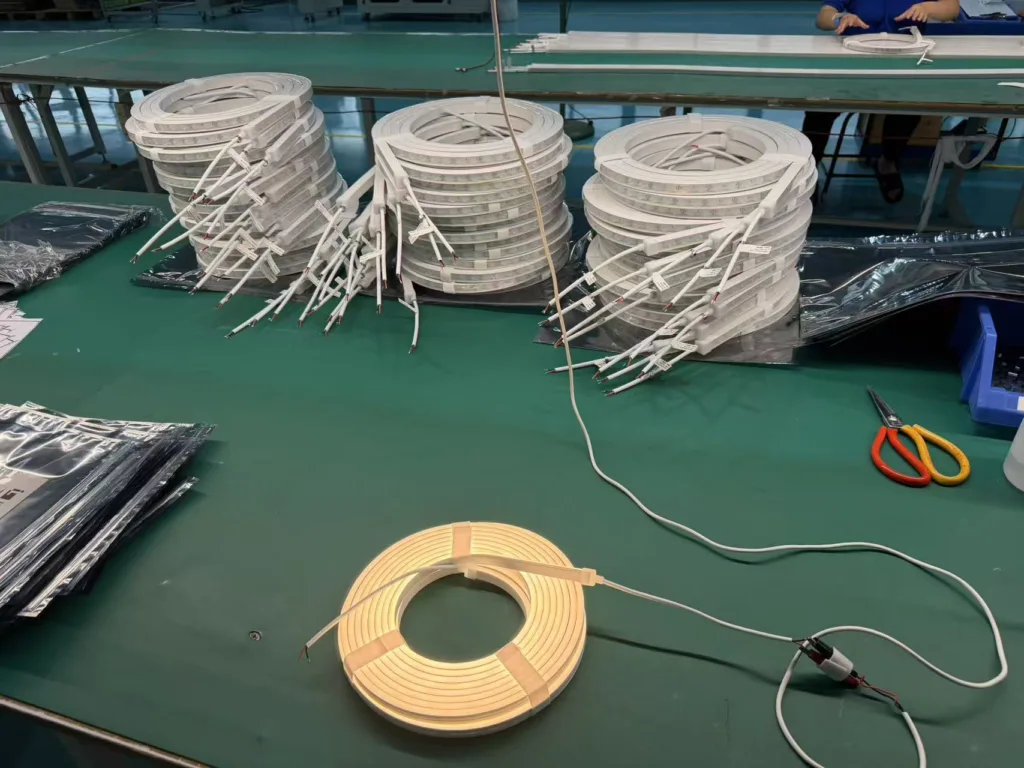
I've worked with hundreds of lighting contractors over the years. One frustration comes up again and again. They bend their neon flex into a beautiful curve. Then they power it on. And the light looks uneven. Dark spots appear. The glow breaks apart. The client isn't happy. The project gets delayed.
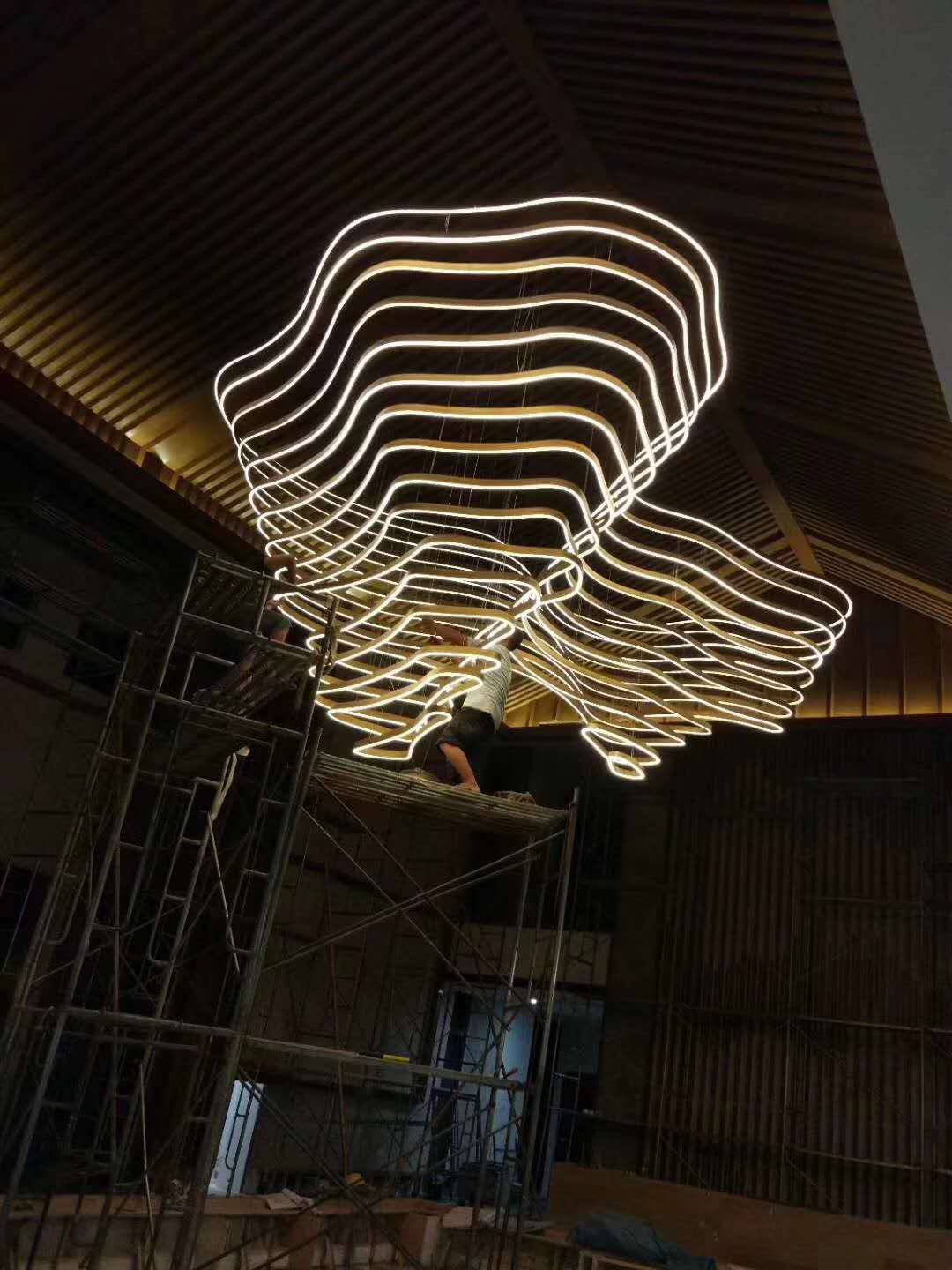
Dual bend neon flex solves this problem when it's built correctly. Our IP67-rated 16mm × 5m silicone neon flex bends horizontally and vertically while maintaining consistent brightness across every curve. It's engineered with internal structural support, premium silicone encapsulation, and precision manufacturing to deliver reliable performance in complex architectural and signage applications.

I remember a signage manufacturer in Texas who called me last summer. He had a hotel lobby project. The design required tight radius curves in three dimensions. He tried three different suppliers. Every sample failed. Either the light dimmed at the bends. Or the flex cracked after installation. He was ready to redesign the entire concept. Then we sent him our dual bend neon flex. He installed it. It worked. No compromises.
What Makes Dual Bend Different From Standard Neon Flex?
Most clients ask me this question first. They assume all flexible neon works the same way. It doesn't. Standard neon flex typically bends in one plane. You can curve it left or right. But try bending it up and down at the same time. The internal components resist. The light output suffers.
Dual bend neon flex is engineered with a specialized internal structure that allows simultaneous horizontal and vertical bending without compromising light output or structural integrity. This is achieved through careful LED spacing, flexible PCB design, and optimized silicone extrusion that distributes stress evenly across the profile.

The key difference lies in three core design elements. First, our LED placement follows a pattern that maintains consistent spacing even when the flex curves in multiple directions. Second, we use a flexible PCB substrate that bends without creating tension points. Third, our silicone extrusion process creates uniform density throughout the profile. This means the material flexes predictably. No weak spots. No stress concentrations.
I've seen competitors cut corners here. They use rigid PCBs with pre-cut notches. This creates flexibility. But it also creates failure points. Over time, those notches become fracture lines. The connections weaken. The light dims. Within six months, you're replacing sections. Our approach costs more upfront. But it eliminates those failures. The initial investment pays back through reliability.
| Feature | Standard Neon Flex | Our Dual Bend Neon Flex |
|---|---|---|
| Bending Planes | Single (horizontal only) | Dual (horizontal + vertical) |
| Internal Structure | Rigid PCB with notches | Flexible PCB with distributed stress design |
| Brightness Consistency | Varies at tight bends | Maintained across all curves |
| Failure Risk | Higher at bend points | Minimized through engineering |
| Installation Complexity | Moderate | Simplified for complex shapes |
Why Does IP67 Rating Matter for Outdoor Installations?
I talk to contractors who don't fully understand IP ratings. They see IP65 and think it's good enough. Then their installation gets hit by heavy rain. Water seeps in. The lights fail. Now they're climbing ladders in bad weather to replace sections. This is preventable.
IP67 certification means our dual bend neon flex can withstand temporary immersion in water up to 1 meter depth for 30 minutes. This level of protection is essential for outdoor architectural lighting, rooftop installations, and any application exposed to direct weather conditions or regular cleaning with pressure washers.
The difference between IP65 and IP67 seems small on paper. But in real conditions, it's massive. IP65 protects against water jets from any direction. That sounds sufficient. But water doesn't just spray at predictable angles. It pools. It sits. It finds gaps. Over thermal cycles, moisture migrates into joints. IP67 handles this. The sealing system prevents water intrusion even during sustained contact.
Our manufacturing process ensures this rating isn't just marketing language. We extrude the silicone around the LEDs and PCB in a single continuous process. No gaps exist between layers. The end caps use compression fitting with silicone gaskets. We test every batch in water tanks. A sample from each production run gets submerged for two hours. We measure resistance. We check for moisture ingress. Only batches that pass ship to clients.
I worked with a landscape lighting contractor in Florida last year. His projects face brutal conditions. Salt air. Hurricane-force wind and rain. Intense UV exposure. He switched to our IP67 dual bend neon flex after multiple failures with cheaper alternatives. Three years later, his installations still perform perfectly. No replacements. No service calls. That's the difference proper waterproofing makes. It's not about surviving one storm. It's about lasting through hundreds of weather cycles without degradation.
How Does 16mm Profile Size Affect Installation Flexibility?
Size matters more than most people realize. I've seen designers spec 20mm or larger profiles without considering the installation challenges. Then the installer calls me. The curves are too tight. The material won't flex enough. The design has to change. Money gets wasted. Timelines slip.
The 16mm profile dimension provides an optimal balance between light output and flexibility for complex installations. This size allows minimum bending radius of approximately 80mm while delivering sufficient luminous intensity for architectural and signage applications. It's small enough for intricate curves but large enough to house quality LEDs and maintain structural integrity.

Let me explain the physics. When you bend any material, the outer edge stretches and the inner edge compresses. The thicker the material, the more stress this creates. At some point, the material reaches its elastic limit. It cracks. Or the internal components fail. A 16mm profile keeps this stress within manageable limits. You can achieve complex curves without exceeding material tolerances.
But size isn't just about bending. It affects light distribution too. A profile that's too narrow concentrates LEDs too close together. This creates hotspots. A profile that's too wide spreads LEDs too far apart. This creates dark gaps between points. Our 16mm dimension optimizes LED density for smooth, continuous illumination. At standard viewing distances, the light appears perfectly uniform. No pixelation. No visible dots.
The 5-meter continuous length adds another practical advantage. Most architectural features and signage designs require runs between 3 and 7 meters. With 5-meter sections, you minimize connections. Fewer connections mean fewer potential failure points. It means cleaner aesthetics. It means faster installation. When you do need to connect multiple sections, our connector system maintains the IP67 rating. The waterproof integrity continues across the entire run.
| Profile Size | Minimum Bend Radius | Best Applications | Installation Complexity |
|---|---|---|---|
| 10mm | 50mm | Very tight curves, small letters | High (fragile) |
| 16mm | 80mm | Architectural details, medium signage | Moderate (optimal) |
| 20mm+ | 120mm+ | Large-scale building outlines, simple curves | Lower (but less flexible) |
What Technical Specifications Should You Verify Before Ordering?
I receive calls from contractors who ordered the wrong product. They assumed specifications were standard. They weren't. Now they have 500 meters of neon flex that doesn't meet their project requirements. Returns are expensive. Delays are costly. This happens because people don't ask the right questions upfront.
Critical specifications to verify include: color temperature (measured in Kelvin), power consumption per meter (watts/m), input voltage (12V/24V DC), LED density (LEDs per meter), viewing angle, and certifications (CE, RoHS, UL). For our 16mm dual bend neon flex, we provide detailed spec sheets with test data and photometric reports to ensure compatibility with your specific project requirements.

Color temperature isn't subjective. It's measurable. When a client says they want "warm white," that could mean 2700K or 3500K. Those look completely different. Our standard range covers 2700K to 6500K in 500K increments. We measure each batch with calibrated spectrometers. The variation between stated and actual CCT stays within 200K. This consistency matters when you're installing across multiple zones that need to match.
Power consumption directly impacts your electrical design. Our 16mm dual bend neon flex typically draws between 8 and 12 watts per meter depending on LED density and color temperature. This seems straightforward. But here's what catches people. That's the LED consumption. You also need to account for power supply efficiency and voltage drop over distance. For runs longer than 5 meters, you need power injection or higher voltage systems. We help clients calculate exact power requirements during the planning phase. This prevents undersized power supplies and prevents overheating.
LED density affects both appearance and cost. Higher density means more LEDs per meter. This creates smoother light. But it increases power draw and heat generation. Our standard dual bend configuration uses 120 LEDs per meter for side-view applications. This provides excellent uniformity without excessive power consumption. For top-view applications where direct viewing is common, we offer 180 LEDs per meter. The choice depends on how the neon flex will be viewed and what kind of light quality the project requires.
Certification isn't just paperwork. It represents third-party validation of safety and performance claims. CE certification confirms electrical safety for European markets. RoHS ensures restricted substances compliance. UL listing allows North American installation. We maintain current certification for all our product lines. More importantly, we can provide certification documentation before you place large orders. This protects you from compliance issues during project approval or inspection phases.
How Do You Ensure Consistent Light Output Across Complex Bends?
This question gets to the core of what makes dual bend neon flex actually work. I've examined competitor products that claim dual bend capability. Many of them fail this test. You bend them into a complex curve. The light gets brighter on the outside edge. It dims on the inside edge. Or worse, some LEDs stop working entirely because the PCB traces crack under stress.
Consistent light output during bending requires three integrated design elements: flexible PCB with stress-distributed traces, precise LED positioning that accounts for curve geometry, and uniform silicone encapsulation that maintains optical properties under deformation. Our manufacturing process controls each element through automated precision equipment and multi-point quality verification.

The PCB design is foundational. We use flexible PCB substrate with copper traces designed to handle repeated bending. But here's the critical part. The traces don't just flex. They're laid out in patterns that minimize stress concentration during bends. Think of it like the difference between folding a piece of paper along a single line versus folding it in a gradual curve. The gradual curve distributes stress. It doesn't create a failure point. Our PCB traces follow this principle.
LED positioning requires mathematical precision. When you bend the flex, the distance between LEDs changes. On the outside of a curve, LEDs spread apart. On the inside, they compress together. If you place LEDs in a simple straight line, this creates uneven brightness during curves. We calculate optimal LED placement using curve modeling software. The initial spacing accounts for how the spacing will change during typical bending. This pre-compensation maintains perceived uniformity even during tight radius curves.
The silicone encapsulation serves multiple functions. Obviously it provides waterproofing. But it also acts as an optical medium. The silicone we use has carefully controlled refractive index. This affects how light spreads from the LED into the visible output area. During bending, the silicone deforms. If the material properties aren't uniform, this deformation changes the light distribution. We use high-grade silicone with consistent density and optical properties. This means the light diffusion remains stable whether the flex is straight or curved.
Quality control happens at multiple stages. First, incoming PCBs get tested for flexibility and electrical continuity. Second, LED placement accuracy gets verified using optical inspection. Third, the silicone extrusion process includes real-time monitoring of temperature, pressure, and flow rate. Fourth, finished sections undergo bend testing. We physically curve samples through standard installation radii while measuring light output. Only production runs that maintain brightness uniformity within 5% across bends move to packaging.
Why Choose 5-Meter Continuous Length Over Shorter Sections?
Length matters more than most installation guides admit. I see contractors working with 2-meter or 3-meter sections because that's what their supplier offers. They end up with multiple connections along a single run. Each connection point is a potential failure. Each connection shows a slight brightness variation. The installation looks segmented instead of continuous.
Five-meter continuous sections reduce connection points by 40-60% compared to shorter standard lengths for typical architectural and signage installations. Fewer connections means improved reliability, faster installation time, better waterproof integrity, and more uniform appearance. For projects requiring runs longer than 5 meters, our connector system maintains IP67 rating and electrical continuity across joints.
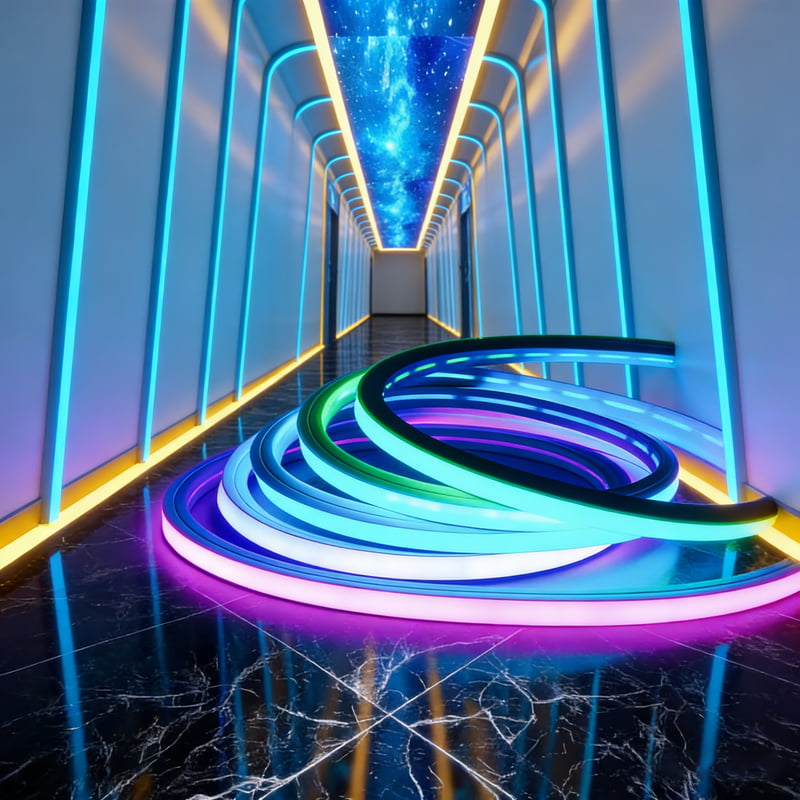
Let's look at real numbers. A typical building facade outline might require 18 meters of neon flex. With 2-meter sections, you need 9 pieces and 8 connections. With 5-meter sections, you need 4 pieces and 3 connections. That's 5 fewer connection points. Each connection takes approximately 10-15 minutes to properly install and seal. You just saved nearly an hour of installation time on a single run. Scale that across a large project and the time savings become significant.
But time isn't the only factor. Every connection introduces resistance. Even with quality connectors, there's a slight voltage drop at each junction. Multiply this across multiple connections and the cumulative voltage drop affects brightness. The last section receives less power than the first section. The light dims toward the end of the run. With fewer connections, voltage drop stays minimal. Brightness remains consistent from start to finish.
Waterproofing becomes more critical with more connections. Our end caps and connectors maintain IP67 rating when properly installed. But installation quality varies. A technician working in good conditions on the ground installs connections perfectly. A technician working at height in cold weather might rush. Even small installation errors compromise waterproofing. Fewer connections mean fewer opportunities for installation errors. The overall system reliability improves.
Aesthetics matter too. Even the best connectors create a slight visual interruption. The housing adds bulk. The joint shows a subtle line. For high-end architectural applications where clean appearance is critical, minimizing visible connections improves the final look. Designers appreciate this. They want continuous flowing lines. They don't want to see where one section ends and another begins. Longer continuous sections deliver this seamless appearance.
What Common Installation Mistakes Should You Avoid?
I provide technical support to installers worldwide. The same mistakes appear repeatedly. These aren't complex engineering failures. They're simple oversights that compromise performance. I want to help you avoid them because prevention is easier than troubleshooting after installation.
The three most common installation mistakes are: over-bending beyond minimum radius specifications, inadequate power supply sizing, and improper connector sealing. Each mistake reduces lifespan and performance. We provide detailed installation guidelines with every order, including minimum bend radius markers, power calculation worksheets, and connector installation procedures with visual diagrams.
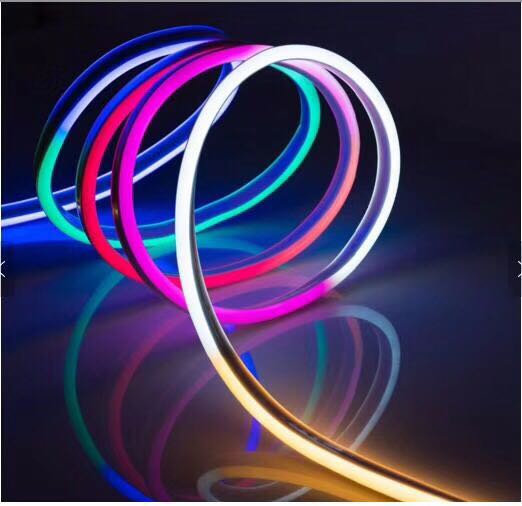
Over-bending happens when installers force the neon flex into curves tighter than the specified minimum radius. I understand the temptation. The design calls for a sharp corner. The neon flex feels pliable. You think you can push it a bit further. Don't. The 80mm minimum bend radius for our 16mm profile isn't arbitrary. It's the threshold where internal stress begins damaging components. Beyond this point, the PCB traces experience fatigue. The LED connections weaken. The silicone develops internal stress points. The neon flex might work initially. But it fails prematurely. Sometimes within weeks. Always respect the minimum bend radius. If the design requires tighter curves, use a smaller profile or redesign the curve.
Power supply sizing gets complicated because people forget about efficiency losses. Here's how the mistake happens. You calculate total LED power consumption. Let's say you have 20 meters at 10 watts per meter. That's 200 watts. You buy a 200-watt power supply. Seems logical. But power supplies operate most efficiently at 70-80% of rated capacity. Running at 100% capacity generates excessive heat. This shortens power supply lifespan. It can cause voltage instability. Always size power supplies to run at 75-80% maximum load. For 200 watts of LED consumption, use a