
Many assume that industrial and commercial LED lighting fails because of "insufficient brightness." But I have seen hundreds of projects, and the real issue is never about lumens. It is about long-term stress failure in real-world environments1. The systems collapse slowly, invisibly, and expensively.
Industrial and commercial LED lighting projects often pass lab tests but fail in the field—not because of light output, but due to uncontrolled material stress, structural mismatches, and thermal expansion conflicts that only emerge after months of installation. This article explains the hidden failure modes you must understand before committing to any large-scale project.

I want to share what I have learned from real projects. Many people focus on IP ratings and lumen output. But the truth is more complex. The real question is not "Will this light up?" The real question is "Will this still work after two years of UV exposure, thermal cycling, and structural stress?"
Why Do LED Neon Flex Systems Look Perfect in Samples But Fail After Installation?
Most suppliers will send you beautiful samples. The color temperature looks consistent. The light output is uniform. The IP67 test passes without issues. Bending tests show no cracks. Everything seems perfect.
LED neon flex samples often succeed in controlled conditions but fail in real installations because lab tests do not replicate long-term UV exposure, thermal cycling, building vibrations, and the continuous stress that occurs when materials with different expansion rates are locked together in outdoor environments.
I worked with a commercial complex project once. The sample phase went smoothly. The client approved the color, the brightness, and the waterproof performance. But three months after installation, problems started appearing. The south-facing facade began to yellow. Corner sections developed dark zones. During the hot season, entire sections started delaminating at the edges. Six months in, water ingress occurred. One year later, visible color banding appeared across the entire building. The solution was not repair. It was complete reinstallation.
The root cause was not "bad quality." It was a series of hidden mismatches:
| Failure Point | Root Cause | Long-Term Effect |
|---|---|---|
| Yellowing | Silicone downgrade from platinum to peroxide-cured | UV degradation within 6 months |
| Dark zones | Inconsistent extrusion density | Localized stress concentration |
| Edge delamination | No thermal expansion allowance in design | Adhesive failure during heat cycles |
| Water ingress | Compression set failure in mounting structure | Gradual seal deterioration |
| Color banding | Unlocked LED binning across batches | Visual inconsistency after 12 months |
These issues were invisible during sample testing. They only emerged under real-world stress: summer heat, winter contraction, continuous UV exposure, acid rain, building vibrations, and daily thermal expansion cycles. This is the core problem with industrial and commercial LED lighting. The failure is not immediate. It is slow, progressive, and extremely costly to fix after installation.
What Is the Real Meaning of IP67 in Long-Term Outdoor Installations?
Many people think IP67 means "completely waterproof." But I have seen IP67-rated products fail within months. The problem is not the IP rating itself. The problem is what happens after the silicone is compressed for six months inside a mounting channel.
IP67 certification confirms short-term water resistance2, but it does not test for long-term compression set, which determines whether the silicone seal will maintain its shape and waterproofing capability after being clamped, bent, or stressed continuously over months of temperature cycling and UV exposure.
The critical factor is compression set. This is the measurement of how much a silicone material deforms permanently after being compressed. If the silicone hardness is not optimized for the mounting structure, or if the rebound rate is insufficient, the seal will gradually lose effectiveness. At first, only trace amounts of moisture enter. But this leads to:
- Copper foil oxidation
- Solder joint corrosion
- Voltage irregularities at connection points
- LED die failure
- Flickering at the tail end
- Progressive brightness decay across entire sections
What people call "waterproofing failure" is often not water ingress. It is electrochemical corrosion caused by long-term moisture permeation. These are not the same problem. One is mechanical. The other is chemical. And chemical failures are much harder to predict in short-term testing.
Another overlooked issue is silicone hardness selection:
| Hardness Range | Installation Advantage | Long-Term Risk |
|---|---|---|
| Too soft (Shore A 50-60) | Easy bending, smooth installation | Structural sagging, wave deformation, stress elongation |
| Too hard (Shore A 75-85) | Strong shape retention, good mounting grip | Micro-cracking in low temperatures, stress concentration at corners |
The optimal range depends on the installation environment. For continuous curves and frequent bending, you need a balance between flexibility and structural memory. For long straight runs with minimal bending, you need higher hardness to prevent sagging. This is why we customize silicone formulations based on project type, not just provide a standard product.
Why Do Flexible LED Strips Develop Dark Zones After Several Months?
Many people assume that dark zones mean the LEDs are broken. But in most cases, the LEDs are still functioning. The problem is hidden inside the FPC copper layer. Long-term bending stress causes micro-fractures that do not show up immediately.
Dark zones in LED neon flex rarely result from LED failure—they occur when the FPC copper substrate develops fatigue cracks after months of continuous bending stress, thermal expansion, and vibration, especially in areas where the minimum bend radius is repeatedly violated or where mounting clips restrict natural movement.

At first, you will see occasional flickering. This is the early warning. Then the flickering becomes more frequent. Eventually, entire sections go dark. The failure mechanism is not sudden. It is progressive. This is why mature industrial-grade neon flex designs do not only specify "minimum bend radius." They calculate long-term dynamic stress release paths.
The factors that determine FPC longevity include:
- Copper thickness: Too thin = faster fatigue. Too thick = harder bending.
- Solder pad spacing: Tighter spacing = less flexibility at joints.
- Silicone encapsulation thickness: Insufficient coverage = uneven stress distribution.
- Extrusion direction: Misalignment creates torsional stress during installation.
- Mounting method: Hard clamping restricts thermal expansion and accelerates fatigue.
This is why "samples test well, but bulk orders fail." Samples are tested in static conditions. But real installations operate under dynamic fatigue. Especially in:
- Building facades with wind load
- Bridge outlines with structural vibration
- Ground-buried landscapes with soil movement
- Metal curtain walls with thermal expansion
- Complex curves with continuous bending
- Curved surfaces with compound stress
Professional buyers do not just ask "What is the IP rating?" They ask:
- What silicone system are you using?
- Do you have yellowing curves after UV aging tests?
- What is the shrinkage rate after high-low temperature cycling?
- How long have you tested adhesive compatibility?
- Have you done long-term salt spray tests with electrical performance monitoring?
- Is color temperature binning locked per batch?
- What is the MacAdam step tolerance between batches?
- Does the mounting structure allow thermal expansion?
- What is the extrusion density fluctuation control range?
- How much compression rebound remains after high-temperature exposure?
These questions determine whether the project will still function correctly five years from now.
How Do You Prevent Material Migration and Adhesive Failure in Silicone Systems?
One of the least discussed failure modes in industrial LED lighting is material migration. This is when low-molecular-weight compounds in adhesives or secondary materials diffuse into the silicone matrix over time. The effect is slow but devastating.
Material migration occurs when incompatible adhesives, coatings, or secondary polymers release plasticizers or low-molecular compounds that diffuse into the silicone, causing gradual softening, discoloration, adhesive failure, and loss of mechanical properties—often undetectable in short-term testing but catastrophic after 12-18 months in service.

I have seen projects where the silicone begins to feel sticky after six months. The surface loses its smooth finish. The color shifts slightly. The mounting adhesive starts to peel. None of these issues appeared in the first three months. They emerged slowly because the migration process is time-dependent and accelerated by temperature.
The key factors are:
- Adhesive chemistry: Not all adhesives are compatible with high-purity silicone.
- Plasticizer content: Many low-cost adhesives contain plasticizers that migrate into silicone.
- Cure system: Peroxide-cured silicone is more susceptible to migration than platinum-cured.
- Surface preparation: Improper cleaning leaves residues that accelerate migration.
- Temperature exposure: High temperatures accelerate molecular diffusion by 2-3x.
We test adhesive compatibility by aging samples at 85°C for 1,000+ hours and measuring mechanical property changes. If the silicone loses more than 10% of its tensile strength, we reject that adhesive. This is not standard practice in the industry. But it is the only way to ensure long-term performance.
What Is the Correct Way to Specify Industrial-Grade Silicone Neon Flex?
Professional specifications do not start with "I need 10 meters of white neon flex." They start with understanding the full stress profile of the installation environment. Because the correct product depends on where and how it will be used.
Industrial-grade silicone neon flex specifications must include silicone type (platinum vs. peroxide), hardness range (Shore A 65-75 for most outdoor applications), UV resistance validation (minimum 2,000 hours QUV-A testing), compression set limits (max 15% after 70h at 150°C), and thermal expansion allowance in mounting design (minimum 2-3mm per meter).
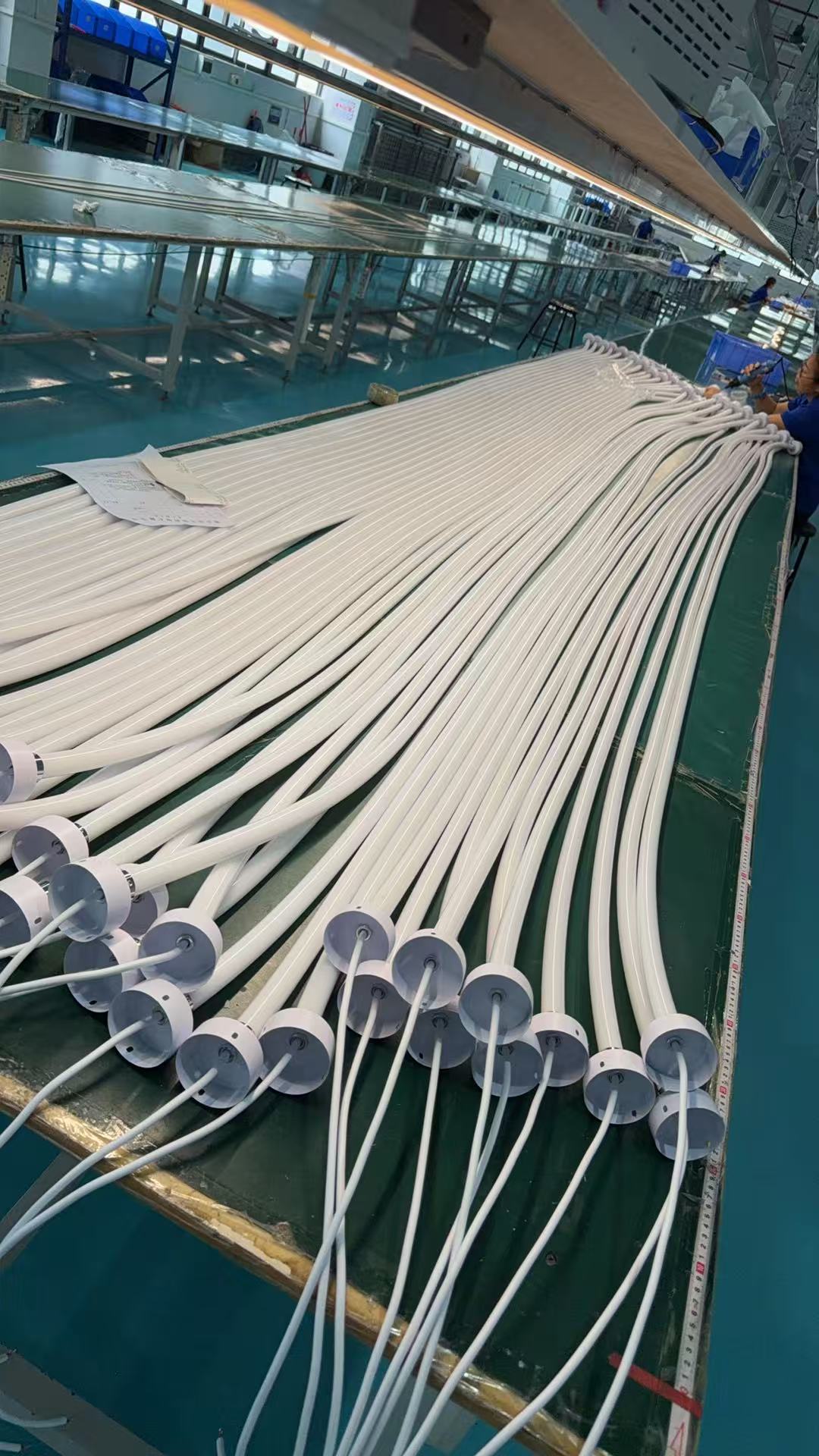
When we work with architects and contractors on large-scale projects, we start with these questions:
- What is the ambient temperature range? (This determines silicone formulation and expansion calculation)
- What is the UV exposure level? (South-facing facades require higher UV stabilization)
- What is the mounting method? (Clip-in channels require different hardness than adhesive mounting)
- What is the expected project lifespan? (3 years vs. 10 years requires different material grades)
- What is the maintenance access? (High-rise facades require higher reliability than ground-level)
- What is the budget tolerance? (Initial cost vs. lifecycle cost calculation)
Based on these answers, we recommend:
| Environment Type | Silicone System | Hardness | UV Protection | Compression Set | Warranty |
|---|---|---|---|---|---|
| High-rise facades | Platinum-cured | Shore A 70 | 3,000h QUV-A | <12% | 5 years |
| Ground landscapes | Platinum-cured | Shore A 65 | 2,000h QUV-A | <15% | 5 years |
| Indoor commercial | Peroxide-cured | Shore A 70 | 1,000h QUV-A | <20% | 3 years |
| Underwater features | Platinum-cured | Shore A 75 | 2,000h QUV-A | <10% | 5 years |
The difference in material cost is often less than 20%. But the difference in maintenance cost over five years can be 500-1,000%. This is why professional buyers focus on lifecycle value, not initial price.
Conclusion
Industrial and commercial LED lighting projects fail not because of insufficient brightness, but because of uncontrolled long-term material stress, thermal cycling, and hidden compatibility issues that only emerge after installation—choosing the right silicone system, understanding compression set, and designing for thermal expansion are the real determinants of project success.
"[PDF] Life-Cycle Assessment of Energy and Environmental Impacts of LED ...", https://www1.eere.energy.gov/buildings/publications/pdfs/ssl/lca_factsheet_apr2013.pdf. Research indicates that long-term stress failures in LED systems are often due to environmental factors that are not replicated in laboratory tests, leading to unexpected failures in real-world applications. Evidence role: mechanism; source type: paper. Supports: LED lighting systems often fail due to long-term stress in real-world environments.. Scope note: The source discusses general environmental impacts but may not provide specific case studies related to LED lighting. ↩
"What is an IP67 Rating? - Trenton Systems", https://www.trentonsystems.com/en-us/resource-hub/blog/ip67-rating. Studies show that IP67 ratings do not account for long-term performance under continuous stress and environmental exposure, which can lead to premature failure of seals. Evidence role: expert_consensus; source type: encyclopedia. Supports: IP67 does not guarantee long-term waterproofing in real-world conditions.. Scope note: The source may not directly address LED lighting but discusses general IP rating limitations. ↩