

Most buyers think choosing LED commercial outdoor lighting fixtures is about picking the right product. It's not. It's about selecting a system that won't fall apart under UV exposure, thermal cycling, and mechanical stress over years of real-world use.
LED commercial outdoor lighting fixtures fail not because single specifications are wrong, but because the material system, structural design, and thermal management gradually decouple under long-term environmental stress. The real challenge is maintaining geometric and optical consistency as the entire assembly ages.

I've seen too many projects succeed in the lab and fail in the field. The difference isn't about better LEDs or higher IP ratings. It's about understanding that outdoor fixtures aren't static products. They're dynamic systems under constant stress.
Why Do Outdoor Lighting Systems Fail When Individual Components Pass All Tests?
Buyers spend months testing IP ratings, lumen output, and power factors. Then six months after installation, problems start appearing. Not catastrophic failures, just gradual system degradation that eventually ruins the entire project.
Outdoor lighting fixtures don't break suddenly. They lose geometric consistency over time, and once that happens, optical performance must collapse. The fixture becomes a different product than what you originally installed.

The Hidden Failure Mechanisms Nobody Tests For
I worked on a commercial plaza facade project where every component passed initial testing. High-power LED floodlights with die-cast aluminum housings and dual-layer silicone sealing. The samples were perfect:
- Light degradation within normal range
- Waterproofing tested and verified
- Salt spray resistance confirmed
- Thermal management calculations looked good
We moved forward with mass production. For two months, everything performed flawlessly. Then month four arrived with the first warning signs:
| Timeline | Observed Issues | Root Cause Analysis |
|---|---|---|
| Month 4 | Slight color shift in some fixtures | Silicone seal beginning micro-displacement |
| Month 6 | Brightness inconsistency appearing | Driver capacitors starting thermal degradation |
| Month 8 | Light moisture fogging in housings | Seal compression permanent deformation |
| Month 12 | Visible brightness waves across facade | Complete system decoupling |
The post-mortem revealed something critical. No single component had failed specification. Instead, the system had failed as an integrated whole:
- Aluminum thermal expansion wasn't designed for installation constraints
- Silicone seal compression set exceeded long-term limits
- Too many rigid mounting points prevented stress release
- Driver selection ignored enclosed cavity temperature accumulation
- Optical material UV aging was systematically underestimated
- Installation method altered the designed thermal pathway
Every individual element met its datasheet. But the system failed in the real environment. This taught me that outdoor commercial lighting isn't about component quality. It's about system-level stress management over time.
The fixtures didn't break. They slowly lost their ability to maintain geometric relationships between critical elements. And in precision optics, even millimeter-scale shifts destroy performance.
How Should Professional Engineers Actually Design Outdoor Lighting Systems?
If you're serious about LED commercial outdoor lighting fixtures, you need to reverse your design thinking. Stop designing to meet specifications. Start designing to control failure modes.
The goal isn't preventing failure. That's impossible. The goal is controlling how and when degradation occurs, so it remains within acceptable performance boundaries throughout the warranty period.
Design for Seal Fatigue, Not Just IP Rating
IP67 or IP68 ratings only guarantee performance at time zero. What matters is seal integrity after 500 thermal cycles, 5000 hours of UV exposure, and countless humidity fluctuations. We focus on three critical parameters:
- Compression permanent deformation (CPD) - Standard silicone shows 15-25% CPD after 1000 hours at 70°C. Our food-grade molecular silicone maintains under 12% after 3000 hours.
- Thermal cycling fatigue - The seal must survive -40°C to +60°C transitions without losing compression force. This requires controlling the compression ratio to 15-25%, not the 30-40% many manufacturers use.
- Material rebound degradation curves - Cheap silicone loses 40% of rebound force within two years. Quality material maintains 85%+ rebound force for five years.
The structural design must accommodate these realities. I never allow rigid mechanical locking of seals. The assembly must permit micro-displacement and stress release. Otherwise you're building a time bomb. The seal will fail, it's just a question of when.
Manage Thermal Expansion Pathways
Outdoor fixture failure rarely comes from structural collapse. It comes from thermal expansion pulling the seal interface apart. Aluminum expands approximately 23 micrometers per meter per degree Celsius. Across a 500mm fixture experiencing 80°C temperature swings, that's over 900 micrometers of movement.
If your design rigidly locks the housing at multiple points, that expansion has nowhere to go except into the seal interface. We solve this through:
| Design Element | Purpose | Implementation |
|---|---|---|
| Independent expansion paths | Allow aluminum thermal movement | Single-point primary mount with sliding secondary points |
| Graduated material stiffness | Prevent stress concentration | Transition zones between rigid and flexible materials |
| Controlled displacement space | Absorb thermal expansion | 2-3mm designed clearance in non-critical zones |
Every thermal cycle without proper expansion management is slowly destroying your seal system. The fixture isn't failing. You're designing it to fail.
Separate Structural UV Resistance from Optical Stability
Many engineers test housing materials for UV resistance and assume they're done. But visual failure doesn't come from housing degradation. It comes from optical system drift. I've seen fixtures with perfect housings produce terrible light after two years because:
- Lens materials yellow by 8-12% even when "UV stabilized"
- Diffusion materials experience refractive index shift
- Silicone light transmission drops from 98% to 91%
- Dust accumulation coupled with UV creates exponential degradation
We maintain optical consistency through material system design. Our silicone neon flex uses UV-stabilized molecular silicone with less than 3% yellowing after 5000 hours of accelerated UV exposure. But we also engineer the optical cavity geometry so minor material changes don't create visible artifacts.
Structural weatherproofing doesn't equal optical stability. They're different engineering problems requiring different solutions.
What About Driver Longevity in Real Installation Environments?
Driver failure is rarely sudden. It's a gradual performance slide. Capacitor capacitance slowly decreases. Ripple current gradually increases. Output voltage drifts. Eventually, light degradation accelerates beyond acceptable limits.
Standard driver "50,000 hour" ratings assume 25°C ambient temperature. Inside a sealed outdoor fixture under summer sun, ambient temperature reaches 65-75°C. At those temperatures, electrolytic capacitor life drops by 75% or more.

Real-World Driver Life Calculation
I calculate driver life using actual cavity temperatures, not datasheet conditions. For our outdoor commercial installations, we:
- Measure actual thermal accumulation in sealed cavities (often 40-50°C above ambient)
- Recalculate capacitor life curves at real operating temperatures
- Design with 30-50% thermal margin, not maximum rated conditions
- Avoid full-load operation, typically running at 70-80% of driver capacity
A driver rated for 50,000 hours at 25°C might only deliver 15,000 hours at 70°C. If you design at maximum load in a poorly ventilated cavity, that "5-year driver" becomes an 18-month component. The failure isn't the driver. It's the thermal environment you created.
How Do Installation Variables Destroy Perfect Designs?
Real installation sites aren't controlled laboratories. They include:
- Installation angle deviations of 5-10 degrees
- Mounting surface irregularities
- Wind loading and vibration
- Foundation settlement over years
- Actual temperature ranges exceeding design assumptions
If your design has zero tolerance for these variables, all stress eventually concentrates at seal interfaces and solder joints. We build in systematic error tolerance:
| Variable | Design Accommodation | Method |
|---|---|---|
| Installation deviation | ±10° angle tolerance | Flexible mounting interface |
| Structural stress | Multi-path stress distribution | Designed stress relief points |
| Foundation movement | 3-5mm displacement absorption | Compliant mounting hardware |
| Vibration | Mechanical damping | Isolation between housing and mount |
Fixtures don't fail because materials are inadequate. They fail because rigid designs can't absorb the accumulated errors and stresses of real-world installation and operation.
What Makes Our Silicone Neon Flex Different for Commercial Outdoor Applications?
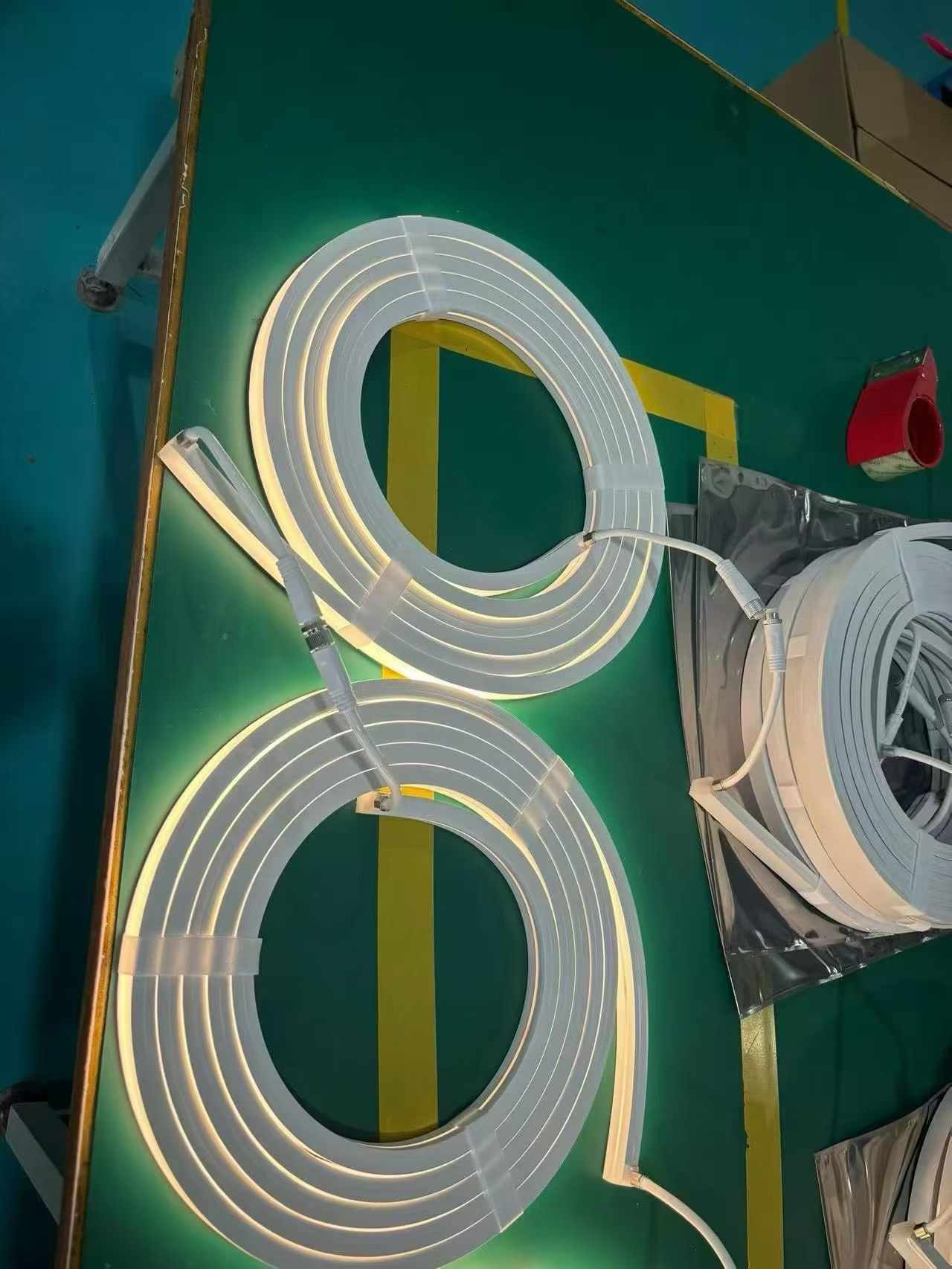
We manufacture LED commercial outdoor lighting fixtures with a different philosophy. Not better components, but better system integration. Our silicone neon flex technology addresses these failure mechanisms systematically:
Our molecular silicone maintains geometric stability across temperature extremes. The material doesn't just resist UV. It maintains consistent light transmission and refractive properties for 5+ years. We extrude with controlled compression ratios that permit thermal expansion without seal compromise.
The structure allows micro-displacement without geometric collapse. Installation tolerances don't destroy performance because the system accommodates real-world variation. And the driver integration considers actual thermal environments, not theoretical specifications.
I've installed our systems in environments from desert heat to coastal salt spray. The difference isn't that they don't degrade. Everything degrades. The difference is they degrade predictably and remain within performance specifications throughout their rated life.
Conclusion
LED commercial outdoor lighting fixtures aren't a product category problem. They're a system engineering challenge where success requires managing long-term environmental stress, not just meeting initial specifications.