


Neon lights have lit up storefronts and skylines for over a century. But when a procurement team specifies "neon lighting" for a modern commercial project, the high-voltage assumption that follows can derail the entire electrical design. The term "neon" now covers two fundamentally different technologies — and confusing them creates real project risk.
Traditional glass neon signs need high voltage because they rely on gas discharge to produce light. A strong electric field must ionize the gas inside the tube before current can flow. LED Neon Flex, by contrast, is a low-voltage semiconductor system — typically 12V or 24V DC — that uses no gas, no high-voltage transformer, and no ionization process whatsoever. The two technologies share a name but nothing else about how they work.
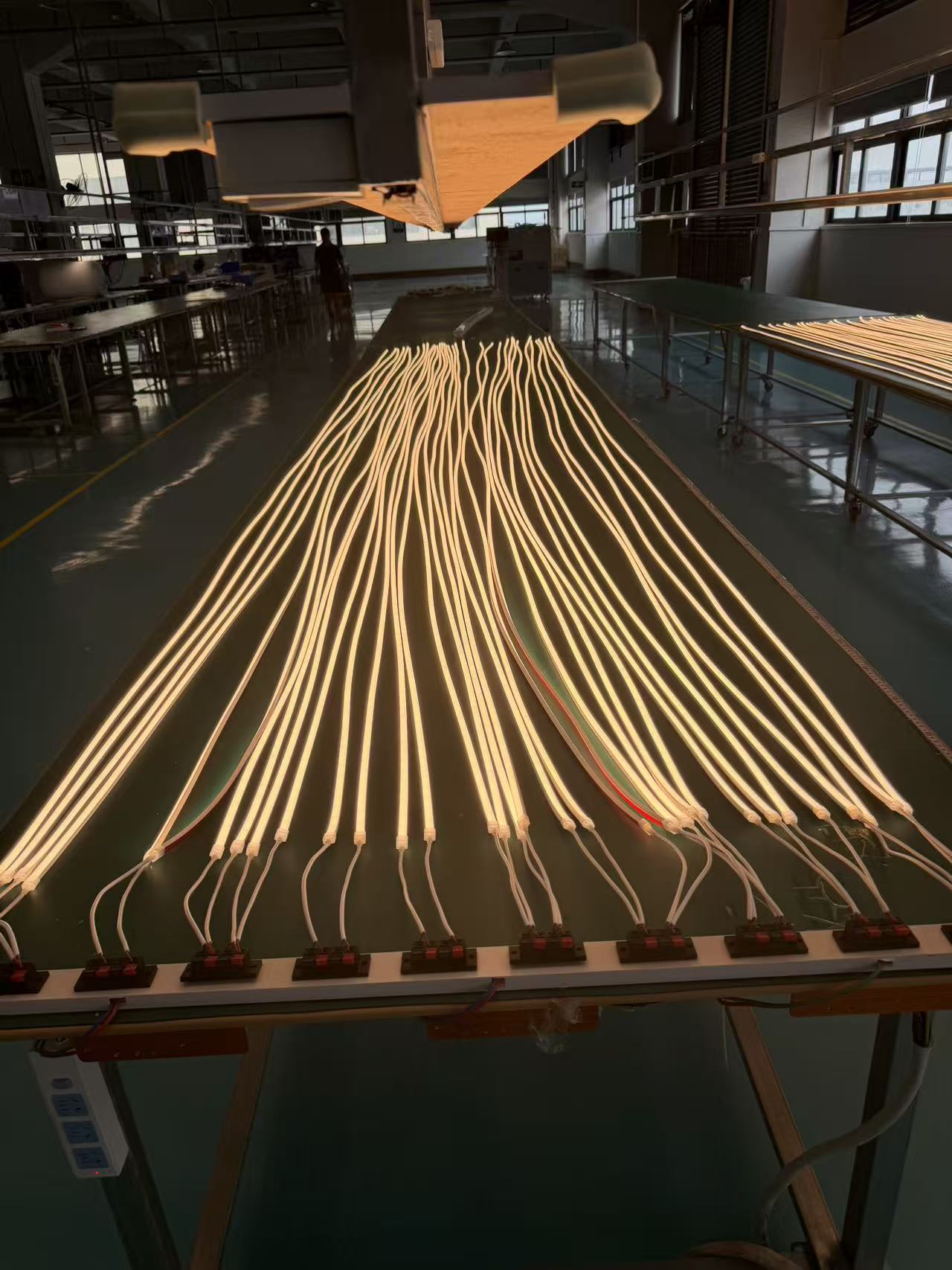
Understanding why traditional neon lights demand high voltage is useful physics. But for engineering and procurement teams, the more pressing question is what happens when that high-voltage assumption gets written — incorrectly — into a specification for an LED Neon Flex project. The consequences run deeper than a wrong number on a data sheet.
Why Does Traditional Gas Neon Actually Need High Voltage?
Most engineers have heard that neon signs run on high voltage. Far fewer can explain precisely why — and that gap in understanding is where specification errors begin.
At rest, the noble gas sealed inside a glass neon tube is an excellent electrical insulator. Electrons are tightly bound to their atoms. A low voltage applied across the electrodes produces essentially no current. To force the gas to conduct, the electric field between the electrodes must reach a threshold strong enough to strip electrons from gas atoms — a process called ionization.
Once ionization begins, free electrons collide with more gas atoms, freeing additional electrons in a chain reaction. This avalanche of charged particles creates a self-sustaining plasma discharge. The excited gas atoms then release energy as visible light at wavelengths specific to the gas used — neon produces red-orange, argon produces blue-violet, and different phosphor coatings on the glass wall shift the apparent color further.

The Role of the High-Voltage Transformer
Traditional neon sign transformers typically output between 2,000V and 15,000V AC, depending on tube length and gas pressure. This elevated voltage serves two functions:
- Strike voltage — the initial voltage needed to ionize the gas and start the discharge
- Operating voltage — the sustained voltage needed to maintain the plasma once discharge has begun (usually lower than strike voltage, but still far above mains levels)
The transformer is not an optional accessory. It is a structural requirement of the gas discharge system. Without it, the gas simply does not conduct, and the sign does not light.
Why the Physics Matters for Procurement
| Parameter | Traditional Gas Neon | LED Neon Flex |
|---|---|---|
| Light source | Gas plasma discharge | LED semiconductor chip |
| Operating voltage | 2,000–15,000V AC (typical) | 12V or 24V DC (typical) |
| Power supply required | High-voltage neon transformer | Low-voltage DC driver |
| Ionization required | Yes — mandatory | No — not applicable |
| Risk if wrong voltage applied | Incorrect transformer sizing | Driver mismatch, possible damage |
The table makes the distinction look obvious. In a project document that simply reads "Neon Lighting," the distinction disappears entirely.
How Does LED Neon Flex Work Without High Voltage?
The confusion around neon lighting voltage often comes from a reasonable but incorrect inference: if the product is called "neon," it must work like neon. LED Neon Flex does not.
LED Neon Flex is a low-voltage LED lighting product. Its light source is a row of surface-mounted LED chips mounted on a flexible PCB. A silicone extrusion — engineered to diffuse and shape the light — surrounds the assembly. The result visually resembles a traditional neon tube. The electrical system has nothing in common with one.
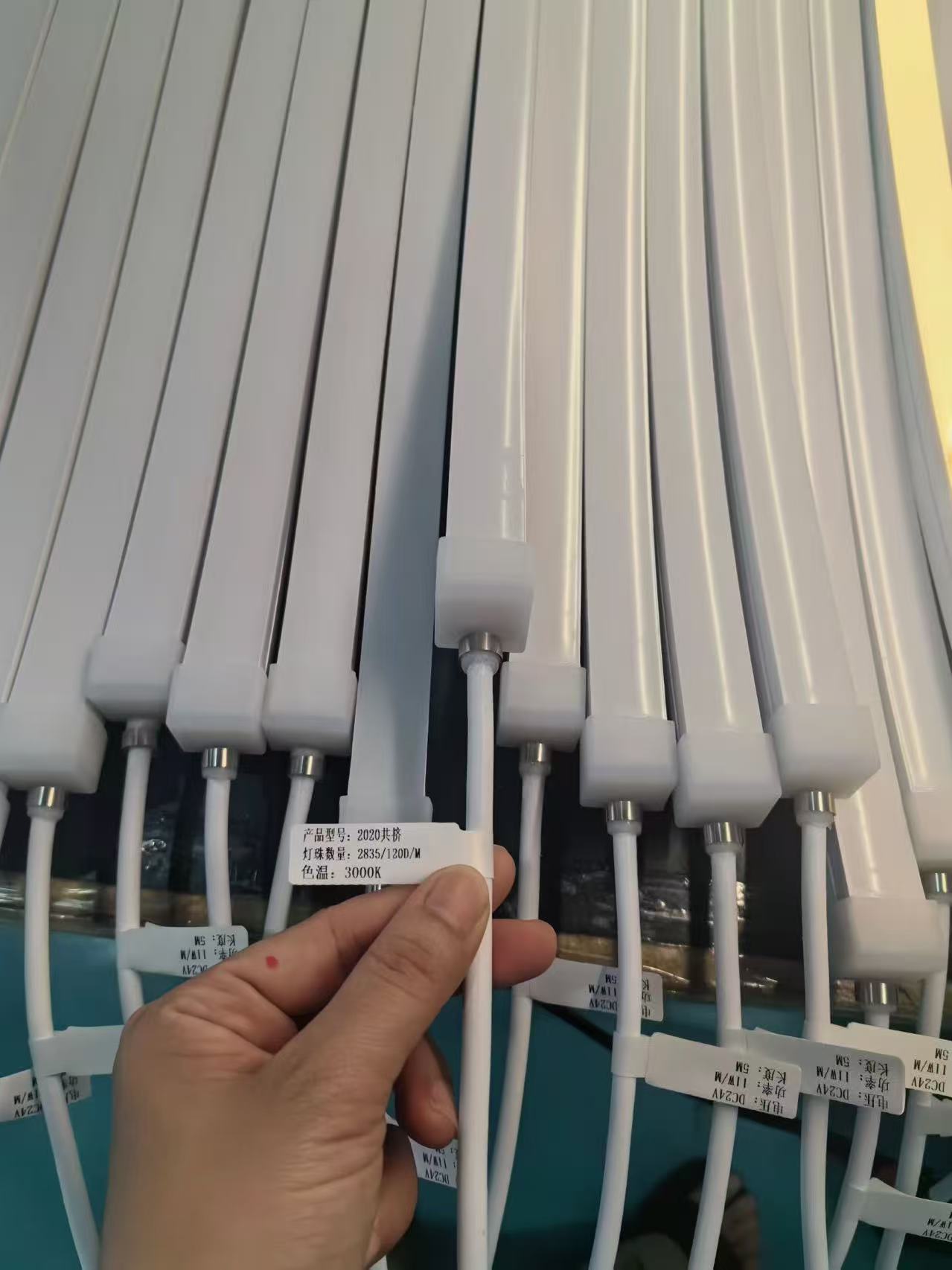
LED chips are semiconductor devices. They conduct current and emit light when a forward voltage — specific to the chip's semiconductor junction — is applied. That forward voltage is measured in single-digit volts per LED. The complete LED Neon Flex strip operates from a standard 12V DC or 24V DC regulated power supply.
Why 12V or 24V — and Which Is Better?
Both voltages are common in LED Neon Flex. The choice has practical implications for large-scale projects:
- 12V systems produce a stronger voltage drop over longer runs, requiring shorter circuit lengths or heavier cable.
- 24V systems reduce voltage drop for a given run length, making them better suited to architectural-scale installations where long continuous runs are required.
- High-voltage AC LED Neon Flex (110V or 220V input) exists as a category but uses an integrated driver within the product — the input is mains AC, but the LEDs still operate internally at low voltage. This is a separate product category with its own installation and safety considerations.
For large commercial projects, I generally see 24V DC LED Neon Flex specified more frequently, precisely because it handles longer runs with less voltage-drop management.
What Happens If Someone Applies High Voltage to LED Neon Flex?
This is not a purely theoretical question. If a project team designs the electrical infrastructure around a traditional neon transformer — expecting to connect "neon" to a high-voltage output — and then a supplier delivers LED Neon Flex, the mismatch is severe. Connecting a 12V or 24V LED product to a neon transformer output would destroy the product immediately and create a serious safety hazard.
The reverse scenario — designing a low-voltage system and then receiving a traditional gas neon sign — means the sign simply will not illuminate at all.
Neither failure mode is the fault of the product. Both failures are the result of an undefined term in a procurement document.
What Happens When "Neon = High Voltage" Gets Written Into a Project Specification?
This is the section where the physics lesson becomes a procurement risk analysis. I have seen this error pattern repeat across commercial fit-out and architectural lighting projects, and its structure is consistent.
The root cause is almost never technical ignorance. It is terminology that was never defined.
A design document written early in a project uses the word "Neon." Every stakeholder reads that word through the lens of their own experience:
- The visual designer sees the aesthetic — the soft, continuous glow.
- The electrical consultant sees "neon" and thinks: high-voltage transformer, specific clearances, qualified neon contractor.
- The procurement officer sees a product category and begins sourcing.
- The supplier sees a line item and quotes based on their interpretation — which may be LED Neon Flex, or may be traditional gas neon.
- The site electrician sees a power supply requirement and sizes the circuit accordingly.
No single stakeholder is wrong given their own frame of reference. But when their frames do not match, every downstream document inherits the error.
The Failure Cascade
The following sequence describes the typical progression of this error in a large multi-site commercial project:
- Design stage — Electrical drawings show a "Neon" power supply point. No voltage or technology type is specified.
- Procurement stage — Multiple suppliers quote. Some quote LED Neon Flex on 24V DC. Others quote gas neon requiring high-voltage transformers. Pricing varies widely. The team selects on price without resolving the technical discrepancy.
- Sample stage — LED Neon Flex samples arrive. The site electrician notes the product requires a 24V DC driver, not the high-voltage supply point shown on the drawing.
- Technical review — A coordination meeting is called. The design team and the electrical consultant discover the electrical infrastructure was partially specified for the wrong system.
- Remediation — Power supply locations, circuit ratings, conduit sizing, and control interfaces must be reviewed across all project areas. Some completed M&E works require revision.
- Contract dispute — Each party believes they followed their brief correctly. The dispute centers on who was responsible for defining "Neon" in the first place.
Why This Problem Scales With Project Size
A single-location retail fit-out can absorb the cost of re-specifying a power supply. An 80-store rollout with 12,000 meters of linear neon lighting — already committed to a particular electrical infrastructure — cannot. The financial exposure grows directly with the number of sites, the length of the lighting run, and the degree to which M&E infrastructure was already installed before the technology type was confirmed.
The most expensive moment to discover that "Neon" was never defined is after bulk procurement and partial site installation.
How Should a Procurement or Engineering Team Prevent This?
The correction does not require advanced electrical engineering. It requires one discipline: define the technology type before writing any other specification parameter.
Step 1: Replace "Neon" With a Precise Product Category
Every project document — from the design brief to the tender package — should specify either:
- Gas Neon Sign (traditional glass tube, high-voltage discharge)
- LED Neon Flex / Silicone LED Neon Flex (low-voltage DC LED product)
These are not interchangeable. They should never appear under the same umbrella term in a technical document.
Step 2: Specify the Complete Electrical System, Not Just the Product
For LED Neon Flex projects, the specification should define:
- Rated input voltage (e.g., 24V DC)
- Power supply type and output rating
- Maximum run length per circuit
- Control interface (e.g., 0–10V dimming, DALI, DMX)
- Cable routing and power injection points
- Conduit and termination requirements
Step 3: Validate the Complete System at Sample Stage
Sample approval should not consist of photographing an illuminated product. It should confirm:
| Validation Item | Confirmed? |
|---|---|
| Product input voltage matches driver output | ☐ |
| Driver output voltage matches electrical drawing | ☐ |
| Control interface compatible with specified system | ☐ |
| Run length within voltage-drop tolerance | ☐ |
| Wiring method matches site installation plan | ☐ |
Step 4: Conduct a System Mock-up Before Bulk Commitment
A representative mock-up — using the specified product, the specified driver, the specified control system, and the actual installation method — validates the full chain. Visual appearance alone is not sufficient. The mock-up should prove that the electrical design works in the real installation condition.
Step 5: Define Acceptance Criteria Explicitly
A contract clause that reads "neon lighting shall operate normally" is not an acceptance criterion. A workable acceptance criterion includes:
- Product type and approved model reference
- Input voltage and driver specification
- Control system function confirmation
- Measured light output against design intent
- System installed per approved drawings
Frequently Asked Questions
Do all products marketed as "neon" require high voltage?
No. Traditional glass gas neon signs require high voltage — typically 2,000V to 15,000V AC — to ionize the gas inside the tube. LED Neon Flex products operate at low DC voltage, usually 12V or 24V. Both are sold under the "neon" label, but their electrical requirements are completely different.
Can LED Neon Flex be connected to a traditional neon transformer?
No, and doing so would damage the product and create a safety hazard. LED Neon Flex is designed for regulated low-voltage DC power supplies. Applying the high-voltage AC output of a neon transformer to an LED Neon Flex product would immediately destroy the LEDs and the driver circuit.
What voltage should I specify for an architectural-scale LED Neon Flex project?
24V DC is generally preferred for large-scale or long-run installations because it reduces voltage drop compared to 12V systems. Always confirm maximum run length per circuit with the supplier based on the specific product's power consumption per meter.
Why do some LED Neon Flex products list a 110V or 220V input voltage?
These are high-voltage input LED Neon Flex products that include an integrated driver within the product assembly. The LEDs inside still operate at low voltage — the high-voltage AC is converted internally. These are a distinct product category with different installation requirements and should be specified clearly as such.
What is the most important step to prevent neon specification errors in a large project?
Define the technology type — gas neon or LED Neon Flex — in the earliest project documents, before electrical design begins. Every subsequent specification, from power supply sizing to conduit routing to acceptance testing, depends on that foundational definition being correct.
Conclusion
Traditional neon lights need high voltage because gas discharge physics demands it — the electric field must be strong enough to ionize the gas before any current flows or any light is produced. That principle is specific to glass tube neon signs. It does not apply to LED Neon Flex, which is a low-voltage semiconductor product that has no gas, no ionization, and no requirement for a high-voltage transformer.
The real risk in modern projects is not a misunderstanding of gas discharge physics. It is an undefined term — "neon" — that carries different technical assumptions for every stakeholder who reads it. When that undefined term enters a design brief, it propagates through electrical drawings, procurement documents, supplier quotations, site installations, and acceptance criteria. By the time the mismatch surfaces, the cost of correction has multiplied.
The fix is straightforward: define whether the project uses gas neon or LED Neon Flex before any other technical specification is written. Everything else follows from that single definition.
If you are specifying LED Neon Flex for a commercial, architectural, or landscape project, contact our team at Ailisiter. We supply silicone LED Neon Flex products across 12V and 24V DC systems, support OEM and custom specifications, and can assist procurement and engineering teams with sample validation, product documentation, and project-scale supply.