

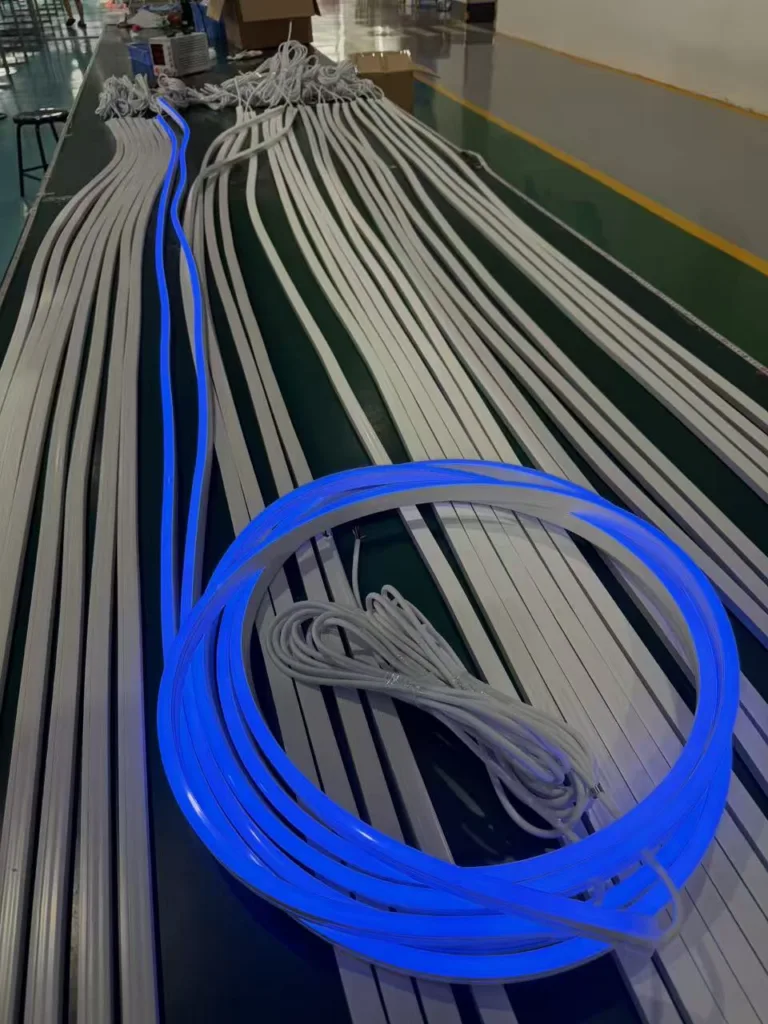
Procurement teams working on large commercial, architectural, and hospitality projects ask this question constantly. The answer they usually get — "50,000 hours" or "60,000 hours" — sounds reassuring. But experienced project managers know that a lifespan number without context can create more risk than clarity. This article explains what that number actually means in practice.
LED neon lights typically last between 30,000 and 50,000 hours under controlled test conditions. High-quality silicone LED neon flex products from reputable manufacturers can exceed 50,000 hours. However, real-world project lifespan depends on installation conditions, operating environment, power supply quality, bending radius compliance, and whether the product delivered at scale matches the approved sample.
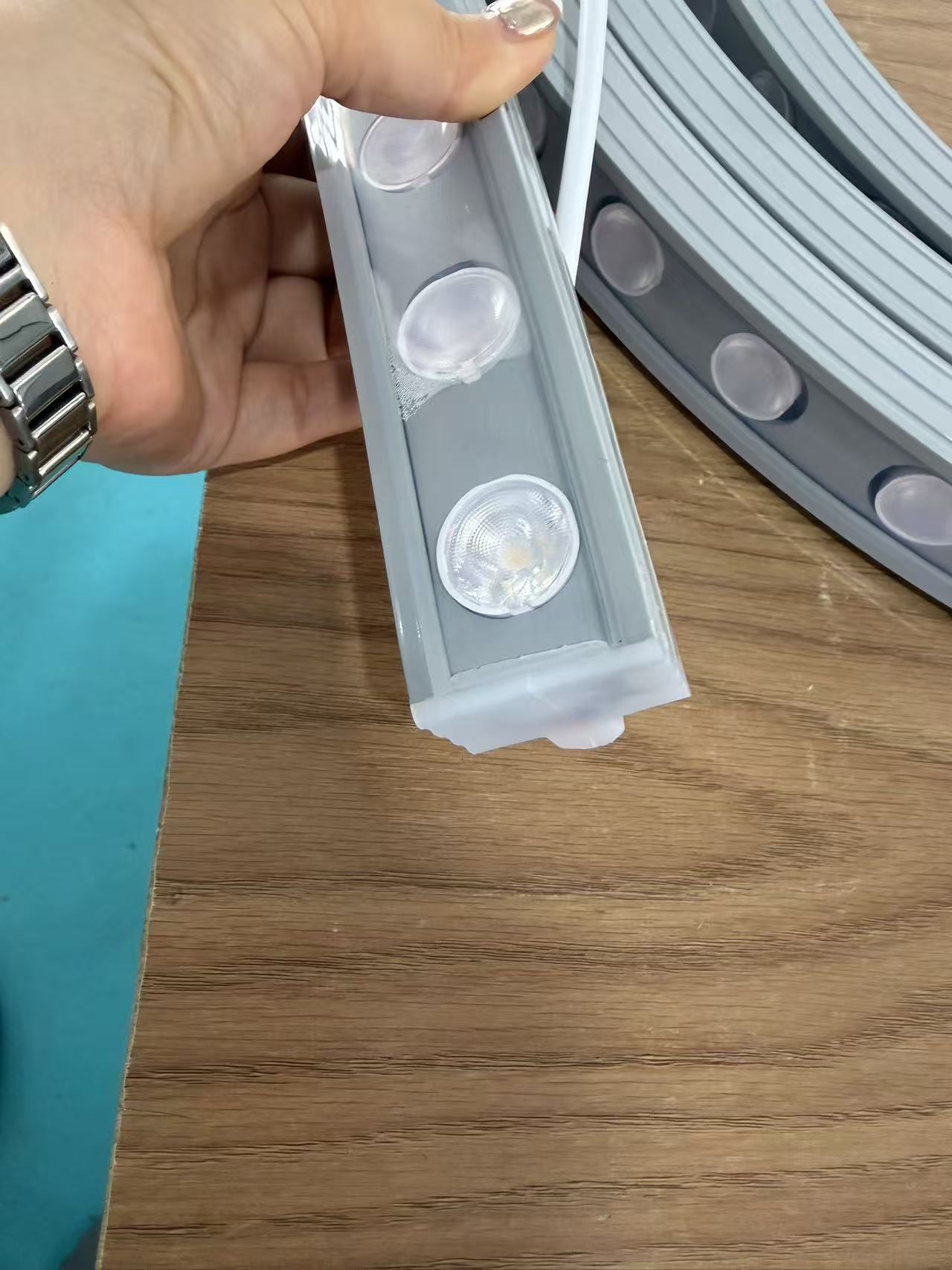
That headline number is a starting point, not a guarantee. The gap between a product's rated lifespan and a project's actual service life is where most procurement and installation problems live. Let me walk through what creates that gap — and how to close it before problems appear on site.
Is "50,000 Hours" a Reliable Lifespan Guarantee for LED Neon Lights?
Buyers who rely solely on a rated hour figure often find themselves in disputes at the delivery or warranty stage. The number means something — but only within a defined set of conditions that rarely appear in standard procurement documents.
A rated lifespan of 50,000 hours for LED neon lights is a valid industry benchmark, but it is only meaningful when paired with the test conditions under which it was measured. Without knowing the test temperature, drive current, duty cycle, and environmental rating, a buyer cannot confirm whether that figure applies to their specific project.
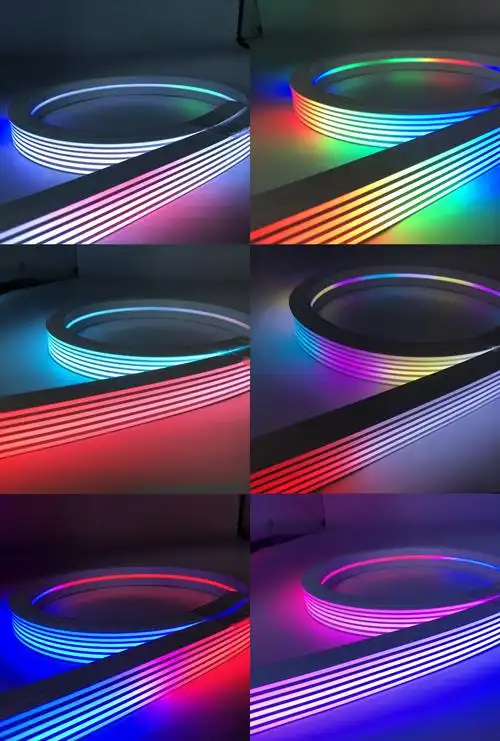
Understanding what sits behind the number is the first step toward using it as a real procurement tool. Here is what that deeper look reveals.
What "Rated Lifespan" Actually Measures
Most LED lifespan figures refer to L70 — the point at which lumen output has dropped to 70% of the initial value. Some manufacturers use L50 or L80. These are not the same standard.
A product rated at 50,000 hours L70 will still be operating at that point, but it will produce noticeably less light than when first installed. Whether that matters depends entirely on the project's visual requirements.
Key variables that affect how the rated figure translates to real-world performance:
- Junction temperature — LEDs degrade faster at higher operating temperatures. The rated lifespan assumes a specific thermal environment.
- Drive current — Running LEDs above their rated current extends brightness short-term but significantly shortens lifespan.
- Ambient temperature — A product tested at 25°C may perform differently installed on a south-facing building facade in a hot climate.
- IP rating and encapsulation quality — Moisture ingress is one of the leading causes of premature failure in outdoor LED neon applications.
- Power supply stability — Voltage fluctuations and poor-quality drivers accelerate LED degradation.
The Specification Document Problem
In my experience reviewing procurement documents for large-scale LED neon flex projects, the most common problem is a specification that simply states:
LED Neon Flex — rated lifespan ≥ 50,000 hours.
That single line leaves the following questions completely unanswered:
| Missing Definition | Why It Matters |
|---|---|
| Test standard (LM-80, IEC 62612, etc.) | Without a standard, the figure is self-reported |
| Test temperature | Lifespan drops significantly at higher temperatures |
| Installation environment | Indoor, semi-outdoor, and fully exposed conditions are not equivalent |
| Bending radius requirements | Excessive bending stresses the internal LED strip and connections |
| Continuous vs. cyclic operation | Thermal cycling affects solder joints and silicone over time |
| Sample-to-production consistency | An approved sample does not automatically guarantee batch consistency |
When these definitions are absent at the procurement stage, every party in the project — the designer, contractor, supplier, and client — is operating with a different assumption about what "50,000 hours" means for this specific project.
What Actually Causes LED Neon Lights to Fail Early in Large Projects?
Most premature failures in commercial and architectural LED neon installations are not caused by poor product quality alone. The root cause is more often a mismatch between the conditions the product was specified for and the conditions it actually experiences.
Early failure in LED neon light installations is most commonly caused by installation stress exceeding the product's specified bending radius, thermal management problems, moisture ingress due to inadequate IP protection for the actual environment, power supply inconsistency, or a gap between the approved sample specification and the mass-produced product.
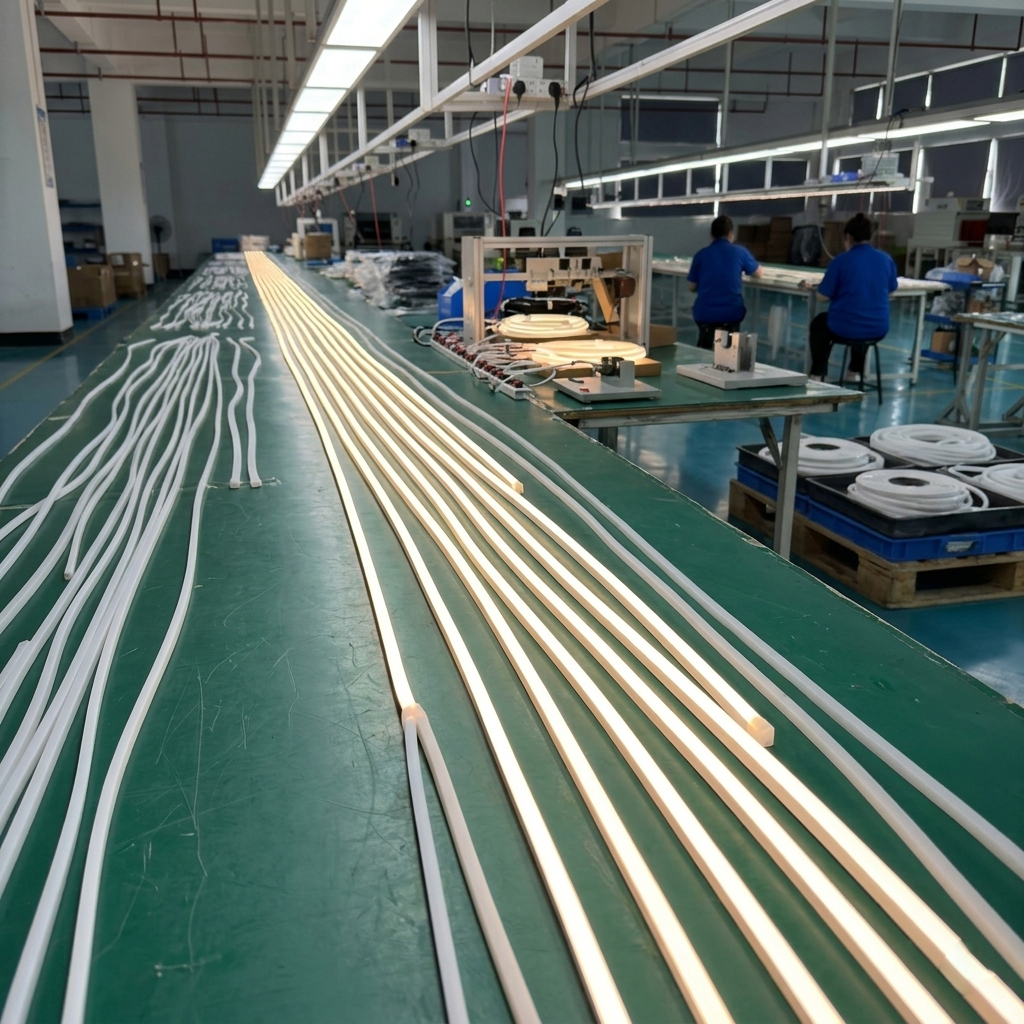
Breaking these down individually helps procurement and project teams know exactly where to focus quality control effort.
Installation Stress and Bending Radius
Silicone LED neon flex is designed to bend, but every product has a minimum bending radius. When site conditions require tighter curves than the product specification allows, the internal LED strip, solder joints, and copper traces experience mechanical stress. This stress may not cause immediate failure. Instead, it creates failure points that appear weeks or months after commissioning.
Common installation errors that create this problem:
- Site installers adapting on the fly to curves not anticipated during design
- Design drawings that do not specify the exact bending radius at complex geometry sections
- No mock-up testing performed before large-scale installation begins
Sample-to-Production Consistency
This is one of the most underappreciated risks in large-scale LED neon procurement. A sample approval process verifies one product — the sample. It does not automatically verify every unit in a 12-kilometre production run.
Critical controls that reduce this risk:
- Locking the sample specification — Supplier confirms that the approved sample reflects the exact production materials, LED binning, silicone compound, and power input parameters
- Batch inspection on delivery — Not just visual inspection, but electrical and photometric spot-checking
- Traceability documentation — Production batch records tied to specific project delivery
Power Supply Quality
LED neon flex lifespan figures assume stable, regulated power delivery. In large architectural installations, long cable runs, shared circuits, and poorly specified drivers can introduce voltage drop and instability. These conditions accelerate LED junction degradation even when the LED neon product itself is correctly specified.
A practical checkpoint: Confirm that the power supply specification — voltage tolerance, output ripple, and protection features — is reviewed alongside the LED neon product specification, not in isolation.
How Should a Project Team Define LED Neon Lifespan Requirements?
Asking a supplier "how long do your LED neon lights last" is the beginning of a conversation, not the end of one. A project team that stops at the rated hour figure is leaving significant risk unmanaged.
A project team should translate a rated LED neon lifespan into a set of verifiable project conditions: the installation environment, operating hours per day, thermal management approach, minimum bending radius, power supply specification, sample-to-production consistency requirements, and on-site acceptance criteria. These conditions — not the rated hour figure alone — define whether the product will meet the project's service life expectations.
A Practical Ten-Point Control Framework
The table below outlines the control points that experienced project teams use to convert a lifespan number into a manageable project condition.
| Project Stage | Who Is Responsible | What to Confirm |
|---|---|---|
| Requirement definition | Client / Design team | Target service life, operating hours, environment classification |
| Technical specification | Technical lead | Lifespan figure, test standard, and test conditions |
| Sample approval | Technical + Procurement | Confirmed sample represents final production specification |
| Mock-up testing | Contractor + Supplier | Full assembly test under actual installation conditions |
| Installation tolerance | Site manager | Bending radius, fixing method, junction treatment |
| Supply chain control | Procurement | Supplier consistency across batches |
| Incoming inspection | QC / Project manager | Batch-to-batch consistency check on delivery |
| Acceptance criteria | Technical lead | Observable, checkable criteria — not just parameter compliance |
| Responsibility boundaries | Contract manager | Clear allocation between supplier, designer, and contractor |
| Ongoing monitoring | Project manager | Change management process for any deviation from approved conditions |
The Six Questions Worth Asking Every Supplier
When evaluating LED neon flex suppliers for large-scale projects, I recommend going beyond the data sheet. These six questions expose gaps that standard specifications miss:
- Under what test conditions was this lifespan figure measured?
- How does our actual installation environment differ from those test conditions?
- How do you ensure the mass-produced product matches the approved sample?
- What is the minimum bending radius, and what happens if it is exceeded?
- What are the acceptance criteria for a compliant installation?
- If a failure occurs, how do we determine whether it is a product, design, or installation issue?
A supplier who can answer these questions clearly and specifically is demonstrating production and technical maturity that a data sheet alone cannot confirm.
Frequently Asked Questions
How long do LED neon lights last compared to traditional neon signs?
Traditional glass neon signs typically last 8,000 to 15,000 hours before the gas tubes require recharging or replacement. Quality LED neon lights are rated between 30,000 and 50,000+ hours under appropriate conditions — roughly three to five times longer. LED neon also runs cooler and requires less maintenance than glass neon.
Does the IP rating of LED neon flex affect how long it lasts outdoors?
Yes, significantly. For exterior architectural and landscape installations, a minimum IP65 rating is generally required to resist dust and water ingress. Full outdoor exposure on building facades often warrants IP67 or higher. Moisture infiltration is one of the primary causes of early failure in outdoor LED neon applications. Buyers should verify the IP rating matches the actual installation environment.
Can the lifespan of LED neon lights be extended with better power supplies?
A high-quality, correctly specified constant-voltage driver with low output ripple and appropriate protection features does extend effective LED neon lifespan. Stable power delivery reduces thermal stress on LED junctions. Voltage drop on long cable runs is a common site problem that shortens lifespan — this should be engineered out during the design stage, not corrected on site.
Why do LED neon lights sometimes fail even when they meet the rated specification?
The rated specification describes a product under controlled conditions. Site failures often occur because installation conditions — bending radius, ambient temperature, moisture exposure, power quality — differ from the conditions assumed in the specification. In large projects, failures also occur when mass-produced batches deviate from the approved sample without detection.
How should I verify an LED neon supplier's lifespan claims before committing to a large order?
Request the test report, including the test standard, conditions, and third-party laboratory name. Ask for an approved sample that formally represents the production specification. If project scale justifies it, conduct a mock-up installation and observe the assembly under operating conditions before mass procurement. Certifications such as CE, RoHS, or UL indicate a compliance baseline, but they should be verified against current documentation rather than accepted at face value.
Conclusion
The question "how long do LED neon lights last?" has a straightforward industry answer: typically 30,000 to 50,000+ hours for quality products. But for commercial, architectural, and large-scale project buyers, that number is the beginning of the specification process — not the end of it. Real project lifespan depends on installation conditions, power supply quality, thermal management, batch consistency, and whether the acceptance criteria are defined clearly enough to be enforced. The projects that manage LED neon lifespan successfully are the ones that translate a rated hour figure into a set of verifiable, documented conditions before the first unit is installed.
If you are evaluating LED neon flex for a large project and need to work through the technical specification with a manufacturer who can support sample confirmation, production consistency, and project documentation, contact our team to discuss your requirements.