

Specifying LED products for a large-scale project without clarifying their power input requirements is one of the most common — and costly — mistakes in commercial lighting procurement. The confusion starts with a deceptively simple question: are LEDs DC or AC? Get the answer wrong at the concept stage, and you risk cascading errors through power design, product selection, wiring, and final commissioning.
LEDs are fundamentally DC devices. A light-emitting diode requires direct current flowing in a specific direction to emit light. However, this does not mean every LED luminaire or LED strip product requires a DC input at the field connection point. Many LED products include internal drivers that accept AC mains input and convert it internally. The critical engineering question is not "are LEDs DC or AC?" — it is "what does this specific LED product actually accept at its input terminals?"
Understanding the distinction between how an LED chip operates and how a finished LED luminaire connects to your electrical system is what separates a well-managed project from a costly rework. The sections below break that distinction down at every level — from component physics to project-level procurement risk.
How Does an LED Actually Work — DC or AC?
Most buyers never purchase bare LED chips. Yet the physics of the chip governs everything upstream.
An LED is a semiconductor diode. When forward-biased — meaning current flows in the correct direction — electrons recombine with holes and release energy as photons. Reverse the current direction, and the diode blocks or can be damaged. This is why LEDs are inherently DC devices at the component level.
The practical implication is straightforward: every LED product in the market, regardless of its input label, contains some form of circuitry that ensures the LED chip itself receives the right DC conditions. What varies enormously is where that conversion happens — inside the product, or outside it in a separate driver.
The Three Layers You Must Separate
Before evaluating any LED product for a project, I recommend separating three distinct layers:
| Layer | Description | Example |
|---|---|---|
| LED chip | Always operates on DC | Emitter on a strip PCB |
| LED product | May accept DC or AC input depending on design | LED Neon Flex, LED strip, LED module |
| Lighting system | The full chain from mains supply to LED output | Switchboard → driver → strip → controller |
Conflating these three layers is the root cause of most AC/DC-related project failures I have seen.
Why Chip-Level Physics Does Not Define System Input
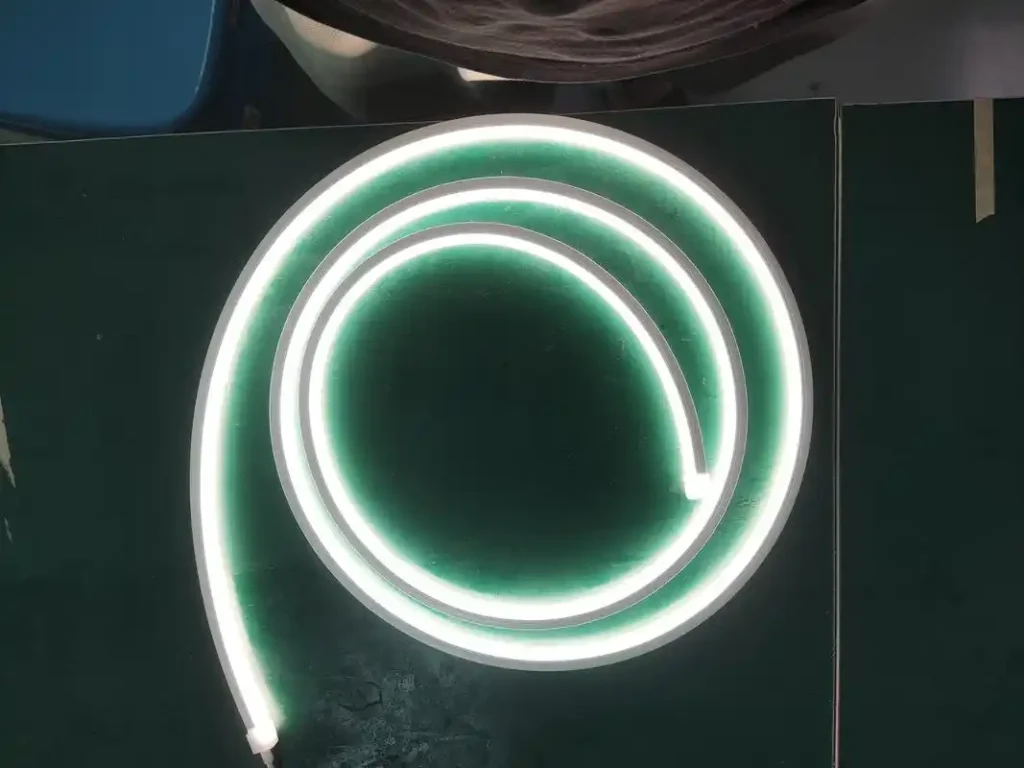
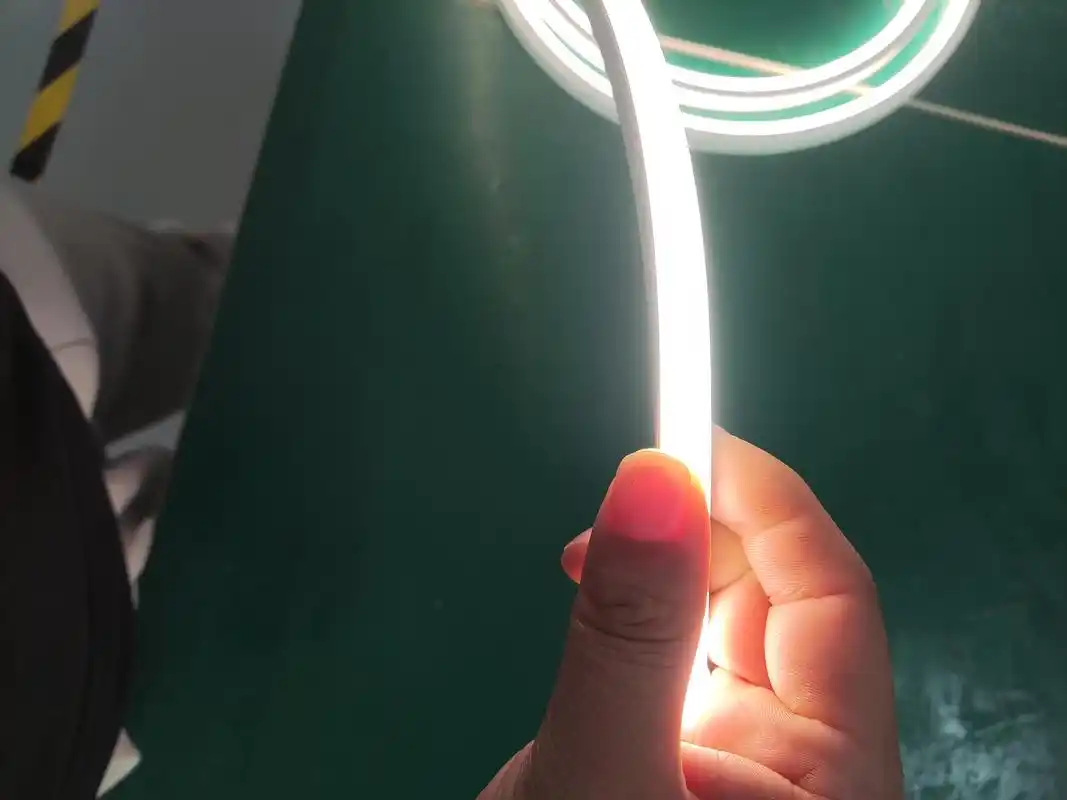
A finished LED Neon Flex product rated at AC 120V input still contains LEDs operating on DC internally. The product simply integrates a rectifier and current regulation circuit inside its housing. From the installer's perspective, the product "runs on AC." From the chip's perspective, it always runs on DC.
This distinction matters because:
- Procurement teams comparing products on price alone may not notice that two visually similar products have completely different input architectures.
- Electrical engineers designing the distribution board need to know whether the product needs an external driver or connects directly to a mains circuit.
- Installers on site need to know which terminals receive AC and which receive DC.
- QC teams receiving shipments need to verify that batch input specs match approved samples.
Skipping any one of these checkpoints converts a technical misunderstanding into a field problem.
What Is the Difference Between an LED Driver and an LED Power Supply?
The terms "driver" and "power supply" are often used interchangeably in the field, which creates its own category of specification errors.
An LED driver is a regulated current-control device designed specifically for LED loads. A power supply is a more general voltage-conversion device. Both may convert AC mains to DC output — but their output characteristics differ in ways that matter for LED performance and longevity.
Understanding which one your LED product requires is a non-negotiable part of product evaluation.
Current-Regulated Drivers vs. Constant-Voltage Power Supplies
| Parameter | Constant Current Driver | Constant Voltage Power Supply |
|---|---|---|
| Output characteristic | Fixed current (e.g., 350mA, 700mA) | Fixed voltage (e.g., 12V DC, 24V DC) |
| Load regulation | Automatically adjusts voltage to maintain current | Voltage stays fixed; current varies with load |
| Typical application | Single LED modules, downlights, high-power fixtures | LED strips, LED Neon Flex, multi-module runs |
| Dimming compatibility | Often DALI, 0–10V, PWM | Often PWM via controller |
| Failure mode if mismatched | LED overdrive or underdrive | Inconsistent brightness, premature failure |
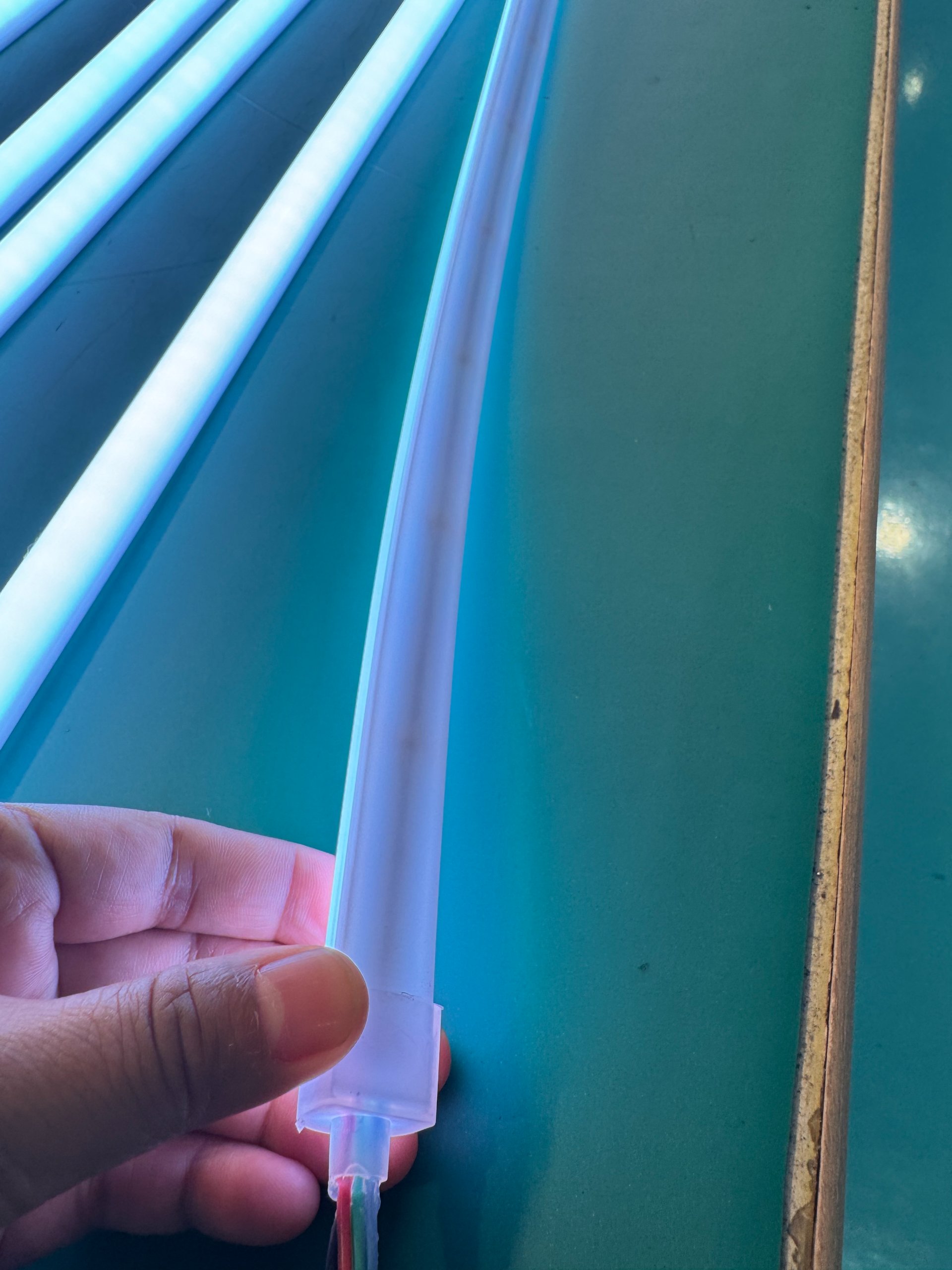
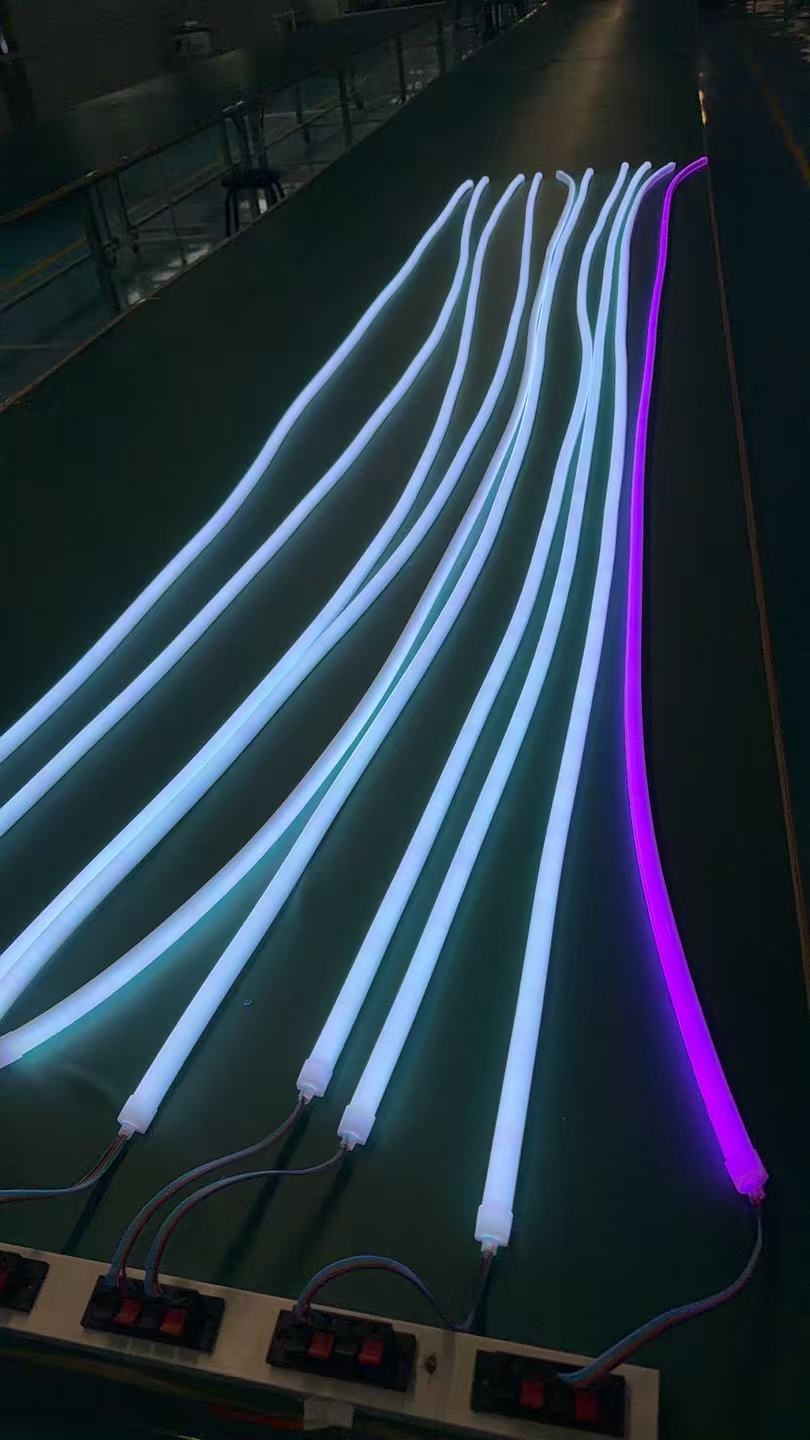
For LED Neon Flex and LED strip products, constant-voltage 24V DC or 12V DC power supplies are the most common external driver type. These products connect at a DC input terminal after the power supply converts incoming AC mains.
Where Does the AC-to-DC Conversion Happen?
This is the single most important question for electrical design on any project using LED products.
Three possible architectures:
-
External driver, DC product input — Mains AC enters a separate driver unit. DC exits the driver and connects to the LED product. The LED product datasheet shows a DC input rating (e.g., DC 24V).
-
Integrated driver, AC product input — The LED product contains an internal driver. Mains AC connects directly to the product. The datasheet shows an AC input rating (e.g., AC 100–240V).
-
High-voltage LED strip (HV LED strip) — A hybrid design where LEDs are arranged in series strings with on-board resistors or ICs, allowing the strip itself to accept AC or rectified high-voltage DC directly. These require careful handling due to high-voltage exposure on the PCB.
If your specification document does not identify which architecture applies to each product in your bill of materials, your electrical design is incomplete — regardless of how detailed the rest of the drawings are.
What Can Go Wrong When AC/DC Input Is Not Specified Correctly?
The failure mode is predictable. It follows a consistent pattern across projects I have reviewed.
A project team forms a shorthand assumption early in design — usually something like "LEDs need DC, so we will run DC to everything." This assumption gets embedded in the distribution design before products are finalized. Products are then selected based on aesthetics, price, and lumen output. Nobody checks whether product input architecture matches the distribution design.

The mismatch surfaces at installation — when it is maximally expensive to fix.
The Typical Failure Chain
- Concept stage — "LEDs are DC" becomes the unchallenged assumption.
- Design stage — Distribution boards, conduit runs, and driver quantities are sized for one architecture.
- Procurement stage — Products are selected without input-type verification.
- Delivery stage — Mixed input-type products arrive on site.
- Installation stage — Field teams discover the wiring does not match product requirements.
- Response — Different zones get different ad-hoc solutions. System uniformity is lost.
- Commissioning stage — Control system behavior is inconsistent across zones.
- Handover — As-built drawings do not match approved designs.
- Disputes — No single party owns the error. Every stakeholder points elsewhere.
I have seen projects where the physical lighting worked — every fixture illuminated — but the project still failed handover because the actual electrical architecture did not match the approved design documentation.
Why "The Light Turns On" Is Not a Sufficient Acceptance Test
Commissioning an LED lighting system only to the standard of "the fixture illuminates" misses critical system-level risks:
- Thermal stress — Running an LED product at a voltage outside its rated range may not cause immediate failure but will shorten service life significantly.
- Driver compatibility — An LED strip connected to a mismatched power supply may exhibit flicker, color inconsistency, or fail prematurely.
- Control system behavior — Dimming protocols designed for constant-current drivers may not function correctly with constant-voltage supplies, and vice versa.
- Code compliance — In many markets, the actual installed electrical configuration must match the approved design and relevant certification basis.
The correct acceptance standard includes verifying that the actual input type, driver position, and distribution configuration match the approved project documentation.
How Should a Procurement Specification Define LED Input Requirements?
Weak specifications are the most common upstream cause of AC/DC mismatches on projects. The following patterns appear repeatedly in tender documents and product enquiries.
Specification Errors to Eliminate
Error 1: Writing only "LED" without input type
LED Neon Flex, 10W/m, IP67
This tells the electrical engineer nothing about how to supply power to the product. A complete specification must include input type and rated input voltage.
Error 2: Using LED chip physics as a proxy for product input
Stating "LED technology requires DC" in a spec does not define the product's field connection requirement. Many LED products accept AC at the terminal. The spec must describe the product, not the chip.
Error 3: Conflating driver output with product input
24V LED system
Does "24V" refer to the power supply output? The product rated input? The control signal voltage? This ambiguity has caused field wiring errors. Every voltage reference must identify exactly what it describes.
Error 4: Accepting "AC/DC compatible" without detail
If a supplier claims a product is "AC/DC compatible," verify:
- The specific AC voltage range
- The specific DC voltage range
- Whether both modes use the same product version
- Whether the control interface is compatible in both modes
- Whether any additional components are required for either mode
Error 5: Allowing "equivalent product" substitution without locking input type
If your tender allows equivalent substitution but does not require input type to match the original specification, a supplier can submit a product with a different electrical architecture. Even if it produces the same light output, it may not be an equivalent product in engineering terms.
What a Complete LED Product Specification Should Include
| Parameter | Required Information |
|---|---|
| Rated Input Voltage | e.g., DC 24V, AC 100–240V |
| Input Type | AC or DC |
| Driver Requirement | External driver required / Internal driver integrated |
| Power Supply Type | Constant voltage / Constant current |
| Control Interface | PWM / 0–10V / DALI / Triac / None |
| Certification Basis | CE, UL, SAA, etc. — and which input configuration they cover |
Suppliers should be required to complete this information for every product submitted for evaluation. Products with incomplete input specifications should not advance to sample testing.
How Should Large Projects Manage AC/DC Risk Across the Procurement Lifecycle?
A structured risk control process prevents the failure chain described above. Based on the project contexts I work with, I recommend organizing controls across ten stages.
Project-Level AC/DC Risk Control Framework
| Stage | Responsible Party | Timing | Key Check | Trigger for Escalation |
|---|---|---|---|---|
| 1. Needs definition | Design lead + Electrical engineer | Schematic design | Define system input architecture | Input type undecided → halt procurement |
| 2. Technical specification | Technical lead | Pre-tender | Lock Input Voltage + Input Type + Driver Requirement | Missing → reject product submittal |
| 3. Sample evaluation | Procurement + Technical | Pre-award | Verify sample input matches specification | Mismatch → reject or re-specify |
| 4. Mock-up testing | Main contractor + Electrical | Pre-bulk | Test full chain: AC supply → driver → control → product | Failure → halt bulk order |
| 5. Contract locking | Procurement lead | Contract stage | Bind input type, driver config, and product model | Change → re-approval required |
| 6. Supplier change control | Procurement lead | Ongoing | Any change to input type triggers re-approval | No silent substitution permitted |
| 7. Incoming inspection | QC | Goods receipt | Check product label, input voltage, driver config vs. approved sample | Non-conformance → quarantine |
| 8. Installation control | Site supervisor | Construction | Follow approved AC/DC wiring diagram | Deviation → stop work |
| 9. Acceptance testing | Technical lead | Commissioning | Verify actual input, driver position, distribution vs. approved drawings | Discrepancy → do not sign off |
| 10. Responsibility matrix | Contract lead | Pre-contract | Define who owns input confirmation, distribution design, driver supply, product substitution approval | Undefined → high dispute risk |
This framework does not require specialized knowledge for every team member. It requires that someone with the right knowledge is assigned to each checkpoint, and that the project does not advance past each stage without a documented confirmation.
Frequently Asked Questions
Do LED strip lights run on AC or DC?
Most standard LED strip lights — including 12V and 24V LED strips and LED Neon Flex products — run on low-voltage DC at the product input. They require a compatible constant-voltage power supply or LED driver that converts incoming AC mains to the rated DC output. Confirm the specific product's rated input before selecting a driver.
Can LEDs run directly on AC mains without a driver?
Some LED products are designed for direct AC mains connection. These products integrate rectification and current regulation internally. However, bare LED chips and most standard LED strip products cannot connect directly to AC mains without appropriate driver circuitry. Always verify the rated input type on the product datasheet before making field connections.
What happens if you connect an LED strip to the wrong voltage or input type?
Connecting an LED product to an incompatible supply can cause immediate failure, reduced lumen output, flicker, overheating, or accelerated degradation. In some cases, the product may appear to work initially but fail prematurely. Always confirm rated input voltage and input type before powering any LED product.
Why do some LED products say "AC/DC compatible"?
Some LED products, particularly high-voltage LED strips, are designed to operate on either AC or DC within a specified voltage range. This is possible because the on-board circuitry handles both input types. However, buyers should verify the exact voltage range for each mode, confirm that the control interface is compatible, and check whether any certification coverage differs between AC and DC operation modes.
Is the LED driver the same as the LED power supply?
These terms are often used interchangeably but are technically distinct. An LED driver provides regulated current output specifically designed for LED loads, with automatic adjustment to maintain stable current. An LED power supply provides a regulated voltage output. Many LED strip and Neon Flex products use constant-voltage power supplies. Confirm the product's driver requirement before selecting a supply unit.
Conclusion
The question "are LEDs DC or AC?" has a clear answer at the component level: LEDs are DC devices. But for anyone managing a commercial or architectural lighting project, the more important question is what a specific LED product requires at its field input terminal — and whether that requirement is consistent with the project's electrical distribution design. Confirming input type, driver position, and power supply architecture before procurement is the single highest-leverage action any project team can take to avoid the rework, schedule delays, and handover disputes that follow from getting it wrong. If you are evaluating LED Neon Flex, LED strip, or other linear LED products for a project, I encourage you to contact our technical team at Shenzhen Ailis Technology. We provide product specifications, sample support, and application guidance to help procurement teams define the right product before the wrong one reaches site.