
Using an indoor LED outdoors seems like a simple cost-saving shortcut — until the fixture fails three months into a two-year project. Water ingress, UV degradation, and thermal stress can destroy indoor-rated LEDs rapidly in outdoor environments, turning a small budget decision into a full replacement job.
Indoor LEDs are not designed for outdoor use. They lack the moisture resistance, UV protection, and weatherproof enclosures that outdoor environments demand. Using an indoor LED outside risks premature failure, electrical hazards, and voided warranties. For any outdoor application, buyers should specify products with appropriate IP ratings and outdoor-rated construction verified by third-party certification.
The short answer is clear. But the full picture is more nuanced. Understanding why indoor LEDs fail outdoors — and how to correctly specify outdoor-rated products — helps buyers avoid costly mistakes at the procurement stage, not after installation.
What Actually Makes an Outdoor LED Different from an Indoor One?
Many buyers assume the difference is cosmetic — a rubber seal here, a coating there. That assumption tends to be expensive.
The engineering gap between indoor and outdoor LED products is significant. Outdoor LEDs are built around a completely different set of environmental stresses: moisture, UV exposure, temperature cycling, and physical impact. Each of these requires specific design choices that indoor products simply do not include.

IP Rating: The Most Important Number in Outdoor LED Procurement
The Ingress Protection (IP) rating is the clearest dividing line between indoor and outdoor LED products. It is a two-digit code defined by IEC 60529.
- The first digit rates protection against solid particles (dust).
- The second digit rates protection against liquids (water).
| IP Rating | Solid Protection | Liquid Protection | Typical Application |
|---|---|---|---|
| IP20 | Protected against fingers | No water protection | Indoor ceiling fixtures |
| IP44 | Protected against objects >1mm | Splash-proof | Semi-exposed indoor areas |
| IP65 | Dust-tight | Low-pressure water jets | Outdoor, general use |
| IP67 | Dust-tight | Immersion up to 1 meter | Outdoor, wet locations |
| IP68 | Dust-tight | Continuous immersion (defined depth) | Underwater, fountains |
Most standard indoor LED strip lights carry IP20 ratings. They have no water protection whatsoever. Installing an IP20 product outdoors exposes bare circuit boards and solder joints directly to rain, condensation, and morning dew.
UV Resistance: The Slow Failure Nobody Notices at First
UV degradation is more insidious than water damage because it happens gradually. Indoor LED products typically use standard plastic or silicone compounds that are not formulated for prolonged UV exposure.
Outdoors, UV radiation attacks:
- Plastic diffusers and covers — yellowing and becoming brittle within months
- Potting compounds and adhesives — softening, cracking, or delaminating
- PCB coatings — degrading and reducing moisture resistance over time
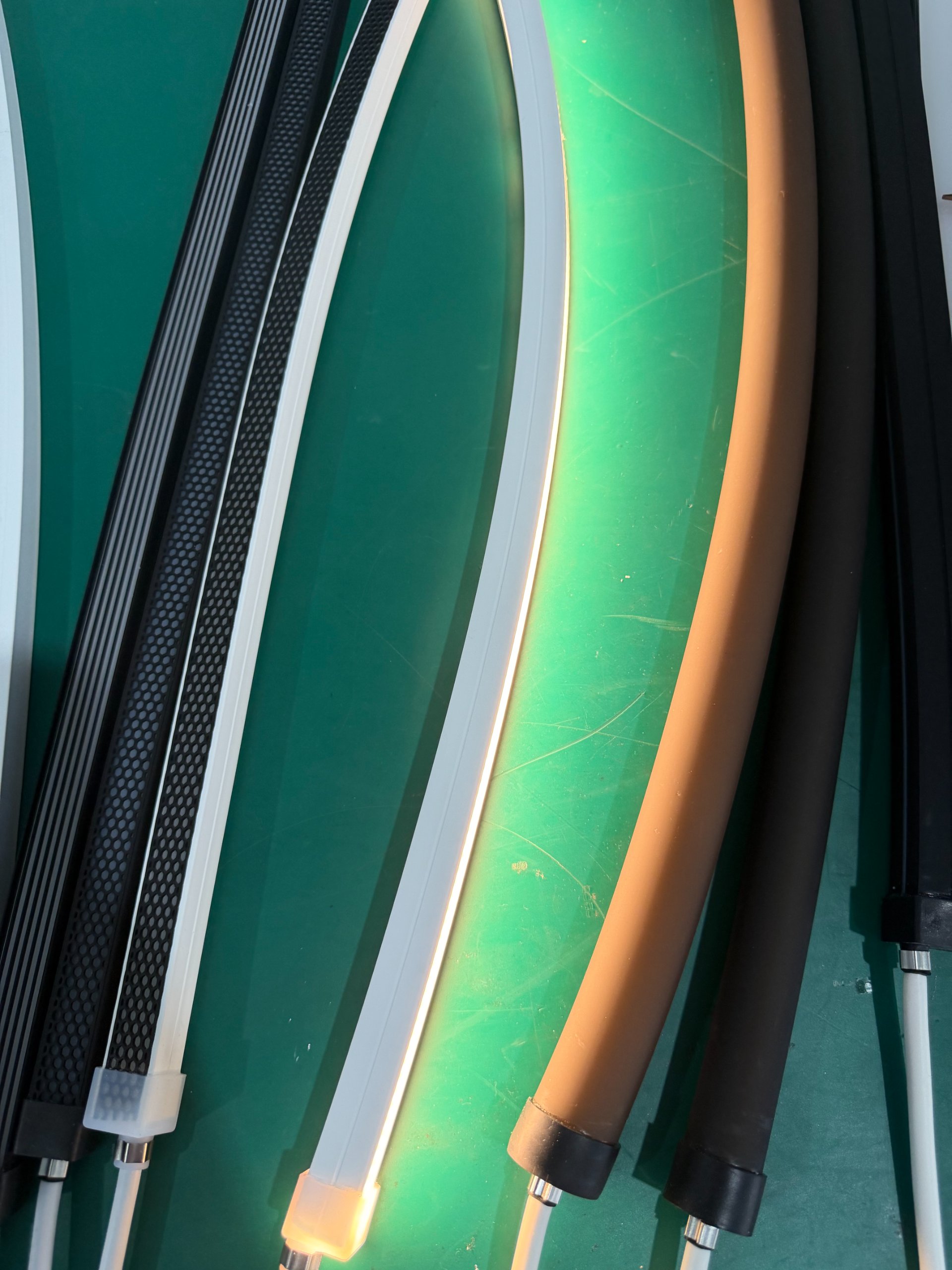
High-quality outdoor LED products, including the silicone LED neon flex and outdoor strip lights we manufacture, use UV-stabilized silicone extrusions specifically formulated to resist yellowing and cracking under prolonged solar exposure. This is a material-level decision made at the design and production stage — it cannot be retrofitted after the fact.
Thermal Management in Outdoor Environments
Indoor environments maintain relatively stable temperatures. Outdoor installations face:
- Wide daily temperature swings — potentially 30°C or more between night and day
- Direct solar heating — a black mounting surface can reach 70°C+ in summer sun
- Freeze-thaw cycling — in colder climates, repeated expansion and contraction stresses solder joints and encapsulant bonds
Indoor LED products are not thermally engineered for these conditions. Solder joint fatigue, delamination of LED chips, and cracking of encapsulants are all documented failure modes when indoor products are installed outdoors.
Construction and Encapsulation Methods
Outdoor LED strip lights and neon flex products use one or more of the following protective constructions:
- IP65 — Sleeve or coating: A clear silicone or polyurethane sleeve covers the LED strip, protecting against directional water jets. End caps are still critical.
- IP67 — Fully encapsulated: The entire assembly is potted in silicone or epoxy. Much more robust against standing water and rain.
- IP68 — Submersible: Heavy-wall silicone extrusions with fully sealed ends, designed for permanent wet or underwater installation.
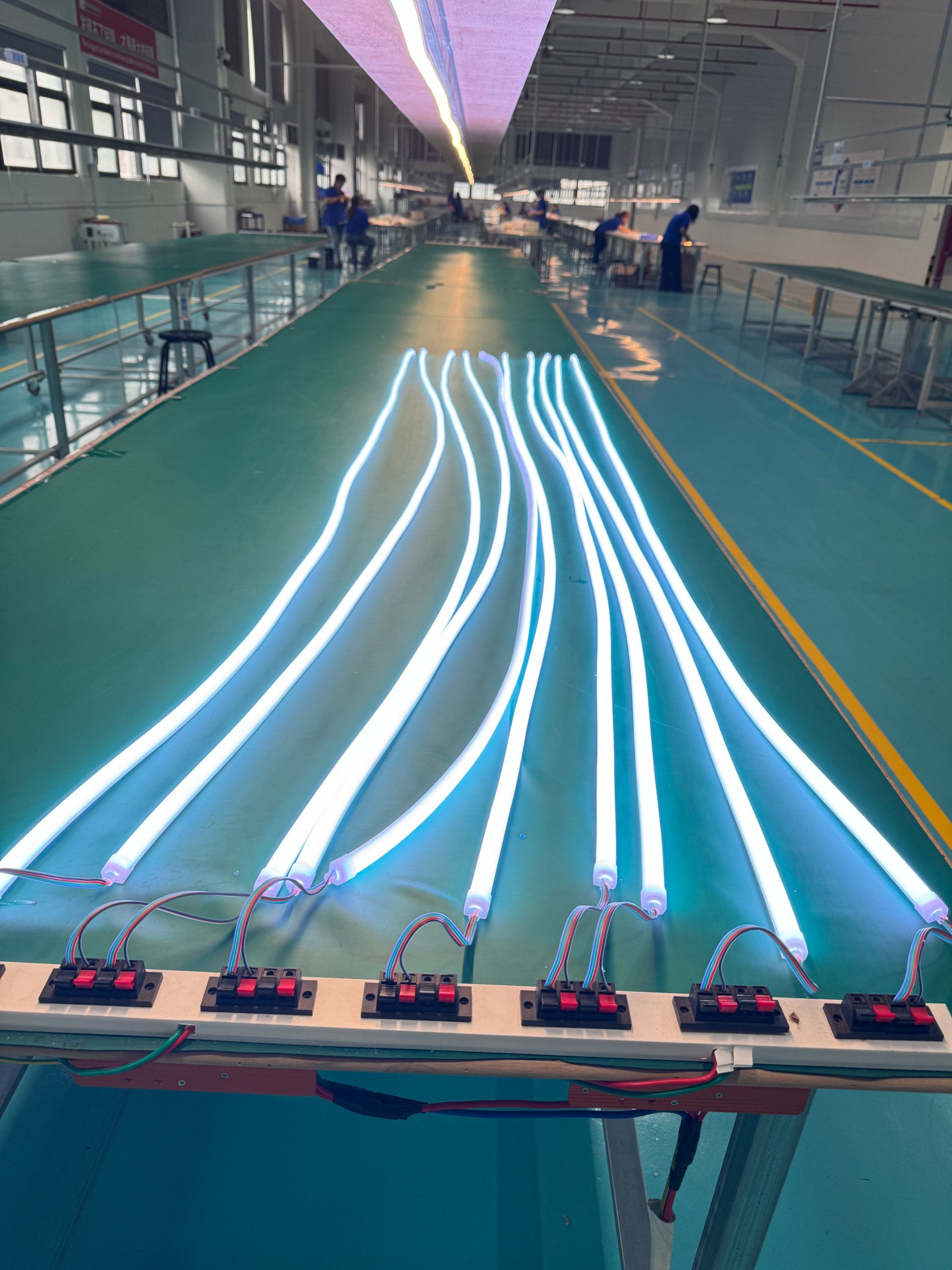
For architectural neon flex products specifically, the silicone extrusion serves double duty: it provides the diffused optical effect and acts as the primary weatherproofing barrier. The material grade, wall thickness, and end-seal design all directly affect long-term outdoor performance.
What Are the Real Risks of Installing Indoor LEDs Outdoors?
The risk isn't just product failure. There are several layers of consequence that procurement professionals should understand before making a substitution decision.
Safety and Electrical Hazards
Water ingress into an unprotected LED driver or strip circuit can cause:
- Short circuits — potentially tripping breakers or damaging connected equipment
- Ground faults — creating shock hazards in publicly accessible areas
- Electrical fires — in worst cases where insulation fails under sustained moisture exposure
For public-facing installations — building facades, signage, retail exteriors, hospitality spaces — the liability implications of using non-rated products are serious. Most jurisdictions require outdoor electrical fittings to meet specific safety standards, and indoor-rated products will not comply.
Certification and Compliance Issues
In markets like the USA and Europe, LED products used in commercial outdoor installations are expected to carry relevant certifications:
- CE (European conformity, covering LVD and EMC)
- UL listing (USA)
- RoHS / REACH compliance for materials
- ETL, SAA, SASO depending on market
An indoor-rated product installed outdoors may be operating outside the conditions of its certification. This can invalidate the product's certified status, create compliance issues during building inspections, and void insurance coverage.
Buyers should always verify that certifications are current, scope-matched to the intended application, and issued by a recognized third-party body. We support certification documentation requests for the markets we supply — but professional evaluation of application-specific compliance requirements is always recommended.
Shortened Service Life and Total Cost of Ownership
This is the financial argument that often lands with procurement teams. Consider a simple comparison:
| Scenario | Product Cost | Expected Life (Outdoor) | Replacement Frequency | Total 5-Year Cost |
|---|---|---|---|---|
| Indoor LED used outdoors | Low | 6–18 months | 3–5× | Very high |
| Outdoor-rated LED (IP65+) | Medium–High | 5+ years | <1× | Low |
Choosing an indoor product to save 20–30% on unit cost, then replacing it twice or three times over a project lifecycle, produces a dramatically worse outcome. For large-scale facade or landscape installations, this calculation becomes even more unfavorable — scaffolding, labor, and downtime costs typically dwarf the material cost difference.
How Should Buyers Specify Outdoor LED Products Correctly?
Specification errors at the procurement stage are the leading cause of outdoor LED failures — not manufacturing defects. Here is a practical framework for getting the specification right.
Define the Environmental Exposure Category First
Before selecting any product, the project team should classify the installation environment:
- Sheltered outdoor — covered walkways, soffits, canopies → IP44–IP54 minimum
- Exposed outdoor, no standing water — building facades, signage, general landscape → IP65 minimum
- Exposed outdoor, wet or washdown areas — near water features, subject to pressure washing → IP67 minimum
- Submersed or permanent water contact — fountains, pool perimeters, underwater → IP68 required
Specify UV Resistance Explicitly
Do not assume IP rating covers UV resistance — it does not. For outdoor installations with direct sun exposure, the product specification should explicitly require:
- UV-stabilized silicone or equivalent UV-resistant outer material
- No yellowing under defined test conditions (reference relevant test standards if required)
Require Outdoor-Rated Drivers and Accessories
The LED strip or neon flex is only one part of the system. The power supply (driver), connectors, junction boxes, and end caps must all carry appropriate outdoor ratings. A perfectly rated IP67 strip connected to an indoor-grade driver installed in a non-weatherproof enclosure defeats the entire protection system.
Verify Certifications Match the Application Market
Request certification documentation from the supplier and verify:
- The certification covers the specific product model being purchased
- The scope includes the intended installation conditions
- The issuing body is recognized in the target market
For export products, different markets require different certifications. Buyers in the USA typically require UL or ETL listing; European buyers require CE marking; Australian buyers require SAA. These are not interchangeable.
Request a Pre-Production Sample Before Large Orders
For large projects, request a physical sample of the specific outdoor product before committing to full production quantities. Verify:
- IP rating marking is clearly present on the product or packaging
- Silicone quality — check flexibility, clarity, and surface finish
- End caps are properly sealed, not simply pressed on
- Connector entry points are sealed or gasketed
Frequently Asked Questions
Can I use IP44 LED strip lights outdoors?
IP44 provides splash protection but not full weatherproofing against rain or outdoor humidity over time. It may be acceptable in covered outdoor locations such as canopies or soffits with minimal direct water exposure. For exposed outdoor applications, IP65 is the practical minimum. Consult the installation environment carefully before specifying IP44 for any outdoor use.
What IP rating do I need for LED neon flex on a building facade?
For standard exposed building facade applications, IP65 is the recommended minimum. This provides dust-tight protection and resistance to low-pressure water jets such as rain. For locations subject to heavy rain exposure, hosing, or installations near water features, IP67 is more appropriate. The exact requirement should be assessed against the specific environmental conditions and local code requirements.
Are silicone LED neon flex products inherently outdoor-rated?
Not automatically. The silicone extrusion provides good UV resistance and flexibility, but the IP rating depends on the full construction — including end seals, connector design, and any internal potting. A silicone neon flex can range from IP65 to IP68 depending on how it is manufactured and sealed. Always verify the stated IP rating and how it is achieved, rather than assuming silicone material alone equals outdoor suitability.
Does using an outdoor LED indoors cause any problems?
Generally, no. Outdoor-rated LEDs can be used indoors without issue. The additional weatherproofing does not impair performance in dry indoor environments. In some cases, the silicone diffuser of outdoor neon flex provides a softer, more even light output that designers actually prefer for indoor applications as well.
How can I tell if an LED strip is indoor or outdoor rated?
Check the IP rating marked on the product, packaging, or datasheet. IP20 indicates no water protection — indoor only. IP65 and above indicates outdoor suitability. Additionally, look for UV-stabilized material specifications for sun-exposed applications. If the IP rating is not clearly stated or documented, treat the product as indoor-rated until the supplier provides written confirmation.
Conclusion
The answer to whether an indoor LED can be used outdoors is a clear no — but the more important question for buyers is how to specify outdoor LED products correctly from the start. Indoor LEDs lack the IP protection, UV resistance, and thermal engineering that outdoor environments demand. Using them outside creates safety risks, compliance failures, and total cost of ownership outcomes that far outweigh any upfront savings.
For procurement teams, distributors, and project buyers sourcing outdoor LED strip lights, neon flex, or related products, the specification stage is where this decision gets made — not on the jobsite. Getting the IP rating, material specification, and certifications right before placing an order is the most cost-effective risk management available.
If you are evaluating outdoor LED neon flex or LED strip products for a commercial, hospitality, or architectural project, contact our team to discuss product specifications, sample requests, and certification documentation for your target market.