

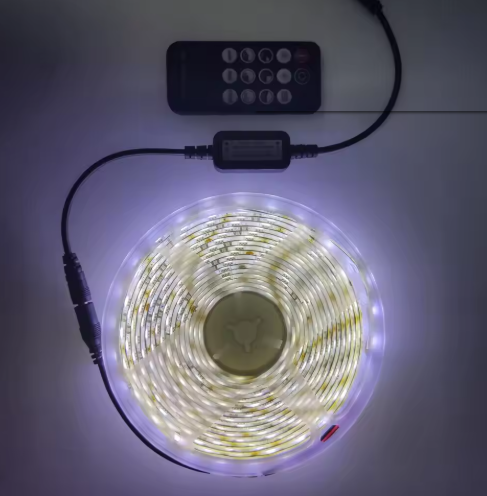
LED strip lights specification sheets look straightforward — a list of technical parameters that tells you what you're buying. But on large commercial and architectural lighting projects, an incomplete or poorly defined specification sheet doesn't just create confusion. It creates a risk chain that can run from design selection all the way through to a contested site acceptance, with everyone holding documents that technically say the same thing.
An LED strip lights specification sheet serves three distinct roles on any serious project: design selection reference, procurement contract basis, and final acceptance standard. When those three roles rely on the same document — and that document hasn't defined its key parameters to an enforceable level — problems rarely surface during procurement. They surface at the most expensive point in the project to fix.

Understanding why specification sheets fail on large projects requires looking past the parameter list itself. The risk isn't usually a wrong number. It's a number that can't be tested, can't be compared fairly between suppliers, and can't be enforced during site acceptance. The sections below break down exactly how that happens — and what to do about it.
Does Having More Parameters Make a Specification Sheet More Complete?
Most procurement and design teams run a quick mental checklist when reviewing a spec sheet: voltage, wattage, CCT, IP rating, CRI, lumens. If all six boxes are ticked, the document gets marked complete and the project moves forward.
This is one of the most common — and most costly — judgment errors in LED lighting procurement. Parameter count does not equal engineering completeness. The real question is whether those parameters allow every stakeholder — designer, procurement manager, installer, and QA inspector — to form exactly the same understanding of the same product.

The reason this error feels reasonable is that standardized parameters are very easy to compare. Two suppliers both quoting 24V / 14.4W/m / 3000K / CRI 90 / IP65 look identical at a glance. But the information that actually determines project outcomes often doesn't appear in that first-glance comparison.
What the Numbers Don't Tell You
Consider two suppliers both quoting 14.4W/m. Neither spec sheet answers:
- Under what test conditions was that power figure measured?
- What is the LED density, and how does it affect visual continuity?
- What is the actual lumen output per meter — and under what conditions?
- What CCT tolerance applies, and from which bin standard?
- What is the PCB width and copper weight?
- What is the maximum continuous run length before voltage drop becomes visible?
- What is the cutting unit, and can project-specific lengths be cut?
- Does IP65 apply to the strip body, the connectors, the end caps, or the installed assembly?
- Does the approved sample represent mass production, or only the sample batch?
When none of those questions have defined answers, two "14.4W/m" products are not necessarily the same engineering product. Treating them as equivalent for procurement comparison is a structural flaw in the process — not a supplier problem.
How Does a Single Undefined Parameter Escalate Into a Project Crisis?
A single vague parameter seems harmless at the RFQ stage. By the time it matters, the project is usually in a position where it's very difficult to fix.
When a critical parameter like CCT is stated without a defined tolerance or bin requirement, every party in the supply chain — designer, procurement, supplier, installer — technically complies with the specification. But the installed result can still fail the design intent. At that point, no document clearly assigns responsibility.

To understand how this plays out, consider a realistic scenario based on the type of large-scale architectural project where these failures are most common.
The Typical Risk Chain
A commercial development specifies linear LED strip lighting for a building facade. The design requirement states:
3000K LED strip, continuous linear effect, architectural facade application.
The specification sheet entry reads: CCT: 3000K.
Here is what happens next:
- Design: The lighting designer completes drawings based on 3000K.
- Procurement: Multiple suppliers are approached. All quote 3000K.
- Sample approval: The submitted sample looks correct under office viewing conditions. It is approved.
- Mass production: Orders are placed across multiple production batches.
- Installation: Product is installed across multiple facade zones.
- Site review: The design team visits at night. Visible color variation exists between facade sections.
Now the dispute begins.
The designer says: "We specified 3000K." The supplier says: "The product is 3000K." Procurement says: "The spec sheet says 3000K." The contractor says: "We installed what we received."
No one has technically violated the specification. Because the specification never defined what range of color temperature constitutes a pass or fail. It never referenced a bin standard. It never specified batch-to-batch consistency requirements. It never defined how visual color uniformity would be judged at site acceptance.
The real failure happened at the earliest stage of the project — not during manufacturing or installation.
What Are the Eight Most Dangerous Gaps in LED Strip Specification Sheets?
Most specification failures on large projects fall into a small number of predictable categories. Recognizing these gaps before issuing an RFQ or signing a purchase order is far more effective than trying to resolve them after installation.
The eight most common specification vulnerabilities are: missing tolerances on key parameters, undefined test conditions, incomplete IP rating scope, undefined cutting units, vague LED density data, absent PCB specifications, unlocked document versions, and no defined non-conformance process.
Gap 1: Parameters Without Tolerances
A specification that reads 24V / 3000K / 14.4W/m without any tolerance ranges creates an implicit assumption that each number is exact. In practice, every manufacturer works within a range. Without defined tolerances, fair supplier comparison is impossible, and acceptance criteria cannot be enforced.
Best practice: Define every critical parameter as one of the following — Nominal, Minimum, Maximum, Typical, or Guaranteed. These terms must not be used interchangeably.
Gap 2: Performance Data Without Test Conditions
A lumen figure like 1,200 lm/m means different things depending on:
- Whether it was measured on a bare strip or inside an aluminum profile
- Ambient temperature at time of test (25°C is standard, but not always used)
- Which CCT the measurement applies to
- Integration sphere method and calibration standard
- Whether the figure represents a new product or stabilized output
When suppliers use different test conditions, their data cannot be directly compared. Procurement decisions based on those comparisons are unreliable.
Gap 3: IP Rating Without System Scope
Stating IP67 or IP68 on a specification sheet usually refers to the strip body under defined test conditions. It rarely addresses:
| Component | Often Covered? | Often Excluded? |
|---|---|---|
| Strip body | ✓ | |
| End caps | Sometimes | Often |
| Connectors | Sometimes | Often |
| Cable entry points | Rarely | Usually |
| Installed assembly | No | Yes |
Projects with outdoor or wet-area applications must separate product IP rating from installed system protection class. These are not the same requirement.
Gap 4: "Cuttable" Without a Cutting Unit
A specification that lists Cuttable as a feature without specifying the cutting unit creates real installation problems. If a project requires 1,830mm segments and the product cuts in 50mm increments with connection pads at fixed intervals, field adjustments will affect joint placement, termination details, and visible uniformity.
"Cuttable" is not a complete technical parameter. The cutting unit must be stated explicitly.
Gap 5: LED Density Without Visual Context
120 LEDs/m appears to be a clear specification. But without knowing:
- The LED package type and size
- Whether the count is per metre of the finished product or of a repeating unit
- Whether the density is sufficient for the intended viewing distance and profile type
...the figure doesn't actually answer the question that matters for the project: will this product produce a visually continuous light line at the specified installation distance?
Gap 6: No PCB Specification
The PCB is one of the most frequently substituted components in LED strip manufacturing. Width, copper weight, substrate material, and layer configuration all affect:
- Thermal management and long-term LED performance
- Mechanical flexibility and minimum bend radius
- Electrical resistance across long runs
- Dimensional fit within specified aluminum profiles
If the PCB is not a controlled parameter in the specification, a supplier can change it between sample approval and mass production without technically violating any stated requirement.
Gap 7: No Document Version Lock
Purchase orders that reference "latest datasheet" or "current specification" are contractually unstable. Suppliers update product specifications. Component substitutions happen. A document reference that isn't tied to a specific revision number and date allows the underlying product to change without triggering a formal review.
All procurement documents should reference: Product Code + Specification Revision + Revision Date.
Gap 8: No Non-Conformance Procedure
A specification sheet describes what the product should be. Without a defined non-conformance process, there is no agreed mechanism for handling product that doesn't meet the stated requirements. Projects should define:
- Isolation procedure for suspect batches
- Expanded inspection triggers
- Retest protocols
- Batch acceptance/rejection criteria
- Replacement and reapproval process
A specification without an enforcement mechanism is incomplete by definition.
How Should a Project Team Structure a Specification Sheet That Actually Controls Risk?
Turning a supplier data sheet into a project-controlled specification requires a different starting point. The question isn't "what does the supplier offer?" — it's "what does the project require, and how will we verify it?"
An effective project-level LED strip specification starts with application requirements, not product parameters. Once the installation conditions, visual objectives, and acceptance criteria are defined, the relevant technical parameters follow naturally — and can be stated in verifiable, enforceable terms.

Step 1: Define the Application Before the Product
Before writing a single technical parameter, the project team should document:
- Installation location and orientation (facade, cove, channel, profile)
- Indoor or outdoor, and applicable environmental conditions
- Straight run or curved installation, and minimum bend radius
- Whether visual continuity is required across multiple segments
- Viewing distance and angle
- Profile type and dimensions
- Maximum continuous run length per circuit
- Power supply configuration
- Operating environment temperature range
This step prevents the most common procurement mistake: selecting a product first, then trying to make the project fit the product.
Step 2: Convert Parameters Into Verifiable Requirements
Every critical parameter should be restated in terms that can be tested and accepted or rejected.
| Vague Parameter | Verifiable Requirement |
|---|---|
| 24V | Nominal 24V DC; operating range and driver compatibility defined |
| 3000K | Nominal 3000K; tolerance/bin requirement stated; visual acceptance criteria defined |
| 14.4W/m | Nominal power; test conditions stated; allowable deviation defined |
| IP67 | Strip body rating; connector and termination requirements stated separately |
| CRI ≥90 | Minimum Ra value; R9 value requirement where applicable |
| 1,200 lm/m | Test conditions stated; measurement method defined; typical vs. guaranteed distinguished |
Step 3: Distinguish Typical Values From Guaranteed Values
This distinction matters most when a parameter appears in a purchase order or acceptance protocol. A supplier who treats a power figure as typical and a buyer who treats the same figure as guaranteed will have a genuine contractual dispute when measurements show variation.
Every parameter that will be used for acceptance testing must be clearly designated as Minimum, Maximum, Nominal, or Guaranteed. Typical values can be included for reference but should be clearly labeled as non-binding.
Step 4: Align Sample Approval With Mass Production
Sample approval is only meaningful if the approved sample actually represents the mass production product. This requires:
- Confirmation that the sample uses the same LED specification, PCB, encapsulation, and manufacturing process as mass production
- A formal statement that mass production will not commence before representative sample approval
- Documentation that ties the approved sample to a specific product code and revision
Without this alignment, sample approval becomes a formality rather than a quality gate.
Step 5: Define Acceptance Criteria Before Procurement, Not After Installation
Site acceptance criteria should be written into the project specification before the first RFQ is issued. At minimum, this should cover:
- Dimensional tolerances
- Electrical parameter verification method
- CCT and visual uniformity assessment method
- Minimum lumen output verification
- IP protection verification scope
- Batch-to-batch consistency requirements
When acceptance criteria are defined after installation, they are almost always defined under pressure — and will be disputed by at least one party.
Frequently Asked Questions
What is the difference between a supplier spec sheet and a project specification for LED strip lights?
A supplier spec sheet describes what a product typically is. A project specification defines what the project requires, how it will be tested, and what constitutes acceptance. On large projects, procurement should be based on a project-controlled specification — not directly on a supplier data sheet.
Why does CCT tolerance matter so much for architectural LED strip projects?
LED chips are manufactured across a range of color temperatures. Without a defined tolerance or bin requirement, two batches of "3000K" product can produce visually different results when installed side by side. On large architectural facades, this variation is clearly visible at night and very difficult to correct after installation.
How do I verify that an approved sample represents the mass production product?
Ask the supplier to confirm in writing that the sample uses the same LED specification, PCB construction, encapsulation material, and production line as mass production. Lock the approval to a specific product code and revision. Any material change to these components should require re-approval before production continues.
What does "IP67" actually cover on an LED strip installation?
IP67 typically refers to the strip body tested under specific laboratory conditions. It generally does not cover connectors, end caps, cable entry points, or the assembled system in its installed state. For outdoor or wet-area projects, the IP protection scope of the full installation should be defined separately from the strip body rating.
When should a project team reject a supplier's standard specification sheet?
When the standard spec sheet cannot answer these questions: What tolerance applies to each critical parameter? Under what test conditions were performance figures measured? Does the approved sample represent mass production? What is the defined acceptance procedure? If a supplier's data sheet cannot answer these questions, it should be supplemented with a project-specific technical requirement document before procurement proceeds.
Conclusion
LED strip lights specification sheets are not just product data summaries. On serious commercial and architectural projects, they function simultaneously as design selection references, procurement contract documents, and site acceptance standards. When a specification sheet cannot define its parameters to a testable, verifiable, enforceable level, that gap doesn't usually appear during procurement — it appears during installation, or worse, during acceptance.
The most expensive specification failures are not caused by wrong numbers. They are caused by numbers that look complete but cannot answer the question that matters: what exactly does "compliant" mean on this project?
The ten questions at the end of this article — covering tolerances, test conditions, sample alignment, version control, and non-conformance responsibility — are a practical starting point for evaluating any specification before a purchase order is issued.
If you are evaluating LED strip products for a large project and need technical data presented in a format that supports engineering review, we are glad to work through the specification requirements with you. Contact our technical team to discuss your project parameters, request samples, or review how our product documentation supports your procurement and QA process.