

Most people think buying RGB LED strips is about picking colors. They look at spec sheets, compare brightness, check the price, and move on. But here's what I've learned after years of dealing with failed projects: the real disasters never happen during installation. They happen six months later.
If you're sourcing RGB LED strips for commercial projects, the most critical factor isn't how many colors they can produce. It's whether the thermal management, voltage distribution, material system, and dynamic load stability are designed for long-term engineering operation—not just lab demonstrations.
I've seen too many projects look perfect during testing and turn into maintenance nightmares within the first year. Let me walk you through what actually separates professional-grade RGB systems from products that just "look good on paper."
Why Do RGB Projects Fail After Passing All Tests?
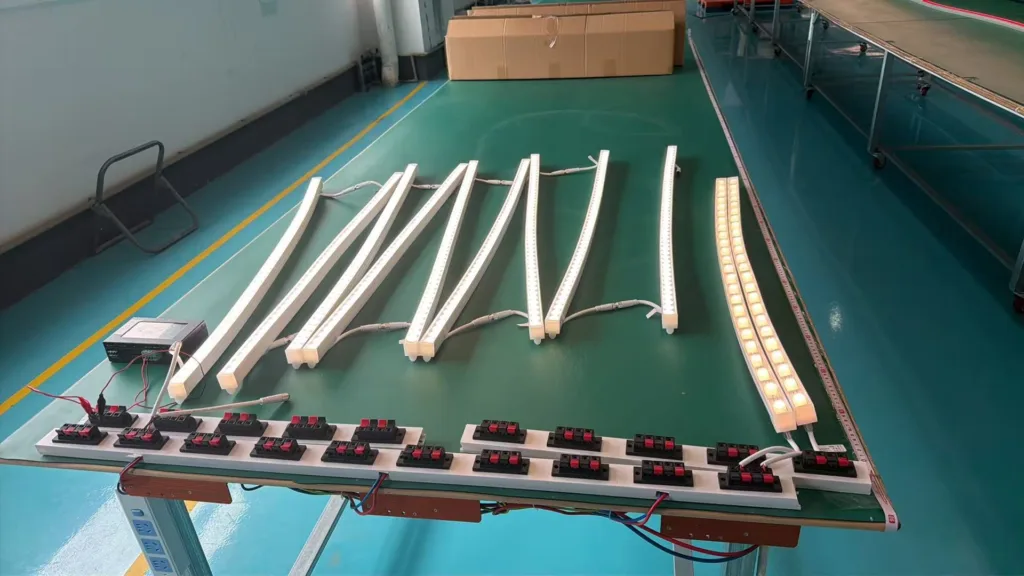
The sample testing phase is where most RGB projects set themselves up for failure. In the lab, everything works beautifully. You test 5 meters. The dynamic chase effects run smoothly. The control system is stable. White balance looks perfect. RGB transitions are flawless.
Then you install 40 meters across an entire building facade. Night-time synchronized operation begins. The system runs continuously in high-temperature environments with constant dynamic color changes.
Three months later, problems start appearing. The tail end shows blue shifting to purple. Red channel brightness drops significantly. Dark spots emerge at corners. Control synchronization starts flickering randomly.
Most people immediately blame the controller. But the real problem lies deeper—in the electrical and thermal physics that short lab tests never reveal. RGB dynamic operation creates dramatically different conditions than static white light. When colors switch, one channel suddenly hits full load. Local current spikes. Tail-end voltage drop amplifies. Copper foil accumulates heat stress.
Low-cost strips make this worse because they use insufficient copper thickness. Circuit traces are too narrow. Under dynamic scenarios, long-term thermal fatigue builds up. The strip doesn't suddenly fail. Instead, colors slowly start drifting—and this is exactly what short-term testing cannot catch.
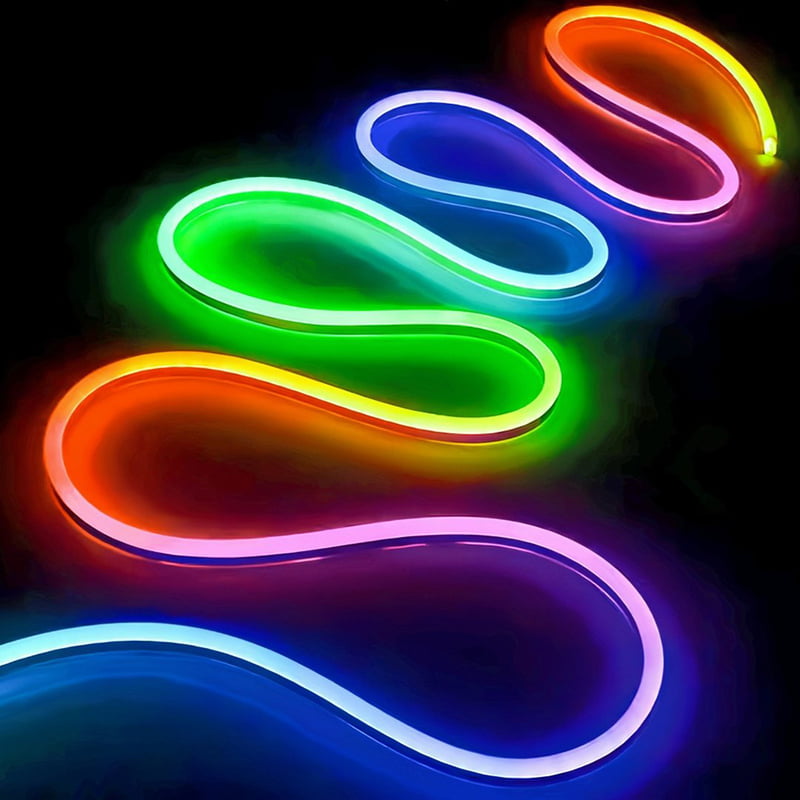
Another common scenario: outdoor RGB Neon installations. At first, colors are pure, diffusion is uniform, and the surface is crystal clear. Six months later, the entire strip starts yellowing. Blue becomes muddy. White shifts green. The LEDs aren't dying. The problem is material system incompatibility with UV exposure.
Many so-called "anti-yellowing silicone" products only pass short-term lab UV tests. Real outdoor environments involve simultaneous exposure to UV radiation, thermal cycling, acid rain, ozone, salt spray, and humid heat. Materials that survive 500 hours in the lab can degrade completely within 4-6 months outdoors.
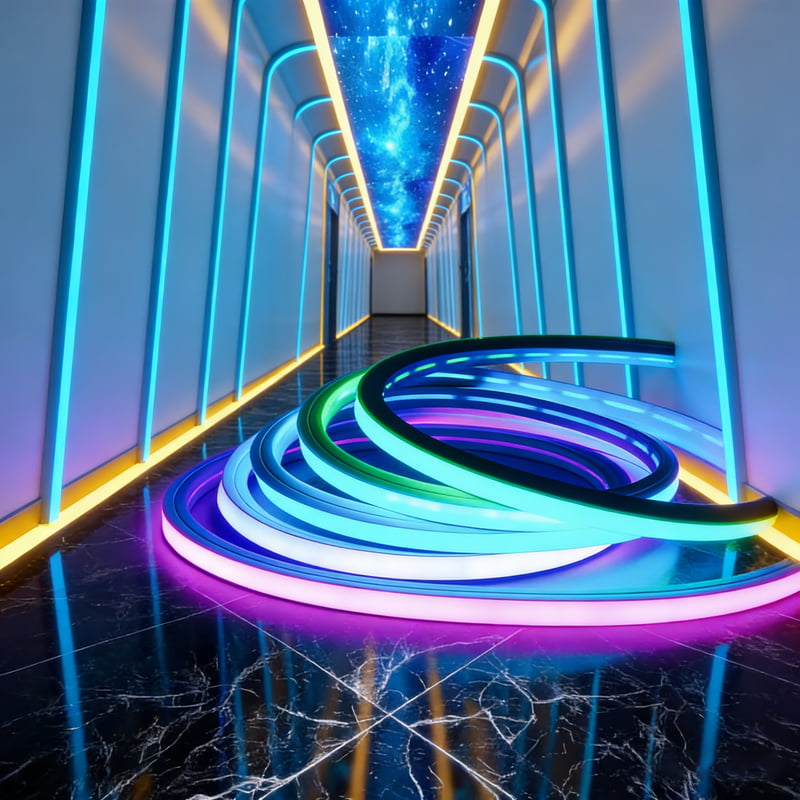
RGB projects are especially sensitive to color purity. When the transparent layer yellows slightly, blue distorts first. Then the entire color gamut shifts. The building's night lighting starts looking "dirty"—and this is most noticeable when fully illuminated at night, making it unacceptable for chain brands, commercial complexes, and landmark buildings.
What Technical Factors Actually Determine RGB Strip Longevity?
Professional RGB LED strip solutions never sell "more colors." They focus on maintaining color consistency for 3-5 years. This requires controlling several critical technical factors that most buyers overlook.
Critical Factor 1: LED Binning Control
Many buyers only lock color temperature specifications. But RGB projects require locking wavelength consistency, brightness bins, forward voltage curves, and same-batch packaging. RGB color mixing is extremely sensitive. Even slight wavelength shifts between different batches create visible color bands, layering, and localized color shifts across building facades—problems that are nearly impossible to fix after installation.
Critical Factor 2: Power Distribution Logic for Long Runs
Many project failures aren't caused by the LED strips themselves. They happen because someone applied single-color strip power logic directly to RGB installations. Under dynamic scenarios, RGB instantaneous load fluctuation far exceeds single-color systems.
Professional solutions implement dual-end power injection, segmented power feeds, 20-30% power supply redundancy, reduced single-circuit length, controlled tail-end voltage drop, and separated control and main power circuits. Without these measures, color drift is inevitable—it's just a matter of time.
| Power Design Element | Why It Matters for RGB | Failure Symptom |
|---|---|---|
| Dual-End Injection | Reduces voltage drop across full length | Tail-end color shift |
| Segmented Feeding | Prevents overload at connection points | Hot spots, local failures |
| 20-30% Redundancy | Handles peak dynamic loads | System instability |
| Shorter Circuit Length | Minimizes cumulative resistance | Uneven brightness |
| Separated Control Circuit | Prevents interference | Random flickering |
Critical Factor 3: Mechanical Stress in Flexible RGB Neon
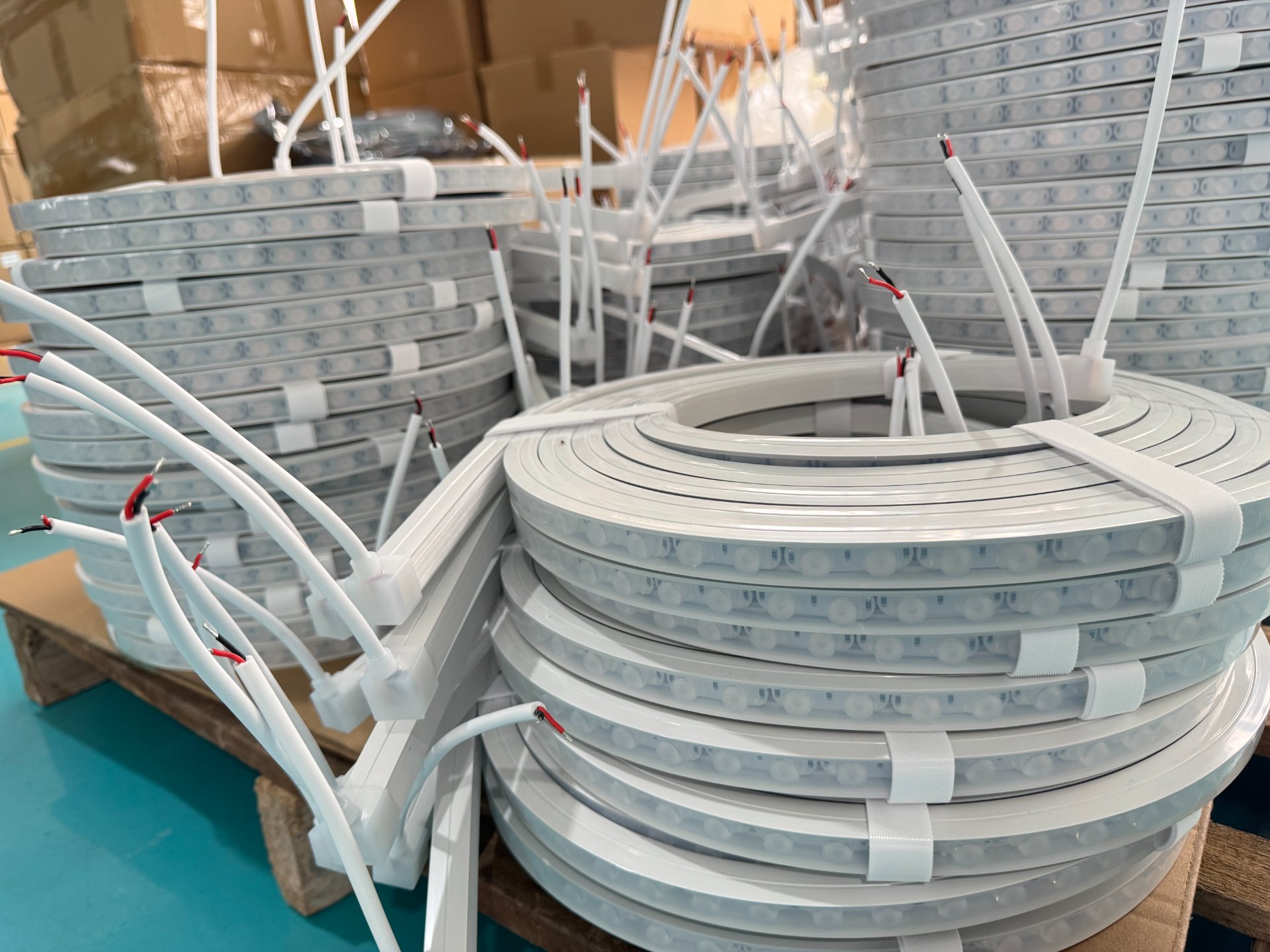
Many ultra-flexible silicone Neon products bend easily during installation. But under long-term outdoor conditions—self-weight sagging, thermal expansion and contraction, continuous stress at corners—the FPC copper board develops microcracks. LED chips experience cold solder joints. Dynamic colors display abnormalities.
Engineering-grade products control minimum bend radius, silicone Shore A hardness, copper foil ductility, and internal stress release structures. The real danger isn't installation difficulty. It's gradual failure six months after installation.
Critical Factor 4: Waterproofing Under Thermal Cycling
Many RGB strips claim IP67 or IP68 ratings. But the real question is whether they maintain sealing integrity after months of thermal expansion and contraction. Many potting structures pass initial waterproofing tests but fail after temperature cycling—potting compound shrinks, end caps develop microcracks, wire entry points leak, internal condensation forms.
The result isn't complete failure. It's localized oxidation, color abnormalities, and random flickering—the hardest problems to diagnose and fix because the system becomes "increasingly unstable" rather than simply "broken."
How Do Voltage Drop and Thermal Management Actually Work in RGB Systems?
Understanding the physics behind RGB strip performance requires examining the relationship between dynamic load patterns and thermal stress accumulation. Unlike single-color LEDs operating at steady state, RGB systems experience constant current fluctuation.
When displaying pure red, only red chips draw power. Switch to blue, and the load shifts entirely to blue channels. This creates several cascading problems. First, localized heat generation concentrates at active chips. Second, sudden current changes create voltage transients. Third, inadequate copper thickness in the FPC causes resistive heating at connection points.
Professional designs address this through several methods. They use thicker copper (2oz or higher) to reduce resistive losses. They implement thermal break zones to prevent heat accumulation. They specify LED spacing that allows adequate air circulation. They calculate maximum continuous operation temperature and design cooling accordingly.
The math is straightforward but often ignored. A 5-meter RGB strip running full white draws approximately 60 watts. That same strip displaying only red drops to roughly 20 watts. This 3x load variation creates proportional thermal stress on power traces and solder joints. Over thousands of color cycles, mechanical fatigue accumulates until connections fail.
Testing protocols matter enormously here. A 100-hour continuous white test reveals nothing about dynamic operation durability. Professional validation requires cycling through full color spectrum for 1000+ hours while monitoring temperature at 50+ points across the strip length and measuring voltage drop at various load conditions.
Why Does Material Selection Determine Outdoor RGB Performance?
The silicone and encapsulation materials used in RGB LED strips face far more complex environmental challenges than indoor applications. UV exposure is just one factor. Outdoor installations encounter temperature swings from -20°C to +60°C, moisture cycling between 30% and 95% humidity, ozone exposure, and chemical contamination from vehicle exhaust or industrial emissions.
Standard silicone compounds use platinum-cure or tin-cure systems. Platinum-cure offers superior UV resistance but costs more. Tin-cure degrades faster but processes easier. The critical difference emerges after 6-12 months of real-world exposure. Platinum-cure maintains transparency while tin-cure yellows progressively.
But UV resistance isn't the only concern. Silicone must also maintain dimensional stability through thermal cycling. Cheap formulations exhibit high coefficient of thermal expansion—they expand and contract significantly with temperature changes. This creates mechanical stress at the silicone-to-PCB interface, eventually causing delamination and moisture ingress.
Professional specifications include several additional parameters. Shore A hardness must balance flexibility with structural support. Tear strength determines resistance to installation damage. Elongation at break indicates ability to handle thermal stress without cracking. Dielectric strength prevents electrical breakdown in wet conditions.
The interaction between silicone and LED phosphor coatings adds another layer of complexity. Some silicone formulations contain trace amounts of sulfur compounds that react with silver-based LED contacts, causing gradual degradation. This manifests as progressive color shift rather than sudden failure—exactly the symptom many outdoor RGB installations experience after 6-18 months.
What Control System Factors Actually Matter for RGB Stability?
The control system deserves separate analysis because it creates problems independent of LED strip quality. DMX512, SPI, and proprietary protocols each have specific failure modes that appear only under long-duration operation.
DMX512 uses differential signaling over twisted pair cable. Signal integrity depends on proper termination, cable quality, and avoidance of electrical interference. Many installations skip termination resistors or use undersized cables, creating signal reflections that cause intermittent data corruption. The symptoms—random flickering, dropped frames, or color glitches—only appear after the system runs continuously for days or weeks.
SPI protocols face different challenges. They use higher data rates but offer no error correction. A single corrupted bit can shift the entire color data stream, causing all downstream LEDs to display wrong colors until the next frame reset. Long cable runs pick up electromagnetic interference from power lines, motors, or radio transmitters. Without proper shielding and grounding, this becomes a chronic reliability issue.
The power supply and control system interaction creates additional complications. Many RGB controllers share a common ground with the LED power supply. Ground loops form when multiple power supplies connect to a single controller. Current flows through unexpected paths, causing voltage offsets that shift colors or create flickering. Professional installations use optically isolated controllers and star-grounded power distribution to prevent these issues.
Controller firmware quality varies enormously between manufacturers. Cheap controllers use simple lookup tables for color mixing, causing visible steps in gradients. They lack temperature compensation, so colors shift as components heat up. They don't implement proper PWM dithering, creating visible flicker at low brightness levels. These problems only become apparent during extended operation across varying environmental conditions.
How Should You Actually Specify RGB LED Strips for Commercial Projects?
Based on everything we've covered, here's how I approach RGB LED strip specifications for projects where failure isn't an option. These requirements go far beyond typical datasheets.
First, demand complete wavelength specifications for all three RGB channels. Not just "red," but "620nm ±5nm with 90% population within ±3nm." Request actual binning data from the manufacturer. Verify they can supply the same bin for future orders—because color matching replacement sections is nearly impossible otherwise.
Second, specify copper weight and trace width explicitly. Minimum 2oz copper for any run over 3 meters. Calculate voltage drop across your specific installation length and require the manufacturer to guarantee it stays within 3% under dynamic full-load conditions. Get this in writing with test data.
Third, define environmental exposure and require matching material specifications. If installing outdoors in direct sunlight, specify platinum-cure silicone with documented UV resistance exceeding 5000 hours accelerated testing. If installing in humid environments, require materials with water vapor transmission rate below 50g/m²/day. If temperature varies more than 40°C, verify coefficient of thermal expansion matches FPC substrate.
Fourth, establish control system architecture before ordering strips. Specify DMX512 with proper termination, SPI with error detection, or whatever protocol matches your installation requirements. Verify controller output drive capacity exceeds total strip load by at least 30%. Design power distribution with redundancy so no single failure takes down the entire system.
| Specification Category | Critical Parameters | Verification Method |
|---|---|---|
| LED Binning | Wavelength ±3nm, VF ±0.1V | Spectrophotometer test |
| Electrical Design | 2oz copper, <3% voltage drop | Full-load dynamic test |
| Material System | Platinum-cure silicone, UV >5000h | Accelerated aging test |
| Mechanical Integrity | Shore A 60-70, tear strength >25 N/mm | ASTM D624 testing |
| Thermal Performance | Junction temp <85°C full load | Thermal imaging verification |
| Control Compatibility | DMX512/SPI with ESD protection | Protocol analyzer check |
Fifth, require sample validation that actually tests failure modes. Don't just run the strip for 100 hours at full white. Cycle through full spectrum every 30 seconds for 1000 hours. Monitor temperature at multiple points. Measure color consistency at start and end. Test mechanical flexibility after 500 thermal cycles from -20°C to +60°C. Apply voltage at upper specification limit while varying ambient temperature. These tests reveal weaknesses that normal validation misses.
Finally, establish clear acceptance criteria for production batches. Color consistency within specified wavelength range. Voltage drop verified across full length. Visual inspection for manufacturing defects. Sample testing from each batch, not just first article. This ensures your 50th meter performs identically to your 1st meter—critical for large commercial installations where visible differences are unacceptable.
Conclusion
RGB LED strip selection isn't about finding the brightest colors or the lowest price. It's about understanding the physics of long-term reliability and specifying components that maintain performance through years of real-world operation. The difference between success and failure lies in details most buyers never consider—until they're facing an expensive retrofit six months after installation.