
You search "best LED light supplier" on Google. You see hundreds of results. Everyone claims they are the best. They promise low prices, fast delivery, and full certifications.
But here is the truth: The real best supplier is not the one who sells you lights. It is the one who prevents your project from collapsing in two years.
I run a silicone neon flex manufacturing facility in Shenzhen. I have watched many projects fail. Not because the lights broke on day one. But because the system started to "fall apart slowly" after 12 months. Different suppliers used different materials. The lights aged at different speeds. The building looked like it was cut into sections with different brightness and color.
Why Do Most People Search for the Wrong Thing?
When you type "best LED light supplier" into a search box, you are probably looking for three things: lower price, faster shipping, more certifications.
But if you have managed a commercial lighting project before, you know these three things are not the core issue. The core issue is: Can this supplier control the risk of system-wide failure?
I once worked on a mixed-use complex project. We used three different LED suppliers. One for linear lights. One for neon flex strips. One for outdoor wall washers. All samples passed tests. Light output was good. IP rating was correct. Color temperature matched. Structure looked fine.
The project was delivered on time. Then problems started to show up between month 3 and month 8. Brightness dropped at different rates in different zones. The building facade developed "color temperature bands." Some neon flex corners started to dim. Outdoor fixtures showed slight condensation inside. Drivers began to flicker in high-temperature areas.
By month 12, the system was visually broken. The building owner was angry. We had to replace parts. But replacing parts did not fix the root cause. Because the root cause was not a single failure. It was three different material systems aging in three different ways inside the same physical environment.
What Is the Real Core Capability of a Best LED Light Supplier?
Let me break this down. The best supplier is not someone who makes a good product. The best supplier is someone who can control "unified system degradation."
This means: All the lights in your project age together, at the same speed, following the same failure curve.
When lights fail at different rates, your building starts to look like a patchwork. You cannot fix it by replacing one light. You have to redesign the entire system. This is expensive. This is time-consuming. This destroys your brand image.
So the question you should ask a supplier is not "Do you have CE certification?" The question you should ask is: "If this project fails in five years, how will it fail? Can you predict the failure mode? Can you prevent it?"
How Does a Good Supplier Control Unified System Degradation?
A good supplier must unify four core systems. If any one of these systems is not unified, your project will fail.
Can the Supplier Unify the Material System?
The most common outdoor lighting failure is not a sudden break. It is different materials aging at different speeds.
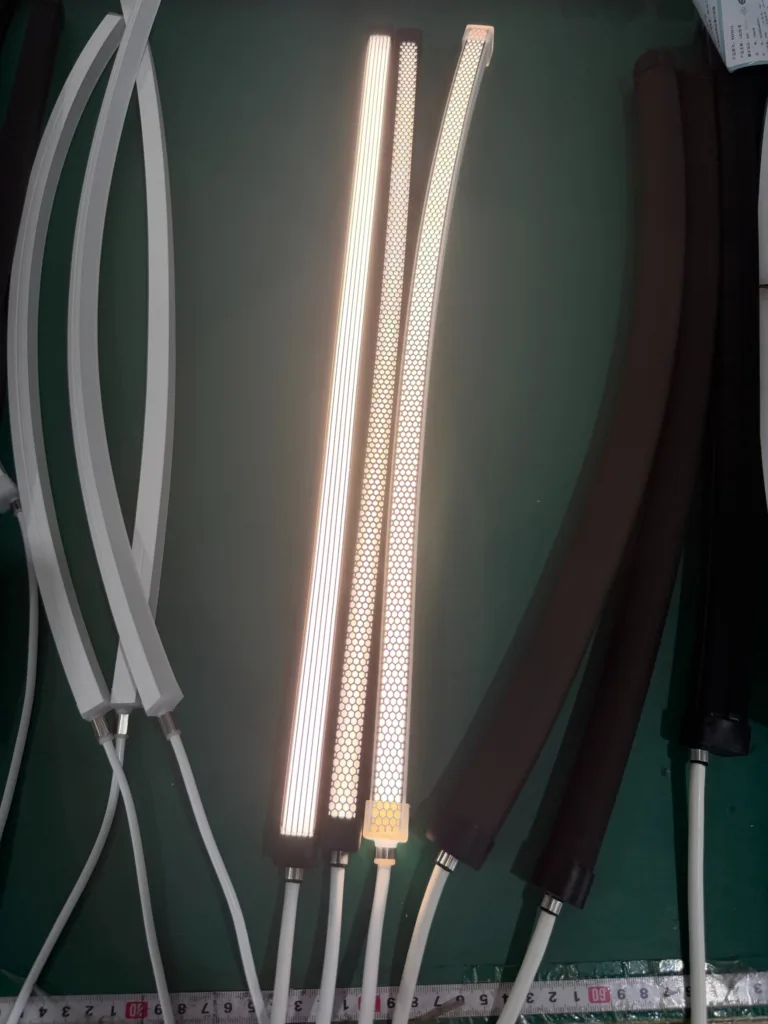
You need a supplier who uses a unified material platform. This means the silicone compression set curves must match. The aluminum thermal expansion rates must match. The adhesive long-term migration behavior must match. The PCB and encapsulation materials must have the same thermal response.
In our factory, we only use food-grade, high-molecular silicone extrusion. We test compression set at 150°C for 72 hours. We test UV exposure for 1000 hours. We test salt spray resistance for 500 hours. We do this because we want to make sure all our products age at the same rate. When you install our linear lights and our neon flex strips on the same building, they will not create a "material boundary" after two years.
I have seen projects where one supplier used soft silicone (Shore A 50) and another used hard silicone (Shore A 70). After 18 months, the soft silicone deformed under UV and heat. The hard silicone cracked under thermal stress. The building looked terrible. No one could fix it without replacing everything.
Can the Supplier Unify Optical Consistency?
A building is not a collection of individual lights. A building is a unified visual system.
You need a supplier who controls LED binning across batches. You need MacAdam step consistency within 3 steps. You need driver output stability under real-world voltage fluctuations. You need voltage drop compensation logic for different cable lengths.
In our production line, we lock LED bins for each project. We do not mix batches. We do not swap suppliers mid-project. We test every driver under 90V to 305V input range. We measure light output at 5m, 10m, and 20m cable runs. We do this because we know that small optical differences become huge visual problems when you scale to a 5000-square-meter facade.
I once audited a failed project in Dubai. The contractor used three different neon flex suppliers. All claimed "3000K warm white." But when we measured them with a spectrometer, one was 2900K, one was 3050K, and one was 3200K. Under daylight, you could not see the difference. But at night, the building looked like it had three different light zones. The owner refused to pay. The contractor lost money.
Can the Supplier Unify the Thermal Path?
Suppliers love to talk about "low power consumption" and "high efficiency." But they rarely talk about the most important thing: thermal path design.
Heat does not care about your datasheet. Heat follows the real installation structure. If your supplier designs a fixture assuming free airflow, but you install it in a recessed channel with no ventilation, the fixture will fail. Not because the fixture is bad. But because the thermal path was never designed for your real environment.
In our factory, we do not just test fixtures in a lab. We test them in mock installation structures. We mount them in aluminum channels. We seal them in tight spaces. We measure junction temperature rise under 40°C ambient. We measure driver case temperature under 60°C ambient. We simulate real-world thermal stress.
I have seen projects where the same fixture performed perfectly in a lab but failed in the field. Why? Because the lab test assumed 25°C ambient with natural convection. But the real installation was in a sealed channel under a roof, with 50°C ambient and zero airflow. The driver overheated. The LED light output dropped by 30%. The project failed.
Can the Supplier Unify Structural Stress Distribution?
This is the most overlooked failure mode. Lights do not just fail electrically. They fail mechanically.
Every material expands and contracts with temperature. Every structure has wind load and vibration. Every installation has human error and tolerance stack-up. If your supplier does not design for long-term mechanical fatigue, your lights will break. Not in one year. But in three years.
In our factory, we design flexibility into every connection point. Our neon flex can bend 180 degrees without stress concentration. Our mounting clips allow 2mm thermal expansion without cracking. Our waterproof connectors have strain relief for cable movement. We test cyclic loading from -40°C to +60°C for 500 cycles. We do this because we want to make sure our products release stress slowly, not catastrophically.
I once saw a project where silicone neon flex strips were installed with rigid metal clips. The installer did not leave any thermal expansion gap. After six months, the clips started to crack the silicone. Water entered. The LEDs shorted. The entire system had to be replaced. The supplier blamed the installer. The installer blamed the supplier. But the real problem was: no one designed the system to handle thermal stress.
How Can You Identify a Supplier Who Can Do All of This?
Here is a simple test. Ask your supplier these four questions:
- "If I install your linear lights and your neon flex on the same building, will they have the same color temperature in three years?"
- "If I install your fixtures in a sealed aluminum channel with 50°C ambient, what will be the junction temperature?"
- "If I connect 20 meters of your neon flex to one driver, what will be the voltage drop at the far end?"
- "If I install your fixtures in a coastal environment with salt spray, what will be the silicone compression set after two years?"
If the supplier can answer these questions with specific numbers and test reports, you have found a good supplier. If the supplier says "our products are very reliable" or "we have CE certification," you have not.
What Do We Do Differently at Shenzhen Alister Technology Limited?
We do not just sell LED lights. We design unified lighting systems.
When you work with us, we give you a complete material traceability report. We tell you the exact silicone Shore A hardness. We tell you the aluminum alloy thermal expansion coefficient. We tell you the LED binning code. We tell you the driver thermal derating curve.
We do not just send you a sample. We send you a system integration guide. We tell you how to install the fixture. We tell you how much thermal expansion gap to leave. We tell you what kind of mounting structure to use. We tell you what kind of driver to pair with what cable length.
We do not just give you a warranty. We give you a failure prediction model. We tell you: "If you install this fixture in environment X, the expected lifetime is Y years, and the most likely failure mode is Z."
We do this because we know the truth: The best LED light supplier is not the one who makes the best product. The best LED light supplier is the one who makes your project succeed in five years.
Conclusion
The best LED light supplier is not someone who sells you lights at the lowest price. It is someone who prevents your project from collapsing after 24 months. Because the most expensive thing in commercial lighting is not the fixture. It is the cost of replacement, high-altitude maintenance, business downtime, brand damage, and system redesign.