
When you invest in custom neon LED signs for your business, you expect them to shine. But here's the uncomfortable truth: most installations start degrading within 18 months. The real question isn't about brightness—it's about survival under real-world abuse.
Custom neon LED signs fail prematurely because manufacturers overlook the fundamental physics of material compatibility, stress distribution, and environmental assault. The gap between showroom samples and field performance reveals a harsh reality: most suppliers optimize for appearance, not for the brutal 24/7 operation cycles and extreme weather conditions your project actually faces.

If you are a lighting designer, contractor, or wholesale buyer, you have probably approved samples that looked perfect in controlled environments. Then six months after installation, the nightmare begins. Let me walk you through what really happens behind those failures, and more importantly, how we engineer our silicone neon systems to survive what your project actually demands.
What Causes the "Dark Corners" in Custom Letter Shapes?
Every custom sign involves tight bends and complex curves. That is where the first structural vulnerabilities emerge. Most manufacturers do not account for the concentrated mechanical stress that occurs at corners.
The root cause is simple: when silicone neon flex is forced into sharp angles during installation, the internal copper PCB experiences localized strain. Combined with daily thermal expansion cycles (outdoor temperatures swinging from -10°C at night to +50°C under direct sun), solder joints develop micro-cracks. After 3 to 6 months, these stressed sections start flickering, then go completely dark.
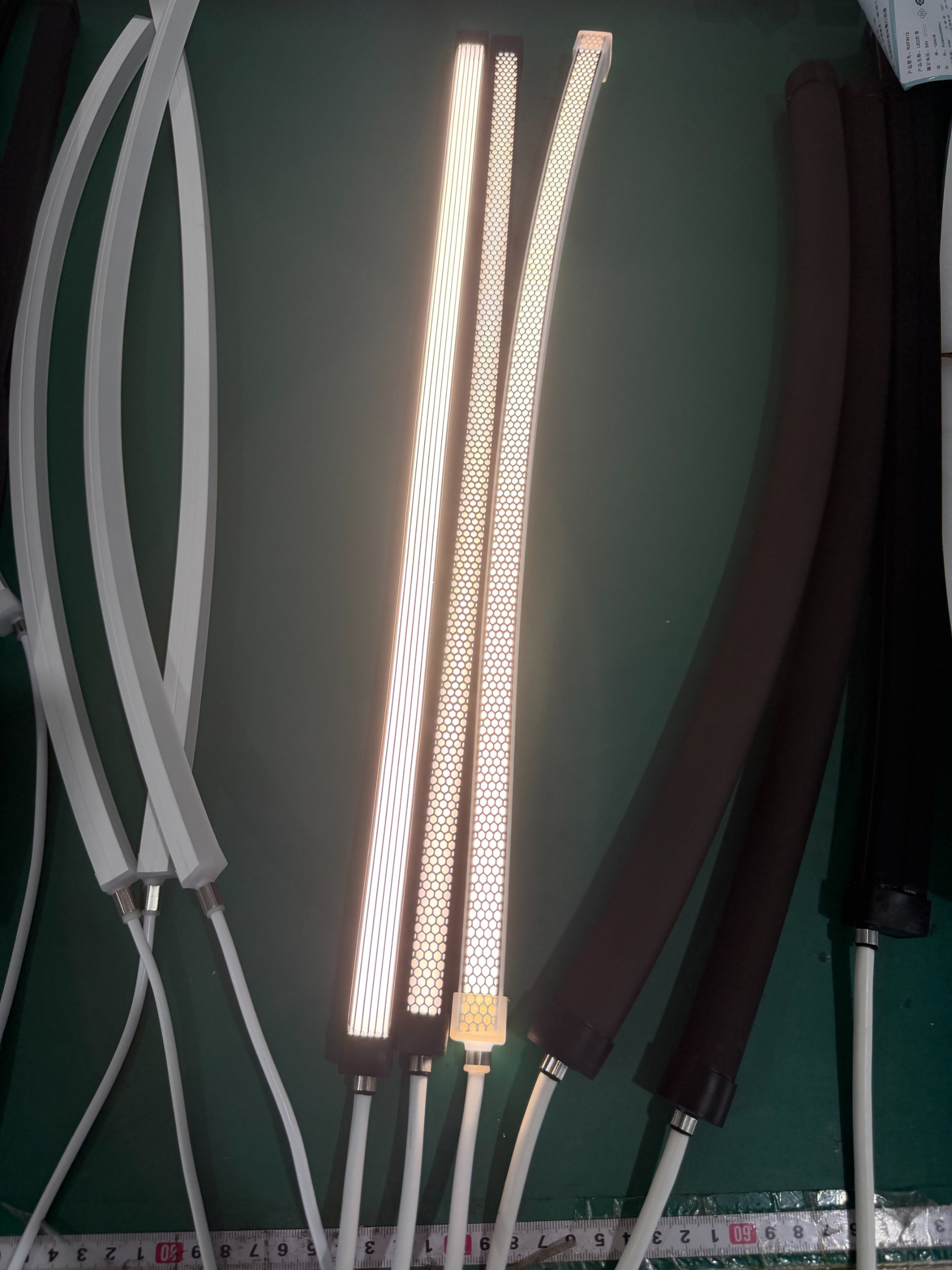
Here is what actually happens at the microscopic level. Standard neon flex uses double-layer copper PCB with rigid solder joints. When you bend it beyond the manufacturer's minimum radius (often not disclosed), the copper substrate undergoes shear stress. Outdoor installations amplify this problem because sunlight heats the top surface while the mounting surface stays cooler. This creates differential expansion—the top layer wants to expand faster than the bottom. The result? Fatigue failure at the weakest points: your custom corners and letter edges.
We address this with three-layer 3405 copper alloy PCB designed with serpentine trace patterns. This design allows controlled flex without transferring stress to solder points. We also precisely calibrate our silicone hardness to Shore A 55°-60°. This range provides enough structural support for complex shapes while allowing the copper substrate to "float" during thermal cycles. Your corners stay lit because the internal structure can breathe.
| Problem | Standard Solution | Our Engineered Solution |
|---|---|---|
| Bend radius limitation | 2-layer rigid PCB | 3-layer flex copper with serpentine traces |
| Thermal stress concentration | Generic silicone (Shore A 40-70) | Calibrated Shore A 55-60° silicone |
| Corner failure rate | 15-30% within 12 months | <2% over 36 months |
Why Do "Waterproof" Custom Signs Fill With Water After One Year?
I have seen countless IP67-rated signs that started leaking within months. The problem is not the IP rating test itself—it is how the seal degrades under real conditions. Let me explain the chemistry that most suppliers ignore.
Silicone neon bodies are chemically inert, meaning their molecular surface does not bond naturally with standard epoxy or polyurethane potting compounds. After UV exposure, acid rain, and internal pressure changes from LED heat, the interface between the glue and silicone body delaminates. Water then wicks in through capillary action, causing catastrophic failure.
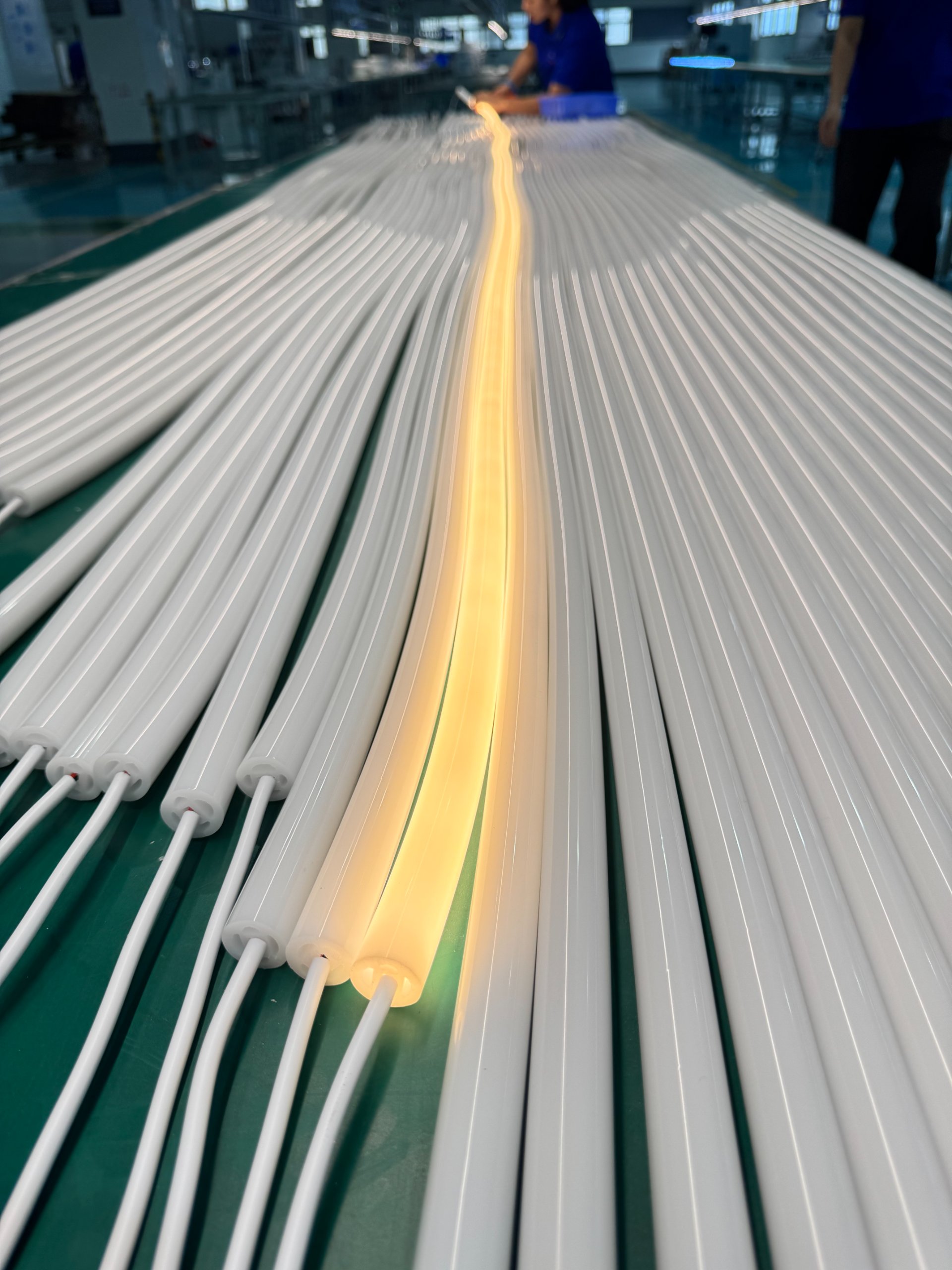
Most manufacturers use a two-step process: extrude the silicone body, then manually apply end caps with adhesive. This creates a fundamental material science problem. The curing agents in epoxy resins cannot penetrate the cross-linked silicone matrix. You get mechanical attachment, not chemical bonding. When temperature cycles cause expansion and contraction at different rates (silicone has a thermal expansion coefficient 10 times higher than most adhesives), micro-gaps form.
We eliminated this vulnerability entirely through co-extrusion and overmolding technology. Our end caps are formed using the same food-grade silicone as the body, applied in a secondary injection molding process at 180°C and 150 bar pressure. At this temperature, the molecular chains of the new silicone interweave with the existing body structure. There is no adhesive interface. There is no material boundary to fail. The end cap and body become a single monolithic structure with uniform expansion properties.
This is not marketing language. We have outdoor installations in coastal environments (salt spray, UV index 11+, temperature range -5°C to +45°C) that have operated continuously for 38 months with zero water ingress incidents. The seal does not degrade because there is no seal—just continuous material.
How Do You Prevent Color Shift Across Hundreds of Meters of Custom Signage?
Brand managers understand that color consistency is non-negotiable. When your custom logo spans 50 meters across a building facade, even slight color temperature variations become glaringly obvious. Yet most suppliers cannot deliver uniform color across large installations or subsequent orders.
The core issue is LED binning control and voltage drop management. LEDs from the same production batch can vary by up to 200K in color temperature. When combined with voltage drop over long runs, you get visible "color fade" from power input to end sections. This destroys the professional appearance your brand demands.
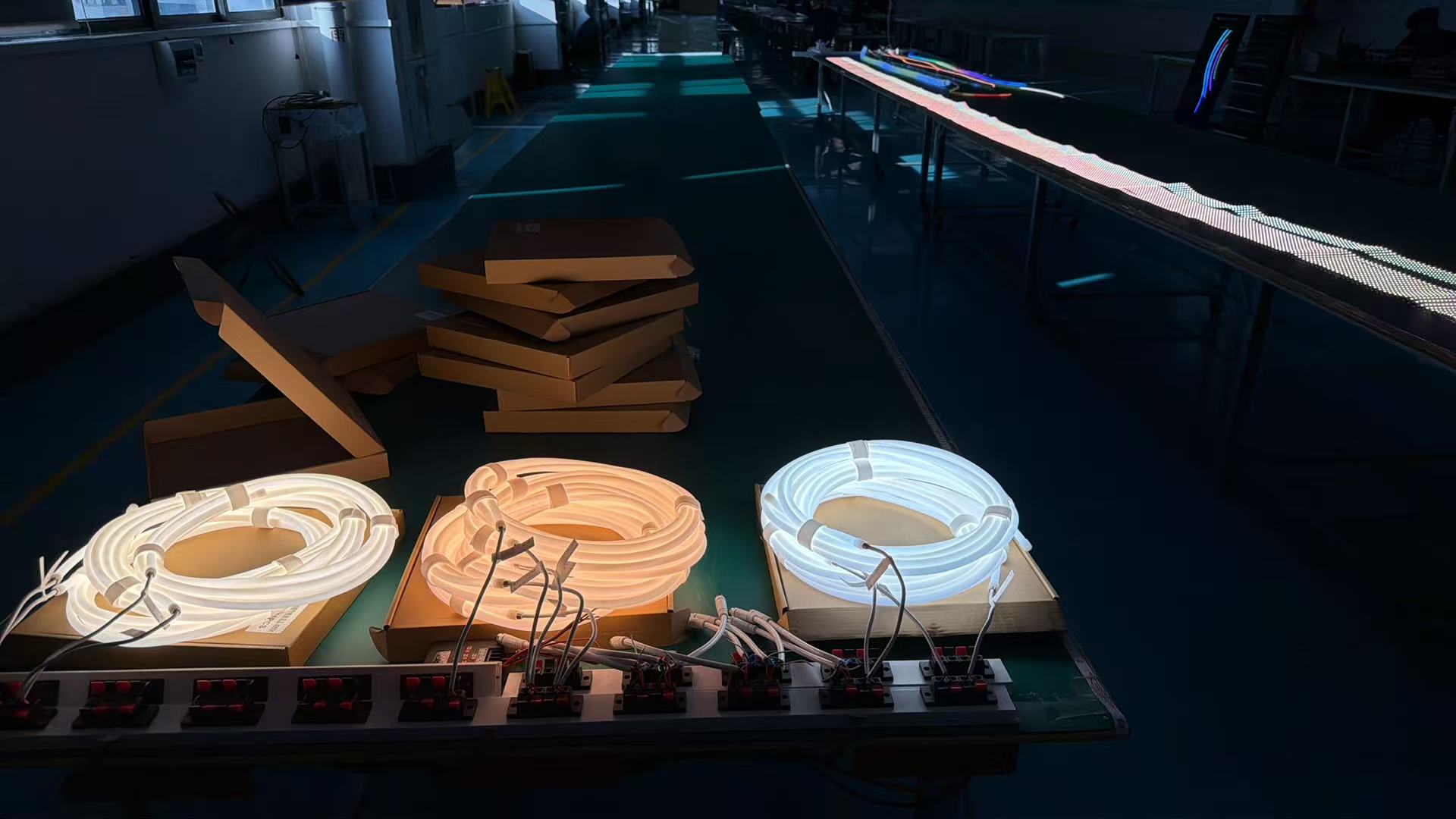
Here is the technical breakdown. LEDs are sorted into bins based on wavelength and forward voltage during manufacturing. A "5-step MacAdam ellipse" means colors can vary enough that 50% of observers will notice the difference. Most suppliers mix bins to reduce waste, gambling that customers will not detect the variation. They also undersize wire gauge to save cost, leading to voltage drop that further shifts color temperature toward the warm end of distant sections.
We implement single-bin lock protocol for B2B projects. When you place an order, we reserve LEDs from one production bin for your initial delivery and all future reorders. We guarantee 3-step MacAdam ellipse or tighter—a threshold where less than 5% of trained observers can detect any variation. This is paired with oversized copper traces (we use 3oz copper weight vs. the industry standard 1oz) and constant current (CC) architecture that maintains ±2% current stability regardless of voltage fluctuation.
The result is simple: your custom signage looks uniform across the entire installation. More importantly, when you need additional sections two years later for expansion, we can match your original specification exactly. No guessing. No "close enough." Just perfect color matching.
| Color Control Factor | Industry Standard | Our Specification |
|---|---|---|
| MacAdam ellipse | 5-7 step | 3 step maximum |
| Bin mixing | Common practice | Single bin lock |
| Voltage drop impact | 8-12% brightness/color shift | <2% across 10m run |
Can Silicone Neon Really Resist Yellowing for Five Years?
The yellowing problem is where most "premium" suppliers reveal their true quality level. You have probably seen neon signs that looked fantastic at installation but turned cloudy and yellow after 18 months outdoors. This is not cosmetic—it represents fundamental material degradation.
Silicone yellowing occurs through UV-induced polymer chain scission and oxidation. Standard industrial silicone uses peroxide catalysts that leave residual molecules susceptible to breakdown. Under continuous UV exposure and thermal cycling, these weak points break down, causing the material to lose transparency and shift toward yellow-brown hues.
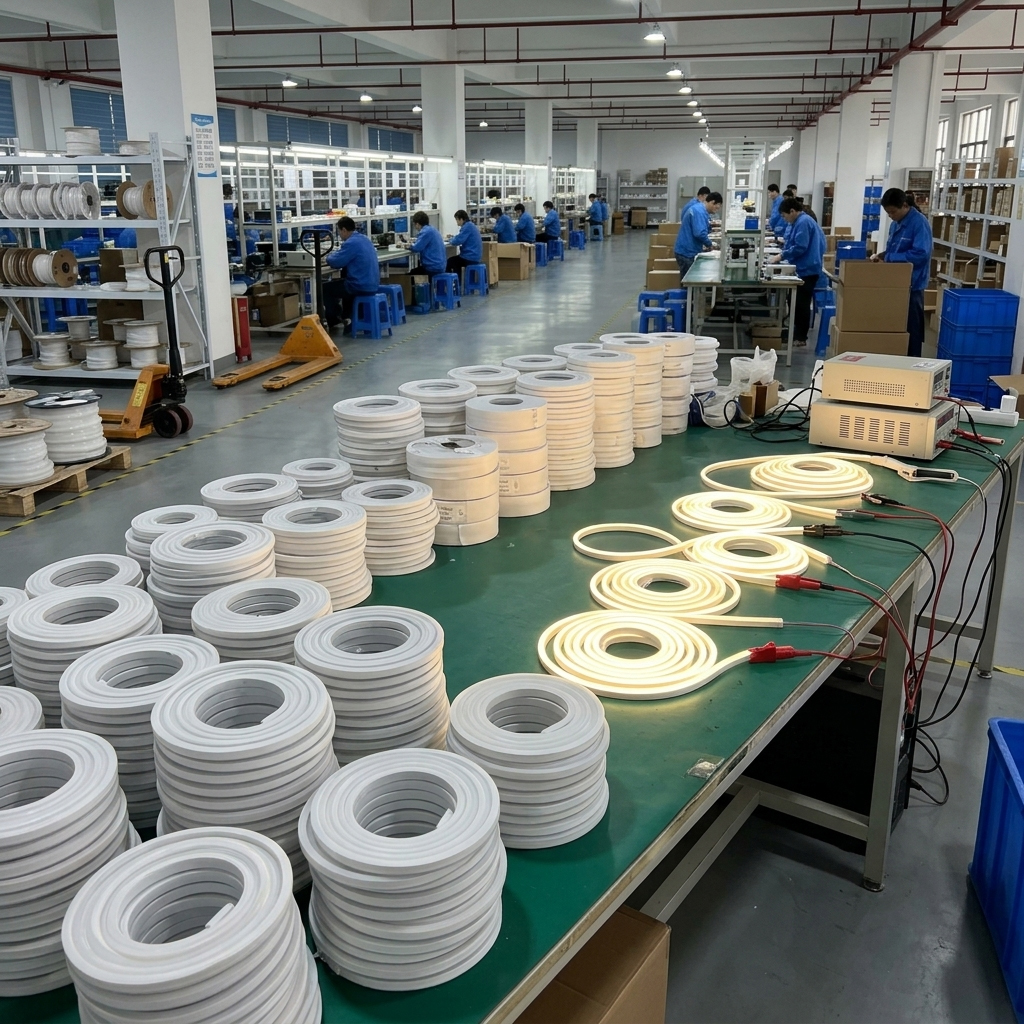
Most factory "anti-UV" claims are based on short-term accelerated aging tests using UV lamps. These tests do not replicate the full solar spectrum, particularly the combined assault of UV-A, UV-B, infrared heating, ozone exposure, and temperature cycling that outdoor installations face. A product that passes 2000 hours of lab UV exposure might fail within 12 months of real-world deployment.
We use platinum-catalyzed, phenyl-modified silicone polymer specifically engineered for outdoor lighting. The phenyl functional groups in the molecular structure provide inherent UV absorption and radical scavenging capability. This is not a coating or additive that can wear off—it is built into the polymer backbone. We also control the cross-link density to balance flexibility with resistance to oxidative degradation.
Our accelerated aging protocol exceeds UL standards: 5000 hours of QUV-A exposure at 70°C, followed by thermal shock cycling between -40°C and +85°C. After this torture test, our silicone maintains >92% light transmission and shows zero visible yellowing. We have installations in high-UV environments (Arizona, Middle East, Australia) that have operated for 40+ months without measurable color shift or transparency loss.
The practical benefit is straightforward: your custom sign looks as vibrant in year three as it did on installation day. There is no progressive dimming, no color shift, no cloudy appearance that screams "aged signage." The investment you made continues delivering the brand impact you paid for.
Conclusion
Custom neon LED signs fail prematurely because most suppliers treat them as lighting products rather than engineered systems. At Shenzhen Alister Technology, we solve material compatibility, stress management, and environmental resistance at the molecular level—ensuring your investment survives real-world conditions for 5+ years.