

When architects ask about custom silicone for their façade lighting project, I don't tell them what shape we can extrude. I ask them what failure mode they fear most. Because in our factory, we've seen enough "perfectly customized" silicone neon flex systems fail at month 18 to know that the real question is not "Can you customize it?" but "Will your custom formulation still perform after 1,000 thermal cycles?"
The real engineering challenge in custom silicone manufacturing is not dimensional flexibility—it's ensuring that your modified material system, LED encapsulation, FPC structure, end caps, and adhesive layers remain chemically and mechanically compatible under 5+ years of UV exposure, thermal stress, and moisture ingress.
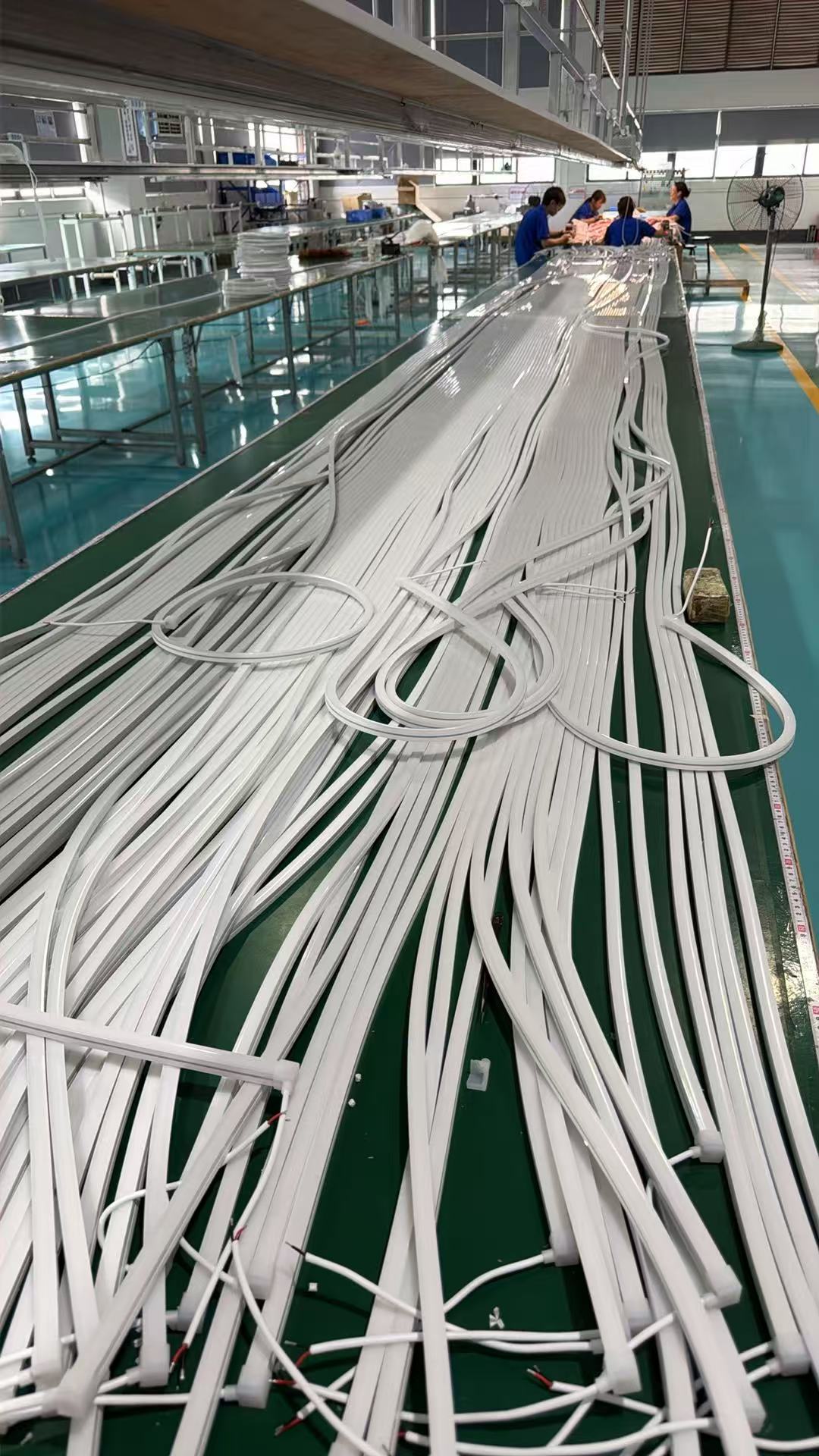
Most custom silicone projects fail the same way. The sample looks perfect. The client approves. The project ships. Then 18 months later, yellowing appears. Or the interface between silicone and end cap starts to delaminate. Or the FPC copper traces crack at the tightest bend. The problem was never the silicone's shape. The problem was that when you change one variable in a material system, you change the entire failure pathway.
Why Do Custom Silicone Projects Fail After Passing All Initial Tests?
I worked on a Southeast Asian marina project where the client wanted a custom cross-section silicone neon flex. The design was beautiful. Non-standard profile. Special diffusion structure. Ultra-tight bend radius. RGBW dynamic control. We passed IP68. We passed 1,000 hours of 85/85 testing. The project was installed across 800 meters of waterfront façade.
At month 11, localized yellowing appeared. By month 18, we found micro-cracks at the silicone-to-end-cap interface. By month 28, intermittent lighting failures began at every bend radius point. The system had entered cascading failure mode, and the root cause was not workmanship—it was material incompatibility that no short-term test could reveal.
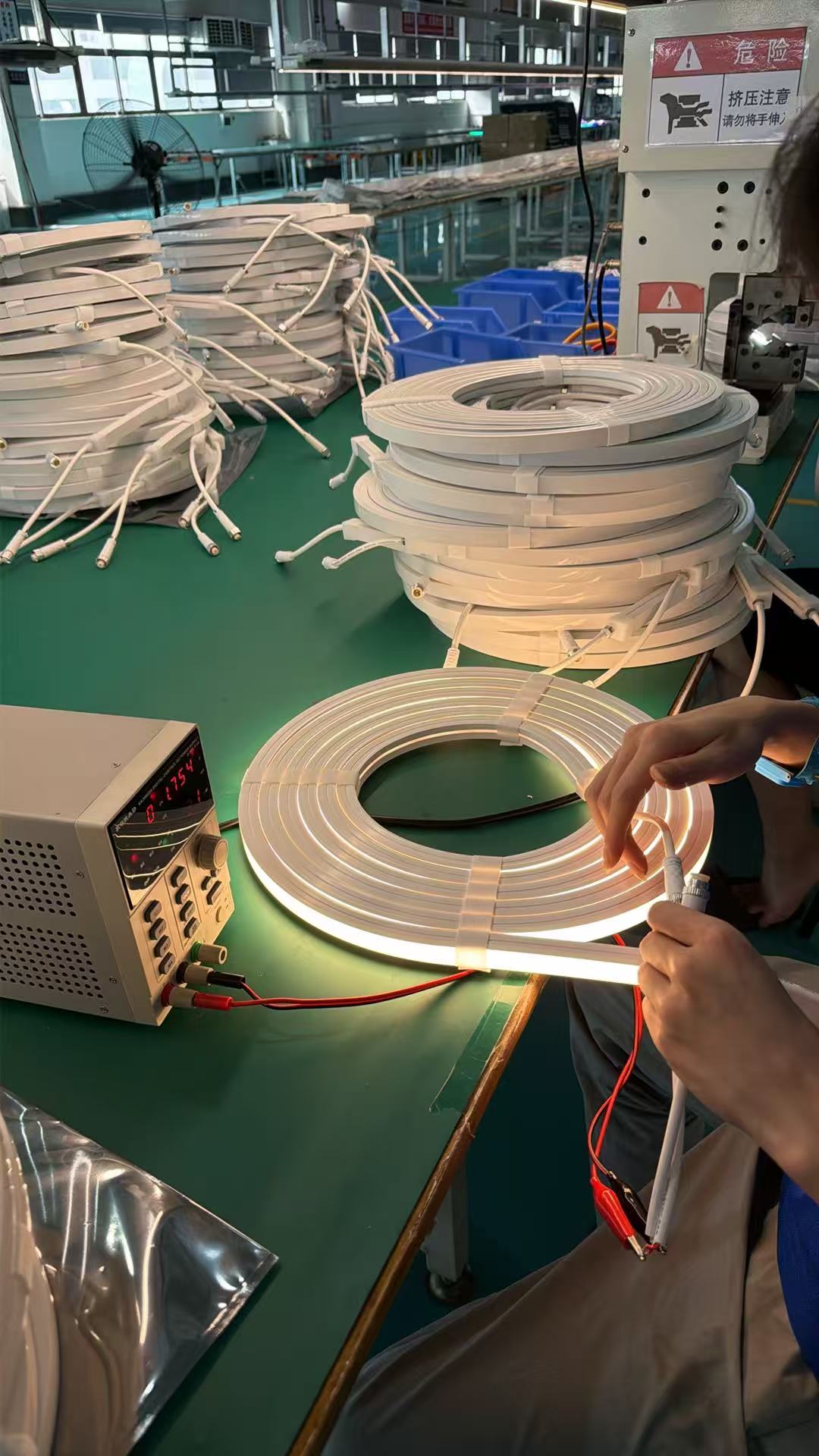
The first symptom was color shift. Delta E went from 1.6 to 6.9 in just 11 months. The LEDs were fine. The driver was fine. The problem was in the custom silicone formulation itself. To achieve the special diffusion effect, we added a modified filler system. Under long-term UV exposure, that filler triggered molecular chain oxidation. Low-molecular-weight components began to migrate. The refractive index started to drift. The result was visible banding.
Then came the interface failure. At month 18, we opened up a section and found 10~30μm microcracks between the silicone body and the end cap sealant. Standard IP68 tests cannot detect this. The issue was thermal mismatch. The custom silicone had a different crosslink density than the end cap material. Their CTEs (Coefficient of Thermal Expansion) were incompatible. Every day, the system went from 75°C in direct sun to 22°C at night. Over 500+ cycles, the shear stress accumulated. The interface peeled.
By month 28, the FPC began to fail. Because we reduced the support structure thickness to achieve the extreme bend radius, the copper traces were subjected to additional stress during every thermal expansion. Eventually, the copper fatigued and cracked. The entire system collapsed in a domino effect.
| Failure Stage | Timeline | Root Cause | Symptom |
|---|---|---|---|
| Phase 1: Yellowing | Month 11 | UV-induced oxidation of diffusion fillers | Delta E >6, visible color banding |
| Phase 2: Interface Delamination | Month 18 | CTE mismatch between silicone and end cap | 10~30μm microcracks, moisture ingress |
| Phase 3: Structural Fatigue | Month 28 | FPC stress concentration at bend points | Intermittent failure, copper trace cracking |
This is why custom silicone is riskier than standard products. Standard silicone neon flex has been tested across hundreds of projects over years. Every failure mode is known. Every material interface is validated. But when you customize, you change the formula. You change the wall thickness. You change the optical path. You change the crosslink density. And every change redefines the failure mechanism.
What Makes a Custom Silicone Formulation Actually Reliable?
The first variable you need to control is the curing system. Many manufacturers use condensation-cure silicone because it's cheaper and faster. But for outdoor projects lasting 5+ years, you need platinum-cure silicone. The molecular structure is fundamentally different. Platinum-cure silicone has higher molecular weight, lower VOC content, and better UV resistance.
For long-term outdoor installations, we only use platinum-cure silicone with the following baseline specifications: VOC content <0.3%, Shore A hardness between 60~70, tear strength >25 kN/m, compression set <20%, and post-UV aging Delta E <3. Any deviation from these parameters increases the probability of long-term molecular degradation.
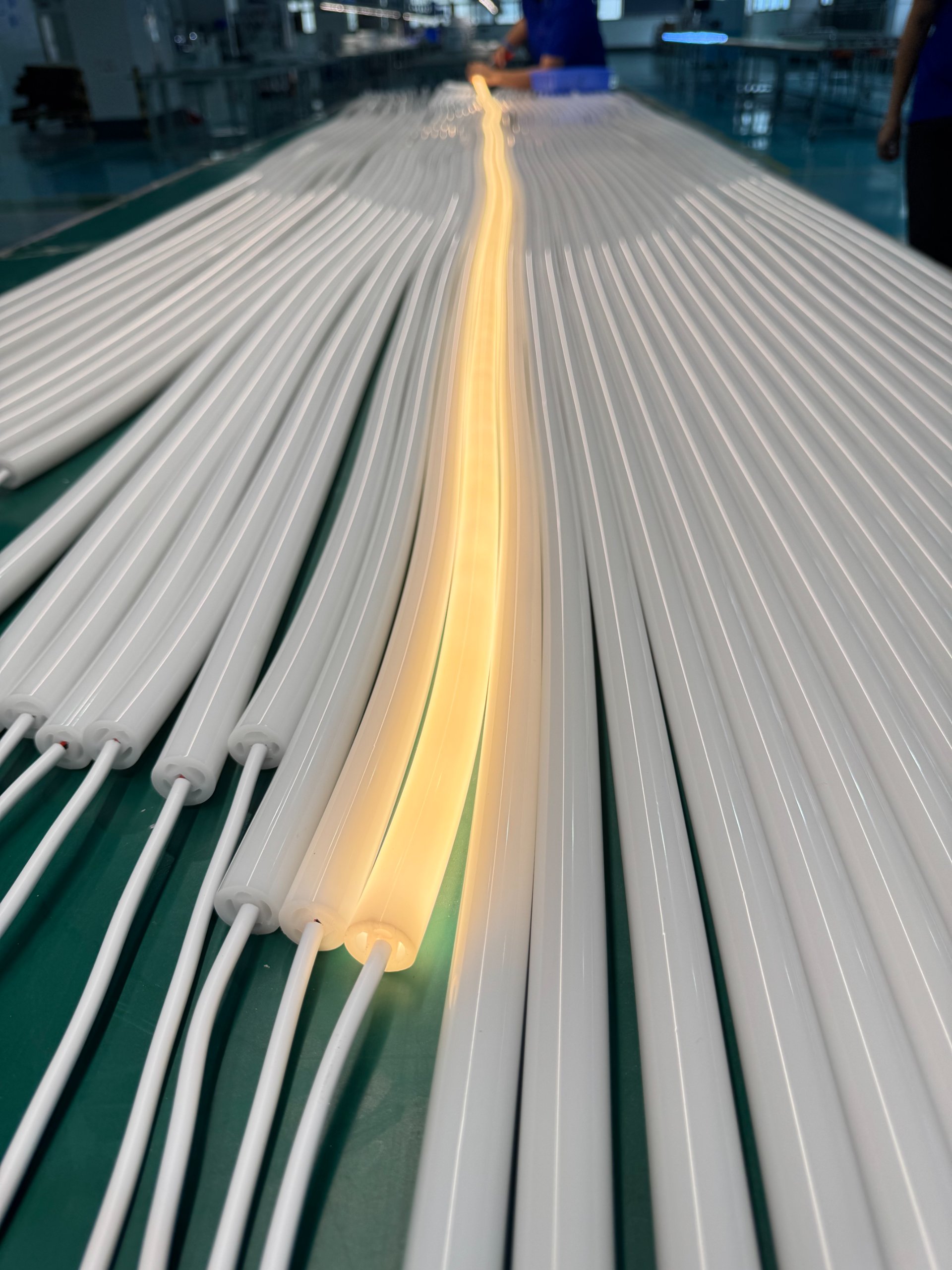
But material alone is not enough. The extrusion structure matters just as much. Many custom projects use single-layer extrusion to save cost. This works for samples. It fails in the field. For projects over 50 meters, we recommend tri-extrusion co-extrusion structure. The first layer is the optical diffusion layer. It controls light uniformity. The second layer is the high-strength skeleton layer. It bears tensile stress. The third layer is the flexible buffer layer. It absorbs thermal cycling stress. This structure reduces CTE mismatch, minimizes shear stress, and prevents interface delamination.
Then there's the FPC. This is where most engineers make a critical mistake. They think that as long as the silicone is customized, the FPC can remain standard. That's wrong. When you change the silicone cross-section, you also change the mechanical stress distribution on the FPC. For custom silicone projects, we always use RA (Rolled Annealed) copper instead of standard ED copper. RA copper has better dynamic flex life. We also add strain relief structures at three critical points: solder pads, wire exit zones, and bend radius zones. Without these modifications, the FPC will fail before the silicone does.
| Design Element | Standard Silicone | Custom Silicone Requirement |
|---|---|---|
| Curing System | Condensation or Platinum | Platinum-cure only, VOC <0.3% |
| Extrusion Structure | Single-layer or dual-layer | Tri-layer co-extrusion (diffusion + skeleton + buffer) |
| FPC Copper Type | ED copper | RA copper with strain relief zones |
| Optical RI Stability | Not specified | ΔRI ≤0.005 after UV + 85/85 |
| MacAdam Binning | 5-Step acceptable | ≤3-Step MacAdam Ellipse required |
The optical design also needs rethinking. Most custom projects focus only on initial light uniformity. But the real problem emerges later. You need to control both the initial refractive index (RI) and its stability over time. Our baseline is RI between 1.40~1.43. After UV aging and 85/85 testing, the delta RI must remain below 0.005. If it drifts beyond that, you will see hot spots, color shift, and uneven light distribution. The client will call it a quality issue. But it's actually a material science issue that should have been caught during formulation.
Why Standard Tests Are Not Enough for Custom Silicone
If your custom silicone project only passes tensile testing and IP68, you are not ready for the field. Those tests are necessary but not sufficient. For projects over $100K USD, we add four additional validation protocols that most suppliers skip because they take too long and cost too much. But skipping them is how projects fail at month 18.
The four critical tests for custom silicone systems are: ASTM G154 UV fluorescent aging (to verify yellowing and optical stability), ISO 9227 salt spray testing (to verify coastal and industrial environment resistance), VOC compatibility testing (to detect gas-phase contamination between silicone, adhesive, and end cap materials), and thermal cycling from -40°C to +85°C for 500~1,000 cycles (to observe interface delamination, crack propagation, and waterproofing system stability).
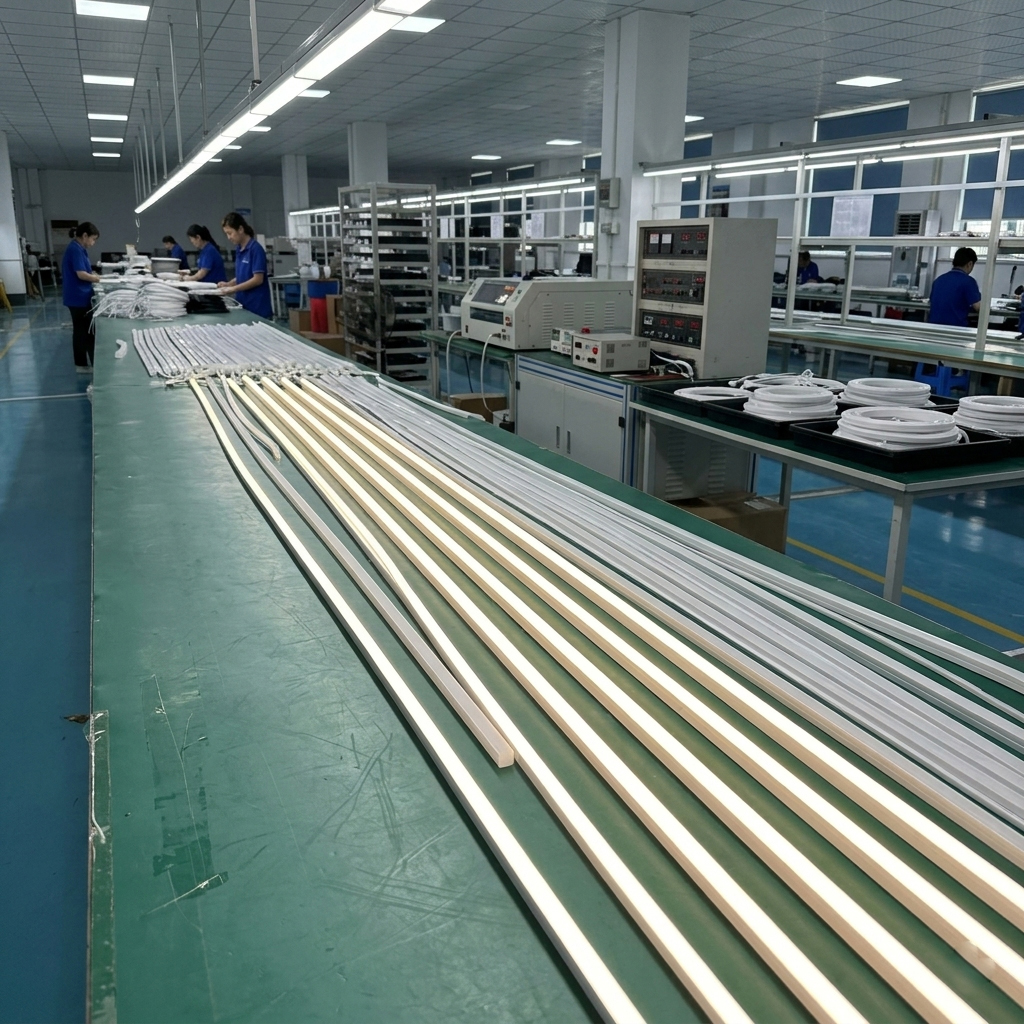
ASTM G154 is critical because it simulates real UV exposure better than a xenon lamp. We run it for 2,000+ hours. We measure Delta E every 500 hours. We check for surface chalking. We verify refractive index drift. If the silicone formulation contains incompatible fillers or low-quality UV stabilizers, this test will expose it.
ISO 9227 salt spray testing is essential for coastal projects. Standard silicone neon flex might pass 500 hours. But custom formulations sometimes fail at 200 hours because the modified resin system has lower salt resistance. We run it for 1,000 hours minimum. We check not just for rust, but for adhesive degradation and silicone surface pitting.
VOC compatibility testing is the most overlooked. Many custom projects use a new silicone formulation but keep the standard adhesive and end cap sealant. The problem is that some silicone additives release volatile organic compounds during thermal cycling. Those VOCs migrate into the adhesive layer. The adhesive softens. The bond fails. Or worse, the VOCs contaminate the LED phosphor coating, causing color shift. We test this by sealing silicone, adhesive, and end cap samples in a chamber at 85°C for 500 hours and then measuring VOC concentration and material property changes.
Thermal cycling is the ultimate stress test. We cycle from -40°C to +85°C with a 30-minute dwell at each extreme. We run 500 cycles minimum, 1,000 cycles for critical projects. We are not just looking for catastrophic failure. We are looking for micro-cracks at interfaces. We are looking for adhesive creep. We are looking for FPC solder joint fatigue. We are looking for waterproofing degradation. Most custom silicone projects never undergo this level of validation. That's why they fail in the field.
| Test Protocol | Standard Requirement | Custom Silicone Requirement | What It Reveals |
|---|---|---|---|
| ASTM G154 UV Aging | 1,000 hours | 2,000+ hours, Delta E tracking | Molecular oxidation, filler instability |
| ISO 9227 Salt Spray | 500 hours | 1,000 hours, adhesive inspection | Coastal/industrial environment durability |
| VOC Compatibility | Not typically tested | 500 hours at 85°C in sealed chamber | Gas-phase contamination between materials |
| Thermal Cycling | -20°C to +60°C, 100 cycles | -40°C to +85°C, 500~1,000 cycles | Interface delamination, FPC fatigue |
The cost of these tests is usually under $5,000 USD. The cost of a failed installation is often over $200,000 USD when you include labor, downtime, and reputation damage. I have never understood why so many projects skip this step.
What Questions Should You Ask Before Ordering Custom Silicone?
When I receive a custom silicone inquiry, I don't ask about the shape first. I ask about the project environment. What is the UV index? What is the temperature range? Is it coastal or industrial? What is the expected lifespan? What is the replacement cost? Because all of those factors determine whether a custom formulation is even appropriate.
The most important question is not "Can you make this shape?" but "Has your custom silicone formulation been validated for long-term compatibility with your LED encapsulation system, FPC structure, adhesive layer, end cap sealant, and mounting hardware under thermal cycling, UV exposure, and moisture ingress conditions?" If the answer is no, you are not buying a custom solution—you are funding an uncontrolled field experiment.
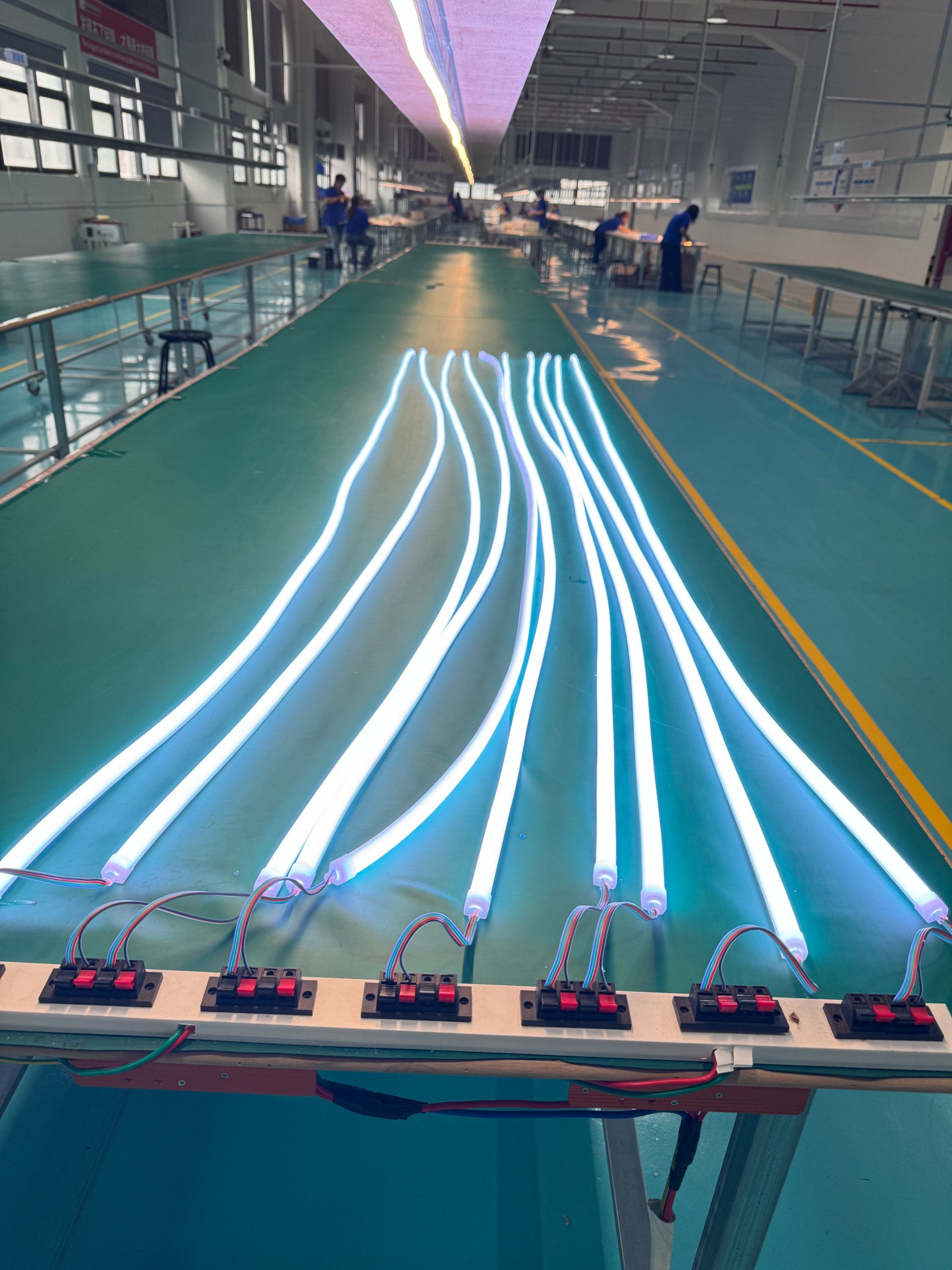
Most manufacturers will tell you they can customize anything. That is true. But customization capability is not the same as validation capability. The hard part is not making a new shape. The hard part is ensuring that the new shape, with its modified wall thickness, altered optical path, different crosslink density, and changed thermal mass, will still perform reliably when exposed to 1,500+ thermal cycles, 10,000+ hours of UV, and 100% humidity at 85°C.
I have worked on custom silicone projects where the client insisted on a 3mm bend radius. We told them that below 10mm, the FPC failure rate increases exponentially. They insisted. We made it work in samples. It failed at month 14 in the field. The client blamed us. But the real problem was that we allowed a design constraint to override a material science limitation. That is the core risk of custom silicone. The client wants something that looks impressive. But what looks impressive in a sample is not always what survives in the field.
If you are specifying custom silicone for a project, ask for thermal cycling data. Ask for UV aging data. Ask for VOC compatibility reports. Ask for FPC fatigue test results. Ask for third-party test lab certifications. If the manufacturer cannot provide these, you are taking a significant risk. Because in my experience, custom silicone projects do not fail because the silicone was poorly made. They fail because the system-level interactions were never validated.
Conclusion
Custom silicone is not hard to manufacture. What is hard is ensuring that your customized material system will survive the next 5 years of thermal stress, UV degradation, and moisture ingress without delaminating, yellowing, or cracking. Customization is easy. Validation is not. Choose your manufacturing partner based not on what shapes they can make, but on what failure modes they have already solved.