

You have been asking the wrong question.
Most people focus on "lumens per foot" when choosing under cabinet lighting. But here is what actually matters: your light output must work as a long-term system, not just a brightness number. If you only look at lumens, you are betting on initial brightness to guarantee five-year stability.
I have seen too many kitchen and commercial bar projects pass inspection with perfect brightness, only to fail within twelve months. The problem is never "not enough lumens." The problem starts at the design stage when engineers ignore the system logic.
What is the Standard Lumen Range for Under Cabinet Lighting?
Most guides recommend 400–600 lumens per foot for under cabinet LED strips.
This range works for general residential kitchens where ambient light exists and task lighting only supplements visibility. For commercial prep areas, jewelry displays, or high-precision workspaces, you need 800–1,200 lumens per foot to meet functional requirements without causing glare.
But this answer only makes sense if you ignore three factors that actually determine whether your lighting works long-term: heat dissipation conditions, mounting structure design, and driver current density.
Here is what happens when you design only for lumens.
A chain restaurant remodel project chose 500 lm/ft LED strips based on standard recommendations. During testing in open air, the light was uniform and temperature rise was acceptable. After installation, the strips were mounted inside sealed aluminum channels beneath wooden cabinets with thermal insulation above. There was almost no convective cooling path.
For the first four months, the lighting looked perfect. The project passed final inspection. Then the problems started.
| Timeline | Observable Issue | Root Cause |
|---|---|---|
| 0–4 months | No visible problems | LED junction temperature slowly rising above design spec |
| 4–6 months | Localized dimming in certain sections | Accelerated lumen depreciation due to elevated temperature |
| 6–12 months | Color temperature shift in warm white zones | Phosphor degradation under sustained thermal stress |
| 12+ months | Uneven brightness across entire run | Cumulative aging effects compounded by poor thermal design |
When we disassembled the failed sections, the LED chips were fine. The problem was not the light source. The problem was three design mistakes stacked together.
First, thermal design was ignored. The actual operating temperature was 15–25°C higher than lab conditions, pushing the light depreciation curve into its accelerated aging zone.
Second, the mounting structure blocked heat dissipation. The aluminum channel had no thermal path to the cabinet body, effectively trapping the LEDs in a semi-enclosed heat chamber.
Third, the driver was running slightly over-voltage to compensate for expected lumen loss. This "safety margin" actually accelerated aging instead of preventing it.
This case shows the most common mistake: using lumens to solve the "initial brightness problem" while completely ignoring the "system lifetime problem."
Why Lumens Alone Cannot Define Under Cabinet Lighting Performance?
Lumens measure light output, but under cabinet lighting fails or succeeds based on four variables that lumen specs never capture.
First, light output must bind with thermal design. The same 500 lm/ft strip has dramatically different lifespans at 40°C versus 65°C operating temperature. Second, optical design matters more than raw lumens. Diffuser type, beam angle, and mounting height determine effective illuminance, not nominal lumen ratings.

Third, current density must be conservatively designed. Many failures come from drivers set "just a bit brighter" to impress clients during handover, but this trades long-term stability for short-term visual impact.
Fourth, compensation thinking is dangerous. Using higher lumens to offset future depreciation sounds logical, but you are actually consuming lifespan in advance.
Here is how professional contractors think differently.
Instead of asking "how many lumens do I need," we ask three questions before specifying any product:
- How many years must this installation maintain stable brightness without noticeable degradation?
- What is the maximum operating temperature inside the mounting structure?
- What failure rate can the maintenance budget tolerate?
When these three questions remain unanswered, any lumen number is just a surface parameter.
The engineering logic works backward from system boundaries, not forward from brightness specs. Under cabinet lighting looks simple, but it is actually a reliability problem under sustained low-dissipation conditions.
| Design Approach | Starting Question | Risk Level |
|---|---|---|
| Lumen-First | "How bright does it look?" | High failure rate after 6–12 months |
| System-First | "What thermal budget do we have?" | Stable performance over 3–5 years |
| Current-First | "What drive current maintains L80 at 50,000 hours?" | Maximum reliability with planned maintenance |
We manufacture silicone neon flex specifically engineered for low-clearance installations. Our extrusion process uses high-molecular food-grade silicone with superior thermal conductivity compared to PVC alternatives. This material choice alone extends L80 lifespan by 40–60% in confined mounting conditions.
But even with better materials, we never recommend choosing lumens first. We start by mapping the thermal profile of your installation space, then select the current density that maintains target brightness within safe junction temperature limits.
How Do Installation Conditions Change Your Lumen Requirements?
The same lumen rating performs completely differently depending on where and how you install the light.
A 500 lm/ft strip mounted on an open aluminum profile with air circulation maintains full output for years. The same strip enclosed in a sealed wooden channel with no thermal path degrades 30–50% faster. Your lumen requirement is not fixed—it scales with your thermal conditions.

Here is what changes between residential and commercial installations.
In home kitchens, under cabinet lighting typically runs 1–3 hours per day with long cooling periods between uses. The duty cycle is low, ambient temperature is controlled, and minor degradation over 2–3 years is acceptable since replacement cost is minimal.
In commercial kitchens, hotel bars, or retail displays, the same lighting runs 8–16 hours daily in higher ambient temperatures with demanding cleaning protocols. The duty cycle is high, replacement cost includes labor and downtime, and any visible degradation within 12 months is unacceptable.
This difference means residential projects can tolerate higher current density for brighter initial output, while commercial projects must design conservatively for sustained performance.
We test all our silicone neon flex products under 24/7 operation at 60°C ambient temperature to simulate worst-case commercial conditions. This is why we can guarantee L90 performance at 50,000 hours even in poorly ventilated installations—our baseline spec already accounts for thermal stress.
But specification alone does not solve installation problems. You need three practical considerations.
First, measure the available clearance between cabinet bottom and mounting surface. If you have less than 3 cm vertical space, you need ultra-slim profiles with side-emission optics to avoid hotspots.
Second, check whether your cabinet material conducts or insulates heat. Metal cabinets provide passive heat sinking. Wood or composite materials trap heat unless you add thermal interface materials.
Third, confirm whether your power supply is locally mounted or remotely installed. Local mounting adds heat load to an already confined space. Remote mounting requires longer wire runs but improves thermal management.
What Lumen Level Should You Actually Specify?
Stop thinking about lumens as an input variable. Think about illuminance as a target output, then work backward through optical efficiency and thermal constraints.
For residential task lighting, target 300–500 lux on the countertop surface. For commercial prep areas, target 750–1,000 lux. For jewelry or inspection work, target 1,500+ lux. Then calculate backward from mounting height and beam angle to determine required lumens.
Here is the calculation framework we use with wholesale partners.
Start with your target illuminance in lux. Measure your mounting height (typically 30–50 cm for under cabinet installations). Check your beam angle (usually 120° for general lighting, 60° for focused task lighting). Apply the inverse square law with a 30–40% loss factor for diffuser absorption and surface reflection inefficiency.
For example: targeting 500 lux at 40 cm distance with a 120° beam requires approximately 450–550 lm/ft of effective output after optical losses. If your diffuser has 85% transmission efficiency, specify 530–650 lm/ft at the source.
But this calculation only gives you the minimum spec. Professional installations add three safety margins.
First, plan for 20–30% lumen depreciation over the warranty period. If your strip degrades from 550 lm/ft to 400 lm/ft over five years, will the reduced illuminance still meet functional requirements?
Second, account for voltage drop over longer runs. Every meter of wire adds resistance. If you are running 10 meters from a single feed point, your far end may receive 10–15% less power than your near end.
Third, consider future cleaning and maintenance impact. Commercial kitchens accumulate grease and particulate. Even with IP67 protection, optical surfaces degrade. Will your illuminance remain acceptable after surface contamination reduces transmission by another 15%?
When you factor all three margins, your specified lumen output may need to be 50–70% higher than the theoretical minimum. But the solution is not always "buy brighter lights." Sometimes the solution is "design better thermal management" or "use higher-efficiency optics" or "plan accessible maintenance protocols."
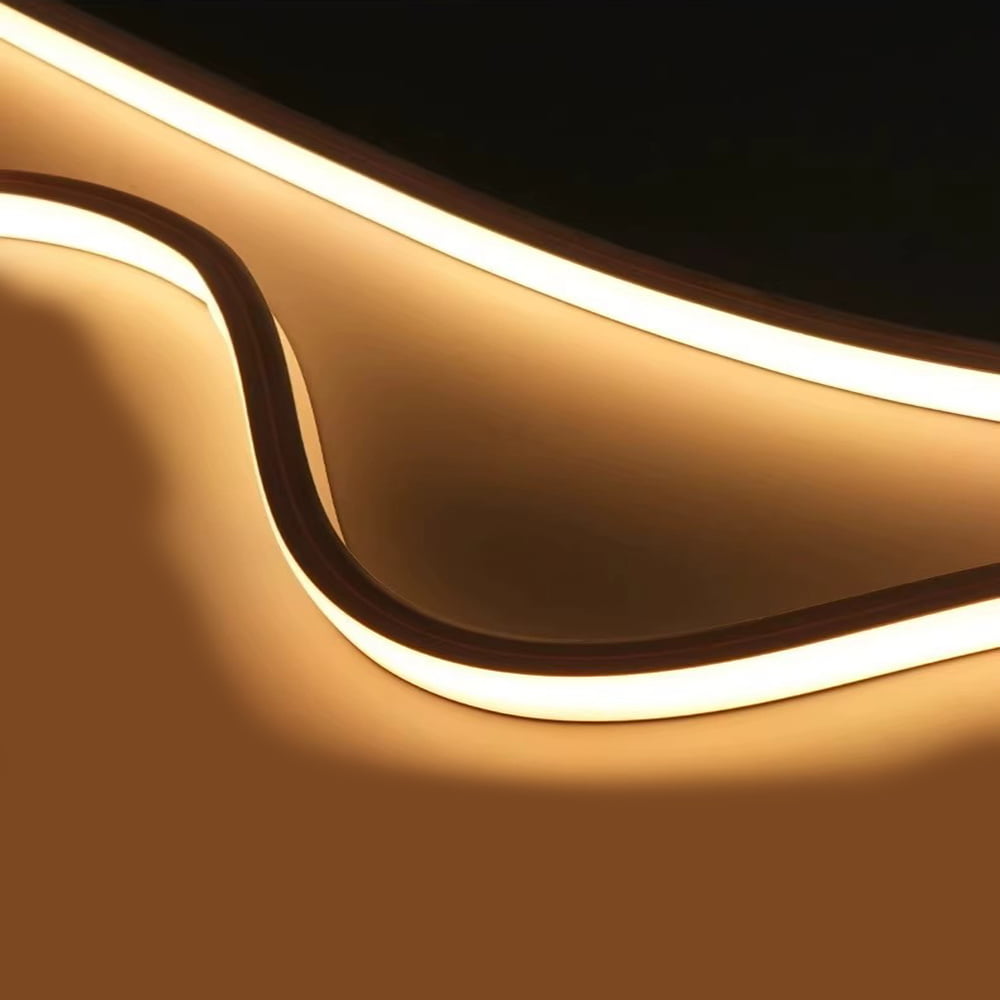
We manufacture both top-view and side-view silicone neon flex precisely because different mounting conditions need different optical strategies. Top-view products provide maximum lumen density with 360° emission. Side-view products concentrate output into focused beam angles for higher lux-per-lumen efficiency in shallow mounting spaces.
Choosing between them is not about which has more lumens. It is about which delivers your target illuminance within your available thermal and spatial budget.
How Do You Verify Your Lighting Will Still Work After Five Years?
Most under cabinet lighting projects fail not at installation but during the first annual maintenance cycle when someone realizes the lights look noticeably dimmer than handover photos.
Verification is not about testing brightness at day zero. Verification is about modeling lumen maintenance curves under your actual operating conditions and confirming you still meet minimum illuminance requirements at L80 end of life.
Here is how we test with commercial partners before finalizing large orders.
We install sample sections in thermally representative conditions—either in client facilities or in our controlled environment chambers with matched airflow, ambient temperature, and duty cycle. We run accelerated aging tests at 1.5x operating current and 20°C elevated temperature to simulate 3–5 years of use within 6–8 weeks of continuous operation.
We measure lux on the work surface every 1,000 hours and plot the degradation curve. Then we extrapolate to 50,000 hours and check whether projected lux still exceeds the client's minimum requirement with 15% safety margin.
If projected lux falls below requirement, we do not recommend "just add more lumens." We analyze the failure mode first.
Is the problem LED chip degradation? Then we reduce drive current by 10–15% and accept slightly lower initial brightness in exchange for longer maintenance life.
Is the problem phosphor degradation? Then we switch from warm white to neutral white CCT, which has more stable phosphor chemistry under thermal stress.
Is the problem driver instability? Then we change from constant voltage to constant current topology and accept slightly higher component cost for significantly better long-term regulation.
This iterative process takes 2–3 months, which seems slow compared to "just order the brightest strip available." But it prevents the problem where you replace entire installations after 18 months because they failed too early.
For our silicone neon flex products, we publish full LM-80 test reports showing measured lumen maintenance over 10,000 hours under ISTMT conditions. We do not claim "50,000-hour lifespan" based on extrapolation from short tests. We show actual measured data that lets engineers model depreciation curves for their specific installations.
This transparency costs us sales to competitors who simply claim "high lumens, long life" without backing data. But it builds trust with professional contractors who need defensible specifications for multi-year warranty commitments.
Conclusion
Stop asking how many lumens you need. Start asking how long your lighting must maintain target illuminance under your worst-case thermal conditions. Design for system stability, not initial brightness, and your under cabinet lighting will still work when others are scheduling replacements.