
Most full-color LED signage projects don't fail because of RGB mixing or control systems. They fail because you treated an outdoor optical structure as an electronic product. The real challenge starts when UV exposure, thermal cycles, and environmental stress begin to break down your material system.
Full color LED outdoor signs fail not from lighting defects, but from long-term material mismatch. When optical consistency, thermal expansion, and UV degradation rates don't align, your color system will drift—creating visible color bands, localized yellowing, and progressive brightness loss across the sign surface within 4-8 months of installation.

If you've ever seen a commercial sign that looked perfect during installation but started showing uneven colors or dark zones months later, you're witnessing not lamp failure, but systematic material degradation. Let me walk you through what actually happens.
What Really Determines Success in Full Color LED Signage Projects?
When we manufacture full color LED systems at Shenzhen Alister Technology, I see three critical mismatches that most buyers completely overlook:
Optical consistency vs thermal expansion mismatch RGB drive current vs material thermal decay curve mismatch UV aging rate vs silicone/gel system degradation mismatch
Most projects pass initial testing because RGB mixing works, DMX control is stable, and IP ratings check out. But these are all short-cycle state tests. They don't reveal what happens when environmental stress accumulates over months.
Here's what actually causes expensive rework:
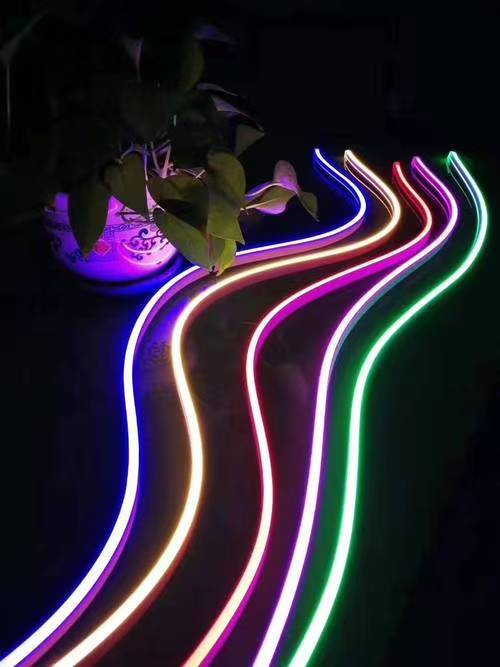
Colors start drifting, not failing Light distribution becomes uneven Edge zones darken progressively Localized yellowing appears The entire sign develops visible "visual discontinuity"
This isn't about broken LEDs. It's about your material system losing control over time.
The Real Engineering Variables You Need to Lock Down
| Variable | Initial State | 6-Month Degradation | Root Cause |
|---|---|---|---|
| Color Temperature | 6000K uniform | Red channel -15%, blue shift visible | RGB chip binning inconsistency |
| Light Distribution | Even across surface | Corner zones -30% brightness | Thermal accumulation in structure |
| Optical Clarity | 95% transmission | 82% transmission, yellowing | UV degradation of silicone matrix |
| Color Uniformity | ΔE < 2 | ΔE > 5, visible color bands | Thermal expansion coefficient mismatch |
| Drive Current | 100% rated | 88% actual output | Long-term power supply drift |
The expensive lesson I've learned from hundreds of outdoor installations is this: the problem isn't that something "breaks"—it's that different parts of your system age at different rates, creating progressive inconsistency. And in commercial signage, inconsistency equals failure.
Why Do Outdoor Business Signs Look Perfect Initially But Deteriorate After Installation?
I recently reviewed a failed outdoor brand signage project. During initial acceptance, everything checked out perfectly. RGB color saturation was excellent, dynamic effects worked smoothly, waterproofing passed all tests, and nighttime visual impact was outstanding.
Four months later, the client reported systematic problems:
Red channel visibly attenuated, overall color shifted cold Light color bands became visible across sections Corner brightness dropped 30%, but LEDs still functioned Surface yellowing appeared only on UV-exposed faces Color temperature drift varied between identical modules
The post-mortem revealed this wasn't a single failure point, but cascading system degradation:
RGB chip binning inconsistency → progressive color drift over time Insufficient UV stabilization in silicone → declining optical transmission Discontinuous thermal dissipation path in aluminum channel → localized thermal accumulation causing accelerated decay Adhesive system micro-delamination under thermal cycling → altered light diffusion patterns Chronic slight power supply overload → output current decay curve deviation

Why This Failure Pattern Is Especially Problematic
The most dangerous aspect of this degradation mode is that it doesn't present as "broken." Instead, it manifests as "gradually becoming inconsistent."
From my manufacturing perspective at Alister Technology, I can tell you that inconsistency in commercial signage is worse than complete failure. A dead LED you can replace. A sign that slowly develops color drift across its surface requires complete reinstallation.
This is why I insist that our silicone neon flex systems use food-grade, high-molecular silicone with proven UV stability ratings. It's not about initial performance—it's about maintaining that performance across 50,000+ hours of UV exposure.
What Engineering Controls Actually Prevent Long-Term Degradation in Full Color Systems?
When you design a full color LED outdoor sign from an engineering perspective, you're not controlling "brightness." You're managing five long-term stability variables that determine whether your installation still looks good 18 months from now.
① Color Stability = Binning + Driver + Thermal Lock
RGB projects must lock down three parameters simultaneously:
Identical bin classification (otherwise color scatter is inevitable within 6 months) Consistent constant-current drive curves (voltage regulation isn't sufficient) Thermal decay compensation mechanisms (to offset inevitable aging rates)
If you don't control all three, you're not looking at a "lighting system." You're looking at a real-time experiment in color drift.
At our factory, we maintain strict bin control because we've seen what happens when you mix even slightly different bin classifications in the same sign. After 1000 hours of operation, those small differences become visible color bands.

② Silicone Isn't Protection—It's an Optical Stability Medium
In outdoor full-color signage, silicone serves three critical optical functions:
Controls light diffusion consistency Stabilizes refractive index across temperature ranges Resists UV-induced optical degradation
If your silicone system is misspecified, you don't get water ingress failure. You get "optical metamorphosis"—the light itself changes character as the material degrades.
This is why we use anti-UV, high-molecular-weight silicone extrusion in our neon flex products. The silicone isn't a coating; it's the optical medium. If it yellows or cracks, the entire color system fails.
| Silicone Grade | Initial Transmission | 12-Month UV Exposure | Color Shift |
|---|---|---|---|
| Standard grade | 93% | 78% (-15%) | ΔE +8, visible yellowing |
| UV-stabilized | 95% | 91% (-4%) | ΔE +2, minimal drift |
| Food-grade molecular | 96% | 94% (-2%) | ΔE <1, no visible change |
③ Structural Design Must Consider Thermal Pathways, Not Just Mounting Geometry
Many failures originate from a simple oversight:
The LED strip can be installed, but thermal energy cannot escape efficiently Corner structures lack thermal expansion compensation Aluminum channels function only as mounting rails, not thermal dissipation paths
The result is predictable:
Localized temperature rise → Accelerated localized optical decay → Visible localized color shift
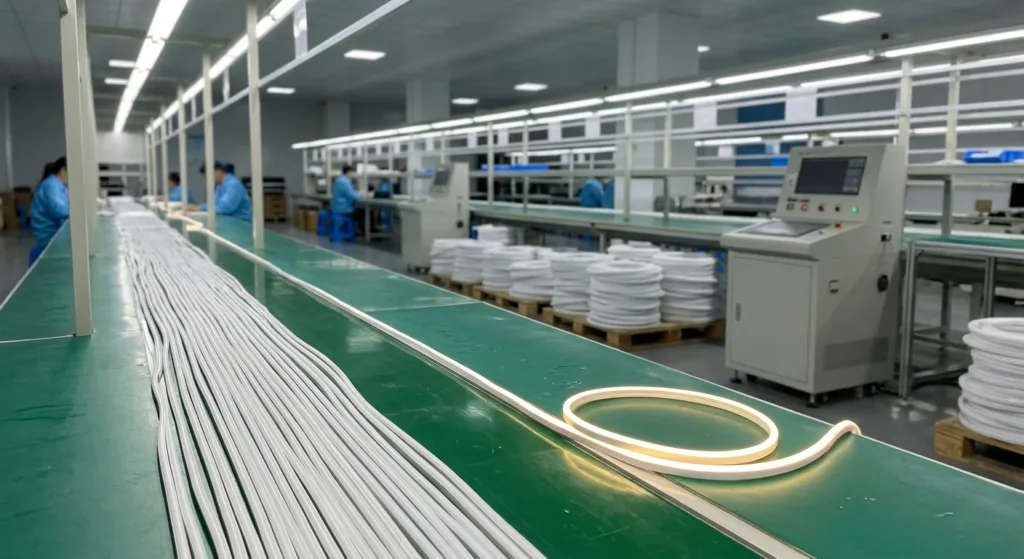
In our manufacturing process, we design the aluminum channel geometry specifically to create continuous thermal pathways. Heat management isn't an afterthought—it's a primary design constraint that determines long-term optical consistency.
④ IP Rating Is the Waterproofing Starting Point, Not the Lifespan Indicator
The real environmental threats to full-color outdoor signage aren't about passing IP65/IP67 tests. They're about surviving:
UV exposure + rainwater + thermal cycling (creates progressive material stress) Gel micro-crack propagation (invisible initially, catastrophic eventually) Long-term capillary infiltration (bypasses initial sealing completely)
IP ratings tell you the system works on day one. They don't tell you whether it still works on day 500 after 200 thermal cycles and 1500 hours of UV exposure.

⑤ Power Supply Isn't Just Electricity—It's a Lifespan Control System
Many project failures have a hidden root cause that's never properly diagnosed:
Chronic slight overload operation (within rated capacity but above optimal efficiency) Voltage fluctuation causing RGB ratio deviation (red channel typically drifts first) Driver thermal degradation causing progressive output drift (current slowly decreases)
The symptom isn't "lights going out." The symptom is that colors gradually become "wrong" in ways that are difficult to measure but obvious to the human eye.
This is why we specify constant-current drivers with thermal compensation in our full-color systems. The power supply must actively compensate for the inevitable aging of the optical system, or the entire installation will drift out of specification.
Conclusion
Full color LED outdoor and business signs aren't about making illuminated graphics. They're about maintaining three-channel optical system consistency in continuously changing outdoor environments. Real success is measured not in the first three months, but after 12-18 months of environmental stress accumulation.