
Before you rush to check rankings, first ask: which company can keep your project alive for 5+ years?
If you've ever managed commercial signage, chain store branding, mall wayfinding systems, hotel facade identities, or urban landmark projects, you know the harsh reality: the biggest risk in Neon Sign projects is not picking the wrong supplier—it's using the wrong criteria to evaluate them.
[toc]

Most buyers focus on company size, factory area, product catalogs, sample quality, unit price, and lead time. These matter. But what truly determines whether your project will require mass rework later is a different question: Does this company genuinely understand the failure mechanisms of Neon Signs in real-world environments?
What Kills Large-Scale Neon Sign Projects?
The real cost is never the manufacturing price.
For large identity projects, the truly expensive part is always the post-installation maintenance cost. Many Neon Sign companies sell products. Companies that truly understand engineering sell risk control capabilities.
If you've managed projects before, you know what matters most. I don't care whether a company can make the sign. I care where that sign will start failing five years from now. Almost all large-scale Neon Sign projects follow an identical failure path.
Stage 1: Perfect appearance. Stage 2: Local brightness drop. Stage 3: Color shift appears. Stage 4: Sealing structure ages. Stage 5: Moisture intrusion. Stage 6: Batch failure.
The problem is when you discover the fault, the real failure has already been happening for two years.
A Real Case That Collapsed an Entire Brand Image
An international restaurant chain upgraded store signage systems across North America. They used LED Neon Sign solutions. The first batch covered over 300 stores. Sample stage performance was excellent—uniform brightness, consistent color, all waterproof tests passed. The project delivered smoothly.
Six months later, problems emerged. South-facing stores gradually showed slight yellowing. By 12 months, some stores' red logos shifted to orange. By 18 months, color differences between stores were visible to the naked eye. The brand headquarters started receiving complaints.
The final failure analysis revealed the LED was fine. The power supply was fine. The real problem came from the material system. The supply chain had replaced some silicone raw materials. Although light transmission remained consistent, the UV stabilizer system was different. This caused completely different aging speeds.
Worse still, subsequent restocking came from different production batches. Color coordinates had shifted. The final result was not one broken sign. It was the entire brand visual system losing uniformity. This type of loss far exceeds lighting costs. Brand consistency itself is an asset.
What Are the Three Most Hidden Risks from Neon Sign Companies?
Many companies showcase samples.
But projects ultimately face environments. Environments never operate according to laboratory standards.
Risk 1: Treating IP Rating as Lifespan
Many suppliers emphasize IP65, IP67, IP68. But few explain under what conditions these tests were completed. In real projects, UV radiation, rain, acid rain, salt spray, and temperature cycling exist simultaneously.
Most Neon Signs that eventually leak water don't fail at the lamp body. They fail at:
- Wire outlet points
- End caps
- Connectors
- Potting zones
These areas are the real failure sources.
| Failure Point | Laboratory Test | Real Environment | Consequence |
|---|---|---|---|
| Wire Outlets | Static IP test | Thermal cycling + UV | Seal cracking within 18 months |
| End Caps | Room temperature seal | -20°C to +60°C cycling | Material embrittlement |
| Connectors | Dry air testing | High humidity + salt spray | Corrosion penetration |
| Potting Zones | Single cure cycle | Multiple thermal expansions | Adhesion failure |
Risk 2: Guaranteeing Factory Color, Not Future Batch Color
For chain brand projects, one of the most dangerous issues is restocking color difference. The first batch has a red logo. The second batch also has a red logo. Specifications are identical. Actual visual effects are completely different.
Causes typically include LED BIN changes, phosphor system variations, supply chain replacements, and batch drift. For brand projects, color difference is often more serious than dead LEDs. This is why I always insist on color coordinate locking rather than simple color temperature specs.
Risk 3: Ignoring Thermal Expansion Stress
This is the most underestimated outdoor Neon Sign problem. Many signs use rigid fixation during installation to achieve straight lines. Result: summer expansion, winter contraction. After long-term cycling:
- PCB fatigue
- Solder joint cracking
- Seal layer delamination
- Local dark zones
Many failures look like waterproofing problems. Actually, the root cause is stress problems.
What Do Truly Professional Neon Sign Suppliers Focus On?
Not advertising brochures.
Failure pathways.
1. Material System Compatibility Verification
Truly mature projects must verify:
- Silicone and sealant compatibility
- Silicone and double-sided tape compatibility
- UV aging compatibility
- Long-term thermal aging compatibility
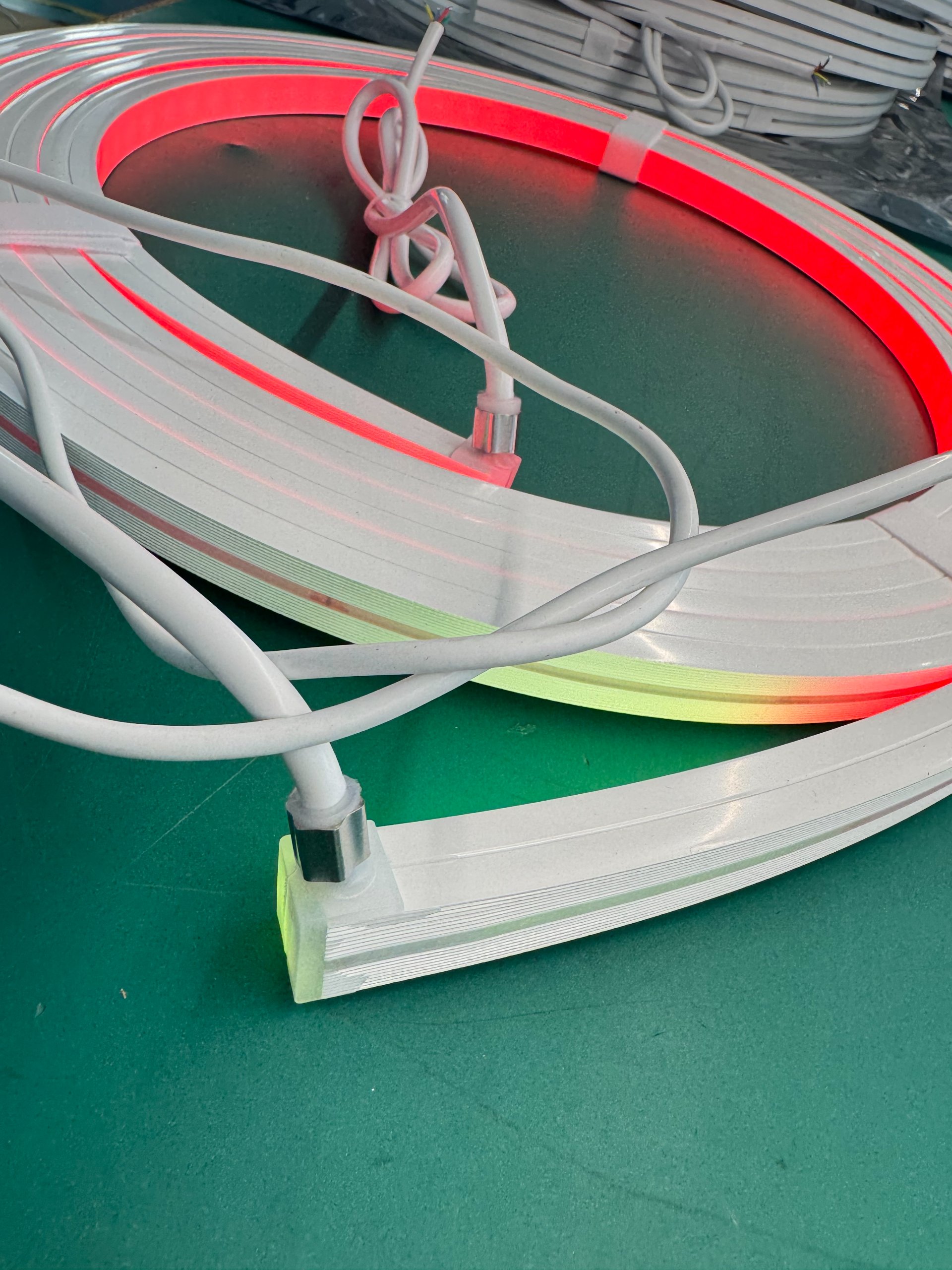
Because much yellowing does not come from the silicone itself. It comes from surrounding material contamination. We conduct full compatibility matrices before finalizing any material specification. This prevents interface failures that only appear after 12-18 months in the field.
2. Lock Color Temperature and Color Coordinates
Large brand projects must achieve:
- Locked BIN
- Locked color coordinates
- Locked batches
Not simply locking "3000K", "6500K", or "RGB Red". What truly affects visual consistency is never the name. It's the color coordinates. I've seen projects fail because suppliers switched from one "warm white" to another "warm white"—both 3000K, but visually different by 200K.
| Specification Method | Consistency Over Time | Suitability for Chain Projects |
|---|---|---|
| Color Name Only | Poor (±500K variation) | Unsuitable |
| CCT Range | Moderate (±150K variation) | Conditional use |
| BIN Code Locked | Good (±50K variation) | Recommended |
| Color Coordinate Locked | Excellent (±3 SDCM) | Professional standard |
3. Select Structure Based on Installation Environment
Different projects correspond to different structures. For example:
Building facades focus on UV stability, thermal expansion compensation.
Chain stores focus on batch consistency, future restocking management.
Coastal projects focus on salt spray resistance, seal lifespan.
High-temperature regions focus on material softening temperature, compression permanent deformation.
Wrong structure selection means guaranteed future problems. It's just a matter of time. We conduct environment surveys before specification—not after complaints arrive.

4. Verify Real Lifespan, Not Laboratory Lifespan
Many suppliers provide LM80, IP testing, UV testing. These are important. But what you should truly focus on is: Do these tests approximate real environments?
Because 1000 hours in the laboratory does not equal five years outdoors. Truly valuable data should include:
- UV + wet heat composite aging
- Thermal cycling testing
- Salt spray testing
- Long-term mechanical fatigue testing
These are closer to real projects. I always request accelerated aging data that combines multiple stressors—not single-factor tests. Real environments don't attack one variable at a time.
| Test Type | Standard Duration | Real Environment Equivalent | Value for Project Prediction |
|---|---|---|---|
| LM80 Photometric | 6,000 hours | ~2 years indoor | Moderate |
| UV-only aging | 1,000 hours | ~6 months outdoor | Low |
| Combined UV + Thermal | 2,000 hours | ~3 years outdoor | High |
| Salt Spray + UV + Thermal | 1,500 hours | ~5 years coastal | Very High |
How to Actually Evaluate the Top 10 Neon Sign Companies
When you search "Best 10 Neon Sign Companies to Light Up Your Space," the real determinant of project success is never which company ranks first.
It's which company can tell you in advance where this project will most likely start failing in the future.
Anyone can create a ranking based on:
- Number of employees
- Years in business
- Website design quality
- Sample library size
- Social media followers
- Trade show presence
But these metrics don't predict field performance. What I look for in a true engineering partner:
Do they ask about your installation conditions before quoting?
Professional companies immediately ask: Indoor or outdoor? Coastal or inland? Average annual temperature range? Direct sun exposure hours? Mounting method? This tells me they're thinking about failure modes, not just sales.
Can they show you failed samples and explain why?
Companies that only show perfect samples worry me. Companies that show me how they've analyzed returns, identified root causes, and modified designs—those are partners.
Do they maintain batch traceability?
For chain projects with 50+ locations, batch control is everything. Can the supplier link every meter of flex to its exact production date, raw material lot, and LED BIN code? If not, you'll face restocking nightmares.
Have they designed their product around maintenance, not just installation?
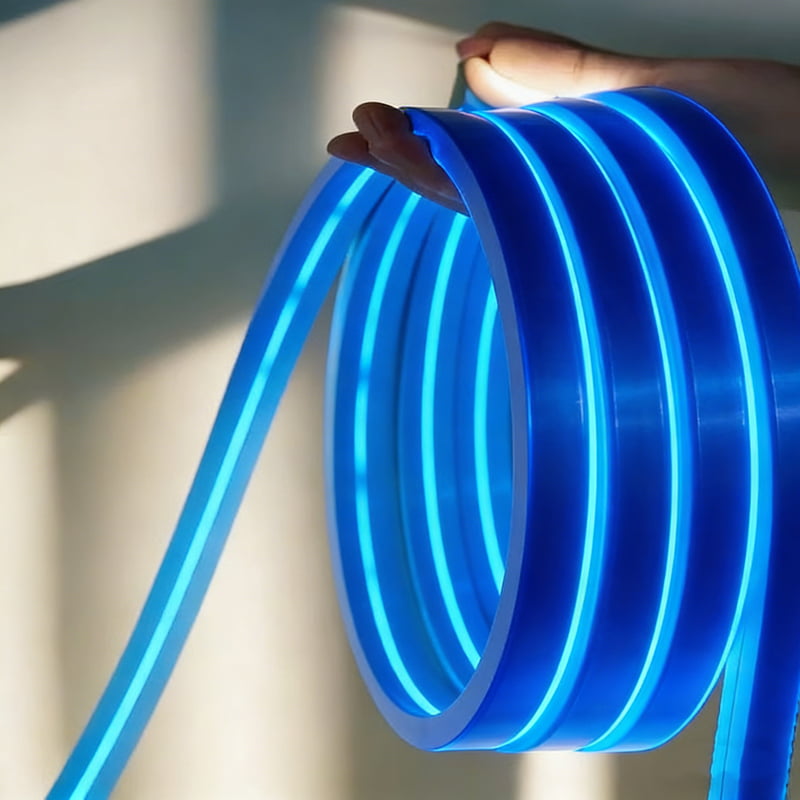
Real projects need serviceability. Can sections be replaced without dismantling the entire run? Are connectors field-serviceable? Is the end-cap design foolproof for non-specialists? These details don't show up in catalogs. They show up at 2 AM when something fails.
Why Material Science Matters More Than You Think
Most buyers think all silicone is basically the same. It's not. The difference between food-grade high-molecular silicone and commodity-grade material is massive—not in week one, but in year three.
We use 100% food-grade silicone extrusion for a reason. Food-grade means strict limits on volatile organics, plasticizers, and additives that migrate over time. These contaminants are what cause yellowing, even when the base polymer is UV-stable.
Anti-UV stabilizers are not all equal. Some work by absorption (they eventually saturate). Some work by radical scavenging (they deplete over time). Some work by reflection (they can affect color). The best systems use multi-mechanism protection. We specify HALS (Hindered Amine Light Stabilizers) combined with UV absorbers—this provides redundant protection.
Salt-spray resistance requires more than just sealing. It requires material selection that resists chloride ion migration. Standard silicone can pass initial salt spray tests but fail after repeated wet-dry cycling because chlorides penetrate at molecular level.
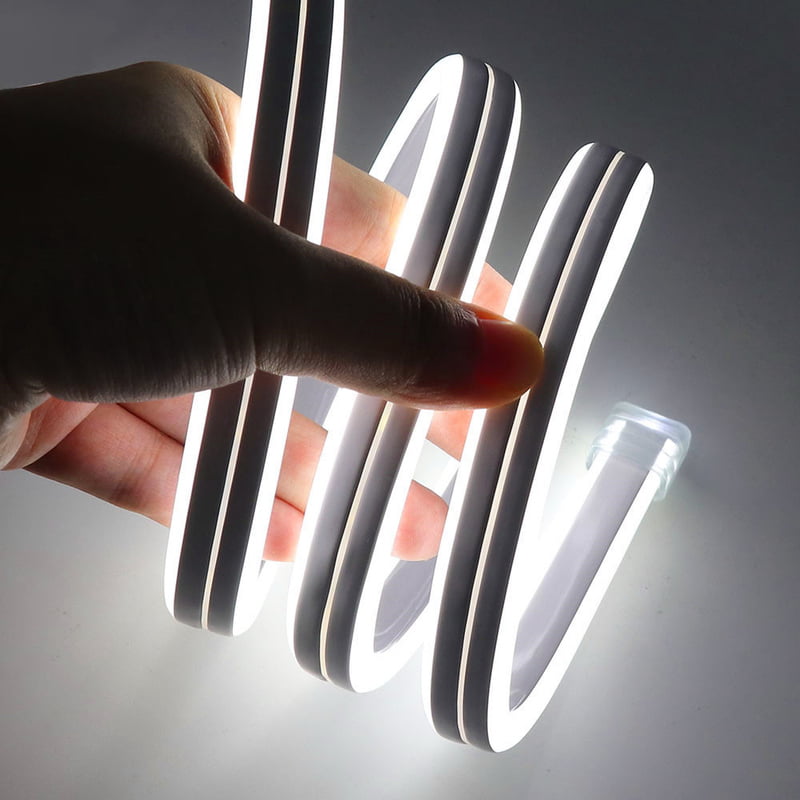
The non-yellowing guarantee we provide isn't just marketing. It's backed by accelerated aging protocols that simulate 5+ years of UV exposure, thermal cycling, and moisture. We track color shift in Delta E units. Our specification allows maximum Delta E < 2.0 after equivalent 5-year exposure. Industry standard is often Delta E < 5.0. That difference is visible.
Temperature performance from -40°C to +60°C means the material doesn't just survive these extremes—it maintains mechanical properties. Silicone that becomes brittle at -40°C will crack during cold snaps. Silicone that softens excessively at +60°C will sag or deform under its own weight.
The OEM/ODM Question: When Does Customization Make Sense?
Not every project needs customization. Standard products exist because they solve common problems efficiently. But certain projects absolutely require OEM/ODM capabilities.
You need customization when:
- Your installation environment is non-standard (extreme cold, high altitude, marine)
- Your brand has strict color specifications that don't match stock CCT options
- You need integrated smart control (SPI/DMX512/DALI) for complex programming
- Your architectural design requires non-standard cutting lengths or bend radii
- You're building a long-term platform and need guaranteed supply continuity
You don't need customization when:
- Your project follows standard architectural patterns
- Standard color temperatures (3000K, 4000K, 6500K) meet your needs
- You need fast turnaround and don't want tooling lead time
- Your volume is small and customization costs outweigh benefits
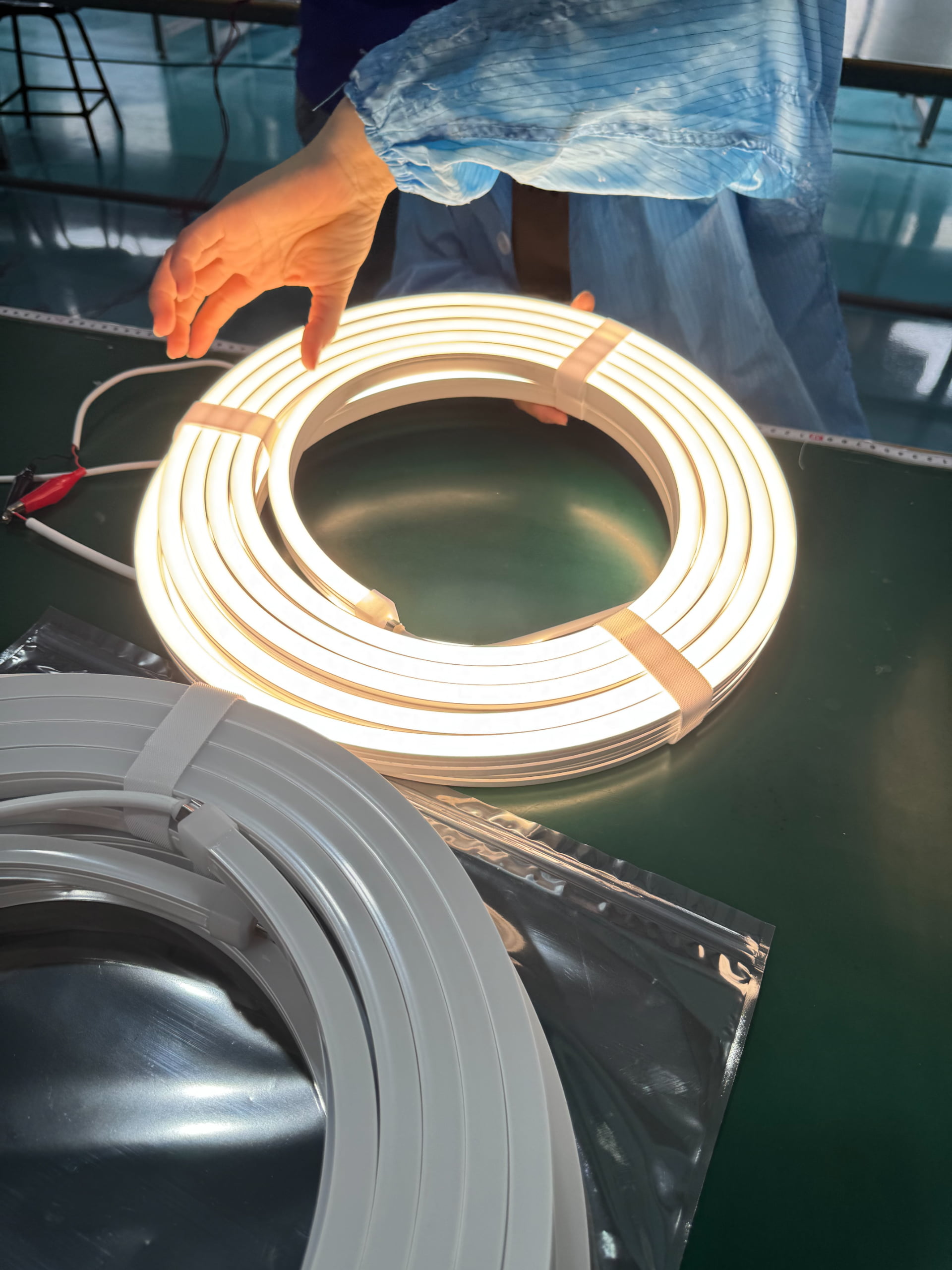
From our experience, successful OEM/ODM partnerships share common traits. The client provides detailed environmental specs, not just aesthetic preferences. They understand that customization requires iteration—first prototypes almost never nail everything. They budget for tooling and testing, not just unit cost. They plan for lifecycle, not just initial purchase.
We've customized everything from bespoke CCT blends for museum lighting (matching specific artwork illumination requirements) to ruggedized marine-grade flex for yacht exteriors (salt spray + UV + constant flexing) to ultra-slim 8mm profiles for jewelry case lighting (minimal visual intrusion).
But every successful customization started with understanding the failure modes we needed to prevent.
What the Certifications Actually Tell You
CE, RoHS, UL—these matter for market access. They're table stakes. But they don't predict field performance.
CE certification means the product meets European safety and EMC standards. It doesn't test long-term reliability or environmental aging.
RoHS compliance means restricted substances are below limits. It's essential but tells you nothing about UV resistance or color stability.
UL listing is more rigorous—it includes fire safety, thermal testing, and construction review. For North American projects, UL or ETL listing is often mandatory. But even UL testing is conducted in controlled conditions.
What matters more than certification logos is: Does the supplier conduct application-specific testing beyond mandatory compliance?
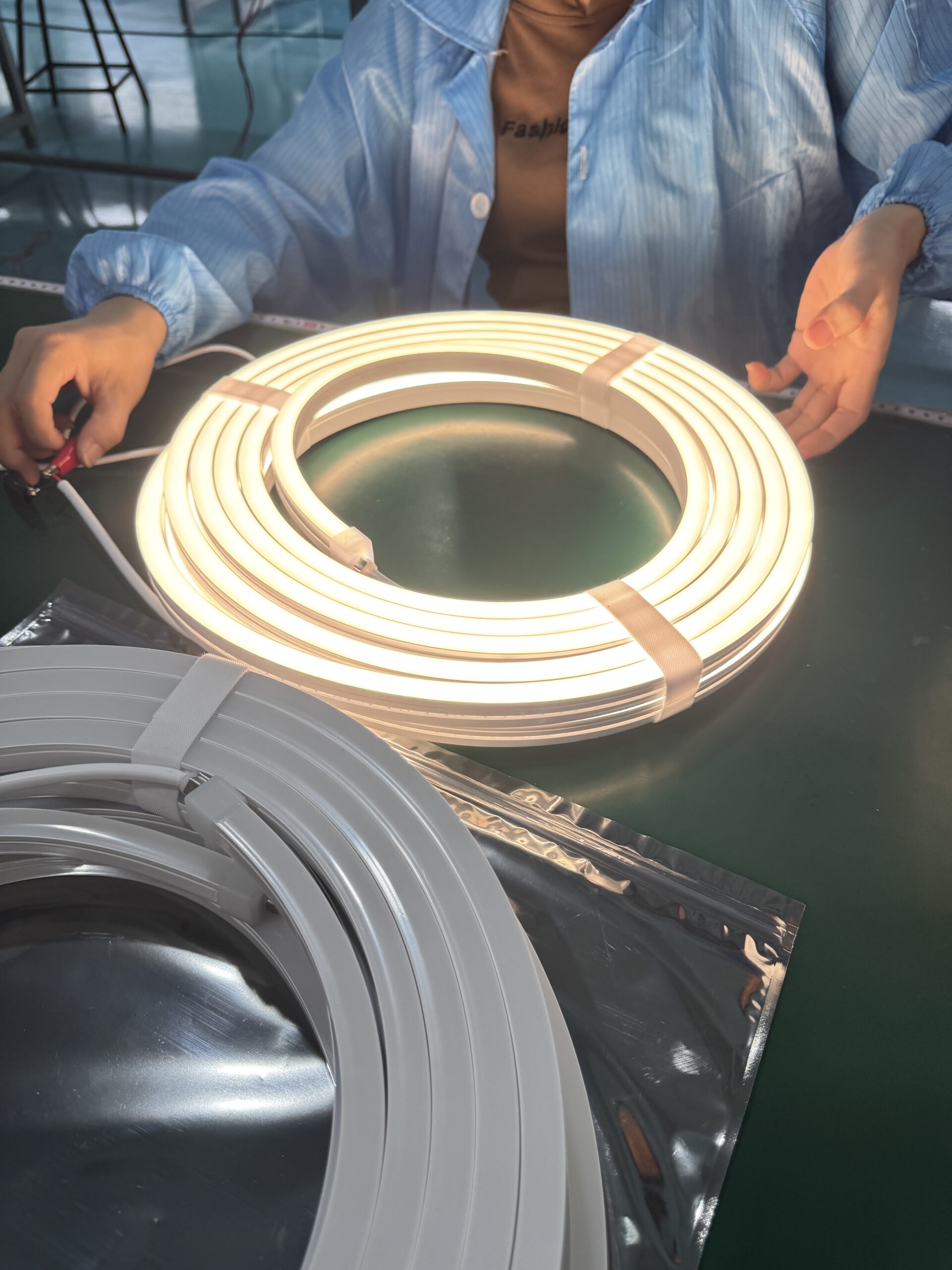
For instance, we conduct:
- Extended thermal shock testing (beyond UL requirements) because we know coastal installations face rapid temperature swings
- Accelerated UV + humidity co-exposure because separate testing misses synergistic degradation
- Flex fatigue testing (repeated 90° bending) because architectural installations involve constant wind loading
These tests aren't required for certification. They're required for not getting callback failures in year three.
The Hidden Cost of Choosing Wrong: A Five-Year Calculation
Let's do realistic math on a chain store project. Assume 100 locations, 20 meters of neon flex per location, $15/meter material cost difference between "cheap" and "engineered" options.
Initial cost difference: $30,000 ($15 × 20m × 100 locations)
Seems significant. But now add maintenance scenarios:
Scenario 1: Cheap supplier, 30% failure rate by year 3
- Failed locations: 30 stores
- Replacement cost: $500/store (materials + labor + logistics)
- Total: $15,000
- Plus brand damage from inconsistent signage: Unquantifiable but real
Scenario 2: Engineered supplier, 3% failure rate by year 5
- Failed locations: 3 stores
- Replacement cost: $500/store
- Total: $1,500
The "cheap" option ends up costing $15,000 - $1,500 = $13,500 more in maintenance alone. The initial $30,000 "savings" becomes a net $16,500 incremental cost ($30,000 - $13,500).

And this calculation ignores:
- Brand reputation impact from failed signage
- Project manager time dealing with complaints and coordination
- Opportunity cost of capital tied up in premature replacement inventory
- Customer confusion when store colors don't match
For large-scale projects, buying based purely on unit price is buying a liability, not an asset.
What Questions to Ask Before You Choose
When evaluating potential neon sign suppliers, skip the surface-level questions. Ask these instead:
"Can you provide UV aging data for your actual production material, not generic silicone datasheets?"
This separates companies that engineer their supply chain from companies that assemble components.
"What is your batch-to-batch color coordinate tolerance, and how do you control it?"
Vague answers like "we ensure consistency" are red flags. Specific answers like "we maintain