
If you've ever specified custom LED neon signs for brand identity, commercial spaces, chain stores, building facades, or large-scale wayfinding systems, you've probably noticed something troubling.
The more customized your LED neon sign becomes, the higher the probability of failure after installation—not because of the LED quality, but because complex shapes often exceed the long-term structural capacity of the materials themselves.

I've seen too many projects fail not during manufacturing, but 18 months after installation—when thermal cycling, UV exposure, and material stress finally catch up with an over-ambitious design that looked perfect in the sample stage.
Why Do Custom LED Neon Signs Fail More Often Than Standard Products?
Most buyers evaluate custom LED neon signs based on obvious criteria.
They check whether the font matches the brand guidelines, whether the color temperature is accurate, whether the illumination is uniform, whether installation is straightforward, and whether the price fits the budget.
The Real Problem Lies Deeper Than Surface Quality
The true determinant of whether a custom LED neon sign will operate reliably for five-plus years is rarely discussed during the quotation phase.
It's this question: Does this custom shape exceed the material's long-term load-bearing capacity?
Because the biggest risk with custom LED neon signs is never whether you can manufacture it.
The risk is whether it can maintain its original form after years of real-world stress.
| Evaluation Stage | What Most Buyers Check | What Actually Determines Longevity |
|---|---|---|
| Design Phase | Visual appeal, brand alignment | Structural stress distribution |
| Sample Testing | Initial brightness, color accuracy | Material compatibility under load |
| Installation | Ease of mounting | Thermal expansion allowance |
| Post-Installation | Immediate function | Long-term dimensional stability |
I remember working with an international restaurant chain expanding into the Middle East.
They commissioned large custom LED neon signs featuring their brand logo—a design with continuous curves and tight-radius corners.
The design stage looked flawless.
Sample testing passed every metric.
The brand team was thrilled.
Batch production began, and installation proceeded smoothly across dozens of locations.
For the first three months, everything functioned perfectly.
Then summer arrived, and exterior wall surface temperatures regularly exceeded 80°C.
By month six, we started seeing corner brightness degradation and localized uneven illumination.
By year one, certain strokes began subtle deformation.
By year two, water ingress and flickering appeared in isolated sections.
When we disassembled failed units, we discovered something critical: the LEDs were fine, the drivers were fine—the problem originated in the structural design.
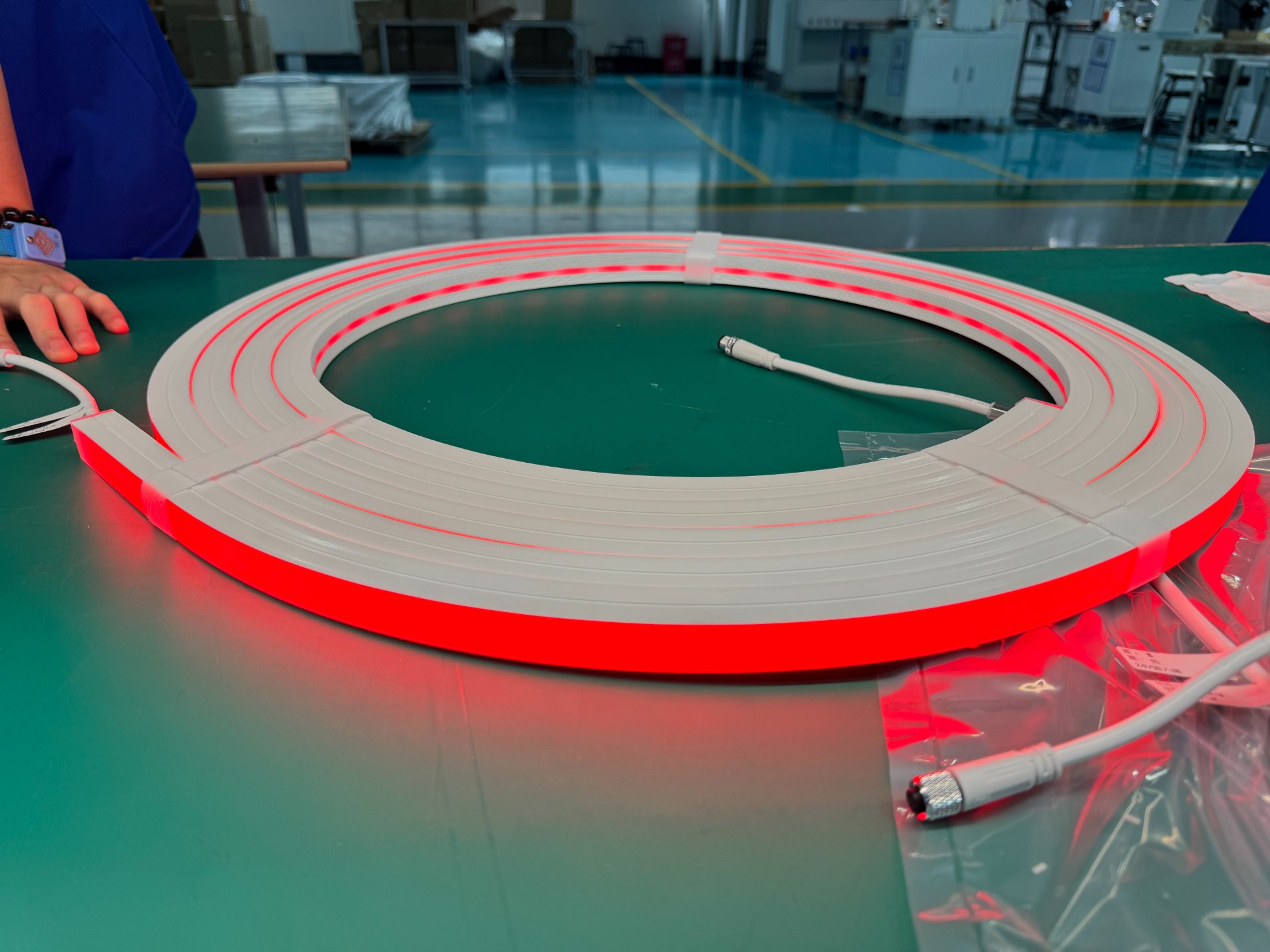
To achieve perfect font reproduction, the design team had specified bend radii far below the product's recommended minimum values.
During installation, the material was forced into shape, leaving the PCB substrate under constant mechanical stress.
High ambient temperatures accelerated material creep, leading to copper foil fatigue, solder joint cracking, and eventual seal layer failure—resulting in systematic batch failures.
The most devastating aspect?
Sample-stage testing revealed nothing, because laboratory tests last weeks while field stress accumulation occurs over years.
This is the most dangerous characteristic of custom LED neon signs: many problems aren't manufactured—they're designed in from the beginning.
What Are the Hidden Structural Traps in Custom LED Neon Sign Projects?
Many people assume the biggest challenge in custom projects is manufacturing difficulty.
Actually, the real danger is this: complex shapes amplify every material and structural defect.
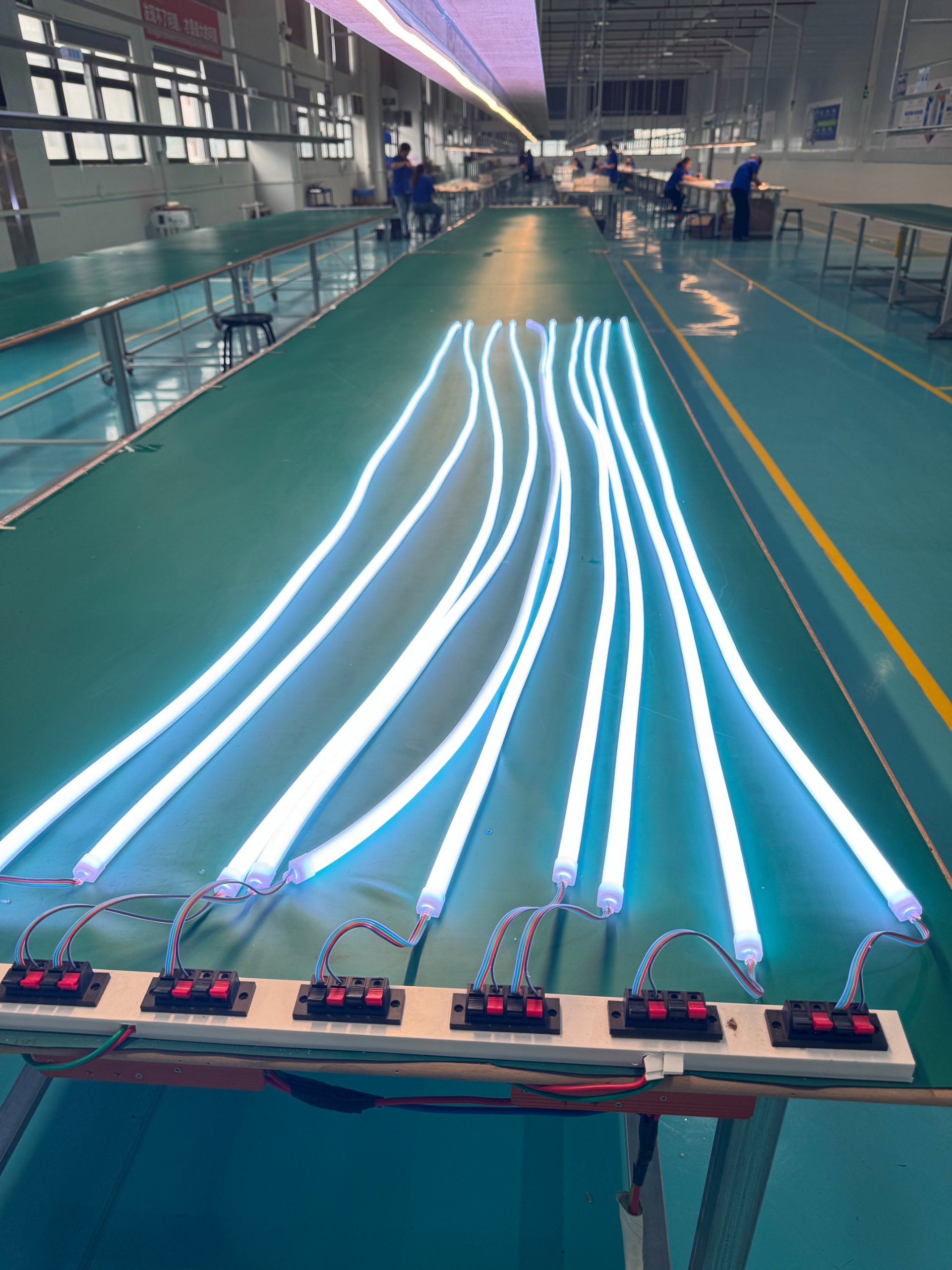
Standard straight configurations can tolerate many issues—complex curves cannot.
Especially problematic are:
- Small-radius letterforms
- Continuous arcs
- Extended strokes
- Cantilevered mounting
- Irregular contours
These locations are natural stress concentration zones.
If design-stage decisions ignore structural lifespan, post-installation failure becomes nearly inevitable.
| Design Element | Visual Impact | Structural Risk | Long-Term Reliability |
|---|---|---|---|
| Tight corners | High brand fidelity | Extreme PCB stress | Low without reinforcement |
| Long continuous runs | Dramatic visual effect | Thermal expansion mismatch | Moderate with expansion joints |
| Thin stroke width | Elegant appearance | Limited heat dissipation | Low in high-temperature environments |
| Multi-plane curves | Architectural integration | Complex stress distribution | Very low without engineering analysis |
Trap #1: Bend Radius Exceeding Material Limits
Many projects focus solely on whether the shape can be formed, not whether it can be maintained long-term.
In reality, most failures occur at letter corners, logo curves, and graphic connection points—because these regions sustain continuous PCB tension, copper foil stress, and solder joint fatigue.
Immediately after installation, everything appears normal.
After thousands of thermal cycles, problems concentrate and cascade.
Trap #2: Material System Incompatibility
Custom LED neon signs typically involve silicone, acrylic, PVC, double-sided tape, sealant, and metal backing plates.
The problem?
Each material ages at a different rate and has a different thermal expansion coefficient.
Yellowing, delamination, and cracking in many projects aren't caused by single-material failure—they result from materials losing equilibrium with each other.
Especially critical: adhesive-silicone incompatibility remains one of the industry's most common hidden failure sources.
Trap #3: Reorder Color Shift
For brand projects, the most dangerous problems often emerge during the second procurement cycle.
The first batch maintains color consistency, the second batch matches specifications, but by the third batch, color shift appears—usually not from incorrect color temperature, but from:
- BIN code variations
- LED packaging changes
- Diffusion material modifications
Result: the same brand logo displays different colors across locations.
This type of problem is far more difficult to resolve than dead LEDs because replacement units don't match existing installations.
What Engineering Solutions Actually Prevent Long-Term Custom LED Neon Sign Failure?
Professional custom LED neon sign projects don't start with design renderings—they start with structural constraints.
Solution #1: Begin Custom Design with Minimum Bend Radius
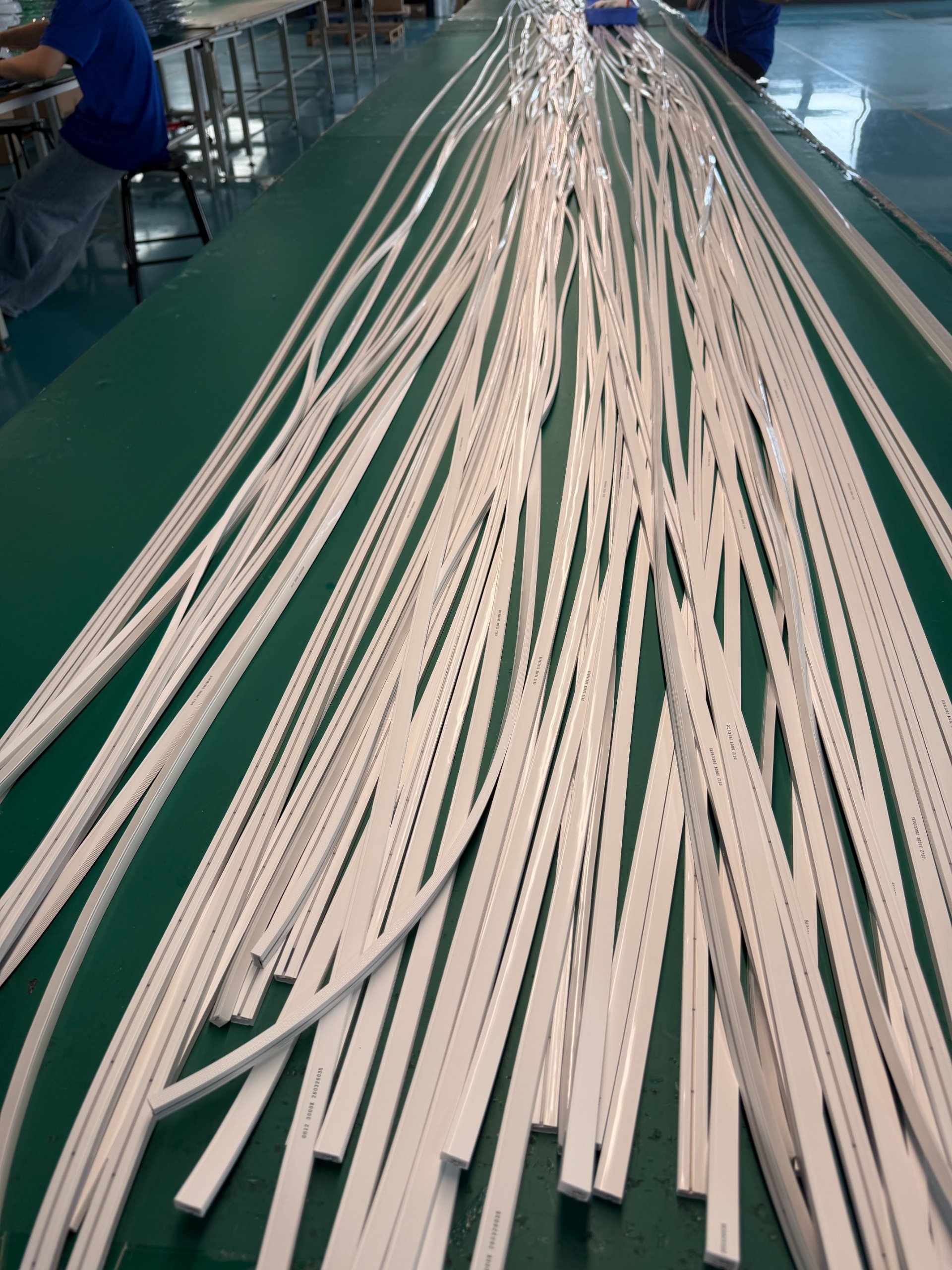
Mature projects establish the structurally permissible minimum bend radius before finalizing any design, because any shape exceeding material limits will eventually become a warranty issue.
Particularly for small fonts, script typefaces, and continuous-curve logos, designs must be structurally optimized rather than forcing production to match the original artwork.
Solution #2: Reduce Copper Foil Stress in Bend Zones
Many failures occur at corners due to stress concentration.
Reliable solutions require optimized PCB layout, controlled copper foil width transitions, and reduced solder joint loading—because while LED failure is repairable, PCB fatigue represents systemic failure onset.
Solution #3: Validate Material Lifespan in High-UV Regions
Many supposedly anti-yellowing products base claims on idealized test environments.
Real-world yellowing results from combined effects of UV radiation, high temperature, humidity, acid rain, and air pollution.
What actually needs verification:
| Test Parameter | Standard Lab Test | Real-World Critical Metric |
|---|---|---|
| UV resistance | 1000-hour accelerated aging | Post-UV light transmission retention |
| Color stability | Initial CCT measurement | Color coordinate shift after 3000 hours |
| Mechanical integrity | Tensile strength at 23°C | Flexibility retention after thermal cycling |
Rather than relying solely on factory specifications, we conduct extended environmental exposure testing before approving materials for outdoor installations.
Solution #4: Establish Material Compatibility Validation Protocols
Particularly for silicone-adhesive, silicone-acrylic, and silicone-coating interfaces, long-term compatibility verification is essential.
Many delamination failures don't stem from insufficient bond strength—they result from material migration causing interfacial degradation over time.
Solution #5: Lock BIN Codes, Not Color Names
For brand identity applications, "red" is not simply red, and "blue" is not simply blue.
What truly matters are color coordinates.
Mature projects implement BIN code locking, color coordinate specification, and project-specific batch management—without these controls, reorders will inevitably exhibit color shift.
Solution #6: Allow Material Movement in Mounting Structures
Many custom LED neon signs ultimately fail not from aging but from being mounted too rigidly.
Especially for outdoor installations, large-format logos, and metal-backed structures, designs must incorporate thermal expansion clearance, stress relief zones, and installation tolerances—otherwise, materials will eventually release stress through cracking.
Conclusion
When evaluating a custom LED neon sign solution, the critical question isn't whether it can be manufactured to match your design—it's whether that design can survive thousands of thermal cycles, UV exposure, material aging, structural stress accumulation, and multiple maintenance interventions while maintaining its original color, brightness, contour, and structural integrity.
Because for custom LED neon signs, the greatest technical challenge is never manufacturing—it's making a complex design exist stably in real conditions for many years.