

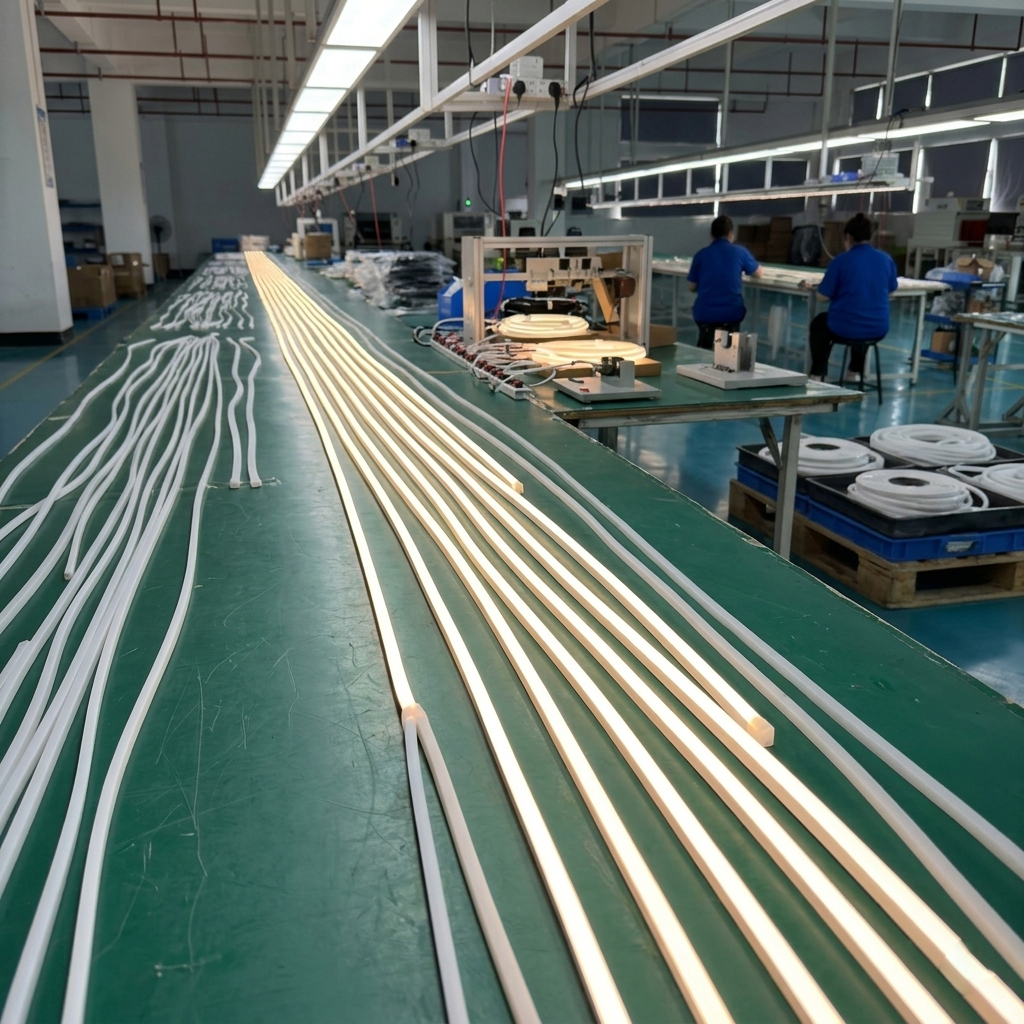
Over the past few years, I've watched a purchasing trend explode across commercial lighting and signage projects: Wholesale LED Neon Dropshipping for orders exceeding 1,000 units. The promise is simple—bulk pricing, flexible supply, and rapid deployment. But I've seen too many engineering teams discover, too late, that this "traffic-driven procurement model" creates invisible systemic risks that no one designed for.
Here's the uncomfortable truth: The same supply chain "efficiency" that makes your 1k+ LED neon order feel smooth is quietly fracturing your project's structural integrity—and most teams don't realize it until installation begins.

The core problem isn't dropshipping itself. It's that project teams confuse "supply chain speed" with "engineering certainty." When you scale to 1,000+ units across multiple suppliers, you're not just buying lights—you're inheriting a fragmented manufacturing ecosystem where batch consistency, installation compatibility, and visual uniformity become variables, not constants.
Why Does "1k+ Bulk Order" Feel Like a Standardized Engineering Solution?
I hear this logic all the time from procurement managers: "We're ordering over 1,000 units. The SKU is locked. Multiple suppliers can fulfill it. Prices are competitive. Delivery is fast." Then they conclude: "This must be a mature, standardized supply chain project."
On paper, it makes perfect sense. Large volumes traditionally signal predictability. But in LED neon dropshipping, scale creates the illusion of standardization while hiding structural complexity.

The Three Surface-Level "Engineering Advantages" That Mislead Teams
Dropshipping models present three deceptive qualities:
- SKU Unity (Apparently): Every supplier lists the same model number.
- Order Scale (Apparently): Large volumes suggest manufacturing maturity.
- Response Speed (Apparently): Fast quoting and shipping feel like operational readiness.
These traits create a false narrative: Bigger orders = Tighter standards = Lower risk.
But here's what this overlooks: Supply chain structural complexity hasn't decreased—it's been concealed. You're not consolidating manufacturing control. You're distributing it across disconnected production lines, each with micro-variations in extrusion tolerances, LED binning, and silicone curing protocols.
Where the Decision Error Actually Occurs
The fundamental mistake is applying e-commerce logic to engineering execution.
E-commerce logic prioritizes:
- Transaction efficiency
- Unit cost reduction
- Shipping speed
Engineering logic demands:
- System-level consistency
- On-site realizability
- Cross-environment stability
- Batch behavioral uniformity
In dropshipping, these two frameworks get forcibly merged. Your procurement team optimizes for the first set. Your installation crew gets stuck managing the second. And no one owns the gap in between.
| Decision Layer | E-Commerce Priority | Engineering Requirement | Gap Risk |
|---|---|---|---|
| Sourcing | Lowest per-unit cost | Single-source batch control | Multi-factory variance |
| Fulfillment | Fastest dispatch | Installation-sequence delivery | Mismatched site readiness |
| Validation | Sample approval | System integration testing | Batch inconsistency |
| Accountability | Platform terms of service | End-to-end project ownership | Responsibility void |
This structural mismatch manifests in five predictable failure modes:
- Same Model, Different Performance: Different batches from different factories exhibit micro-variations in luminous intensity, color rendering, and flex radius—invisible in samples, visible at scale.
- Schedule Looks Normal, Work Keeps Resequencing: Distributed fulfillment means Region A gets product while Region B waits. Your Gantt chart becomes fiction.
- Installation Adapts to Product (Not Vice Versa): Crews start modifying mounting methods per batch instead of following a unified spec.
- Acceptance Criteria Get Quietly Downgraded: To hit deadlines, teams start segmenting inspections and rationalizing "acceptable variance."
- Responsibility Structure Atomizes: The platform says "We just connect buyers and sellers." Suppliers say "We only control our batch." Contractors say "The material keeps changing." Procurement says "We ordered what you specified." No one owns system outcomes.
How a 120-Store Commercial Street Upgrade Collapsed Under "Efficient" Dropshipping
Let me walk you through a project I reviewed last year—a cautionary tale that's become disturbingly common.
The Setup: A developer needed to rebrand 120 retail storefronts across an international commercial district in 90 days. The plan was to use Wholesale LED Neon Dropshipping with orders exceeding 1,000 fabricated logo units. The procurement model: multi-supplier parallel sourcing, platform-aggregated ordering, direct-to-site batch shipping.

Phase 1: Platform Procurement Launches Smoothly
The purchasing structure looked textbook:
- Multiple pre-qualified suppliers
- Unified SKU specification
- Centralized order processing
- Phased regional delivery
Everyone felt confident. The model had "worked before" in smaller pilots.
Phase 2: Sample Validation Passes Without Issues
Every supplier submitted prototypes. They all matched:
- Visual appearance: identical
- Technical specs: within tolerance
- Illumination test: uniform
The design team signed off. The project moved to production.
Phase 3: Batch Delivery Begins—Discrepancies Emerge
The first wave of shipments arrived at installation sites. That's when installers started reporting anomalies:
- Luminous border widths varied by 0.8mm–1.2mm between batches (same logo, different visual weight)
- Color temperature shifted from 3000K to 3200K across suppliers (samples were all 3000K)
- Mounting channel compatibility diverged—some units required modified brackets
These weren't defects. Every batch met its individual supplier's internal QC. But the system was diverging.
Phase 4: On-Site Execution Loses Structural Control
Installation crews faced an impossible situation. Each new batch required:
- Adjusted mounting protocols
- Recalibrated power distribution
- Modified trim details
The "unified installation manual" became obsolete. Crews started improvising per batch. The project stopped being an engineering system and became a series of adaptive workarounds.
Phase 5: Systemic Failure Across Three Dimensions
By month two, the project exhibited total loss of control:
1. Visual System Breakdown The same brand logo now displayed:
- Variable brightness (10–15% flux difference)
- Inconsistent color (noticeable under daylight comparison)
- Non-uniform edge sharpness
2. Construction System Collapse Installation teams abandoned the master spec and began "installing to the batch." This meant:
- No transferable learning between crews
- No predictable labor productivity
- No enforceable quality benchmarks
3. Project Management Dissolution What started as "one integrated project" fractured into:
- Parallel mini-projects per supplier
- Competing installation standards
- Fragmented acceptance procedures
| Failure Dimension | Original Assumption | Actual Outcome |
|---|---|---|
| Visual Unity | Uniform brand presentation | 15% luminous variance across zones |
| Installation Efficiency | Replicable process | Batch-specific adaptation required |
| Quality Control | Single acceptance standard | Region-by-region negotiated criteria |
| Accountability | Clear vendor responsibility | Distributed blame, no system owner |
Why Didn't Anyone Catch This Earlier?
Because all pre-production validation happened in idealized conditions:
- Small sample batches
- Single-supplier evaluation
- Controlled lab environments
No one tested:
- Multi-supplier batch interaction
- Cross-shipment consistency
- Real-world installation sequencing
The system failure wasn't in any individual component. It was in the untested architecture of the procurement model itself.
The Final Cost
- 40% schedule overrun (original 90 days became 126 days)
- High rework rate (estimated 22% of installed units required adjustment or replacement)
- Brand inconsistency (visible luminous variance required post-project correction)
- Cost overrun (unbudgeted remediation and extended labor)
The devastating part? No supplier breached their contract. Every batch met its isolated specification. The failure was systemic, not component-level.
The Hidden Specification Traps in Wholesale LED Neon Dropshipping
Let me break down the six specification illusions that cause most 1k+ dropshipping projects to drift off course.
Trap 1: Identical SKU ≠ Identical Product
In dropshipping, an SKU is a label, not a manufacturing fingerprint. The same model number can route to:
- Different extrusion facilities
- Different LED binning batches (color variance within "3000K" can span 200K)
- Different silicone compound formulations (affecting UV resistance and flexibility)
Why It Matters: Two "identical" 5-meter segments may exhibit different bending radii, making corner installations inconsistent.
Trap 2: Sample Consistency ≠ Production Consistency
Samples typically come from:
- Optimized production runs
- Hand-selected units
- Single-batch material lots
Production fulfillment pulls from:
- Mixed production schedules
- Variable raw material inventory
- Multi-facility allocation
Why It Matters: Your approved sample represented best-case output. Your bulk order represents average-case reality.
Trap 3: Parameter Match ≠ System Compatibility
Standard datasheets cover:
- Voltage (e.g., 24VDC)
- Power consumption (e.g., 10W/m)
- Color temperature (e.g., 3000K ±200K)
They rarely specify:
- Extrusion die tolerances (affects cross-sectional uniformity)
- Optical diffusion consistency (affects "dotless" appearance at scale)
- Thermal expansion behavior (affects long-run installations)
Why It Matters: Two suppliers can hit identical electrical specs but deliver incompatible installation experiences.
Trap 4: Platform Vetting ≠ Engineering Validation
Dropshipping platforms typically verify:
- Business licenses
- Product certifications (CE, RoHS)
- Sample aesthetics
They rarely test:
- Batch-to-batch consistency
- Multi-supplier system integration
- Long-term environmental performance
Why It Matters: Platform approval guarantees transactional legitimacy, not engineering reliability.
Trap 5: Logistics Distribution ≠ Construction Sequencing
Fulfillment logic optimizes for:
- "Ship fastest available inventory first"
Construction logic requires:
- "Deliver in installation sequence"
Why It Matters: When Batch C arrives before Batch A, your schedule breaks—and you can't install out of order without creating visual discontinuity.
Trap 6: Unified Purchase Order ≠ Unified Accountability
In fragmented dropshipping, responsibility splinters across:
- The platform (order aggregation)
- Supplier A (Batch 1–3)
- Supplier B (Batch 4–6)
- Regional logistics (delivery timing)
- Installation contractors (on-site adaptation)
Why It Matters: When problems emerge, everyone points to someone else. There's no single entity responsible for system performance.
| Specification Element | What Gets Verified | What Doesn't Get Verified | Risk |
|---|---|---|---|
| SKU | Model number match | Manufacturing source variance | Cross-batch incompatibility |
| Sample | Single-unit performance | Production-scale consistency | Batch divergence |
| Parameters | Electrical specs | Mechanical/optical uniformity | Installation mismatch |
| Certifications | Compliance documents | Engineering integration | System-level failure |
| Delivery | Shipping confirmation | Construction sequence alignment | Schedule disruption |
| Accountability | Contract existence | System ownership | Responsibility void |
The Project-Level Risk Control Framework You Need
If you're managing a 1k+ LED neon dropshipping project, here's how to impose engineering discipline on a commerce-optimized supply model.
1. Shift from "Procurement Platform Mode" to "Engineering System Mode"
Reframe the project: You're not buying 1,000 light units. You're integrating a distributed manufacturing system into a unified visual outcome. Treat it like systems engineering, not commodity purchasing.
2. Force Supply Chain Convergence
For orders exceeding 1,000 units:
- Designate a primary manufacturing source (single factory, single production line if possible)
- If multi-sourcing is unavoidable, lock sub-suppliers (no dynamic allocation)
- Prohibit ad-hoc fulfillment routing (all batches must trace to pre-approved facilities)
Implementation: Write this into your RFQ: "Supplier must disclose and lock all sub-tier manufacturers prior to PO issuance."
3. Implement Cross-Supplier Consistency Testing
Before committing to full-scale orders, test multi-supplier integration:
- Pull samples from at least 3 different batches (not just one "golden sample")
- Install them side-by-side in a 10-meter continuous run
- Test under actual site lighting conditions (not lab environments)
- Measure luminous uniformity, color delta-E, and joint visibility
Pass/Fail Criteria: If adjacent segments from different suppliers show >5% luminous variance or visible color shift, the supply chain structure is not viable.
4. Build Engineering-Grade Prototypes, Not Commerce Samples
Your validation sample must include:
- Actual installation hardware (not just the flex strip)
- Real-world mounting conditions (corners, vertical runs, overhead spans)
- Full-length power distribution (not just 1-meter segments)
- Environmental exposure testing (if outdoor: UV, thermal cycling, moisture)
Why: A 20cm desk sample tells you nothing about a 50-meter rooftop installation's real behavior.
5. Establish Batch-Locking Protocols
Rule: Units installed in visually continuous zones must come from the same production batch.
Enforcement mechanism:
- Require batch ID labels on every reel
- Map batch IDs to installation zones in your project plan
- Prohibit cross-batch mixing within 10 meters of visual adjacency
Example: If Storefront A and Storefront B share a sightline, their LED neon must trace to the same extrusion run.
6. Synchronize Logistics with Construction Rhythm
Problem: Standard dropshipping delivers "when ready." Construction needs "when sequenced."
Solution: Impose delivery schedules that match installation phases:
- Phase 1 sites: Deliver all materials 2 weeks before start
- Phase 2 sites: Deliver only after Phase 1 completion
- No mixed-phase deliveries (prevents premature material staging and loss of batch traceability)
Contract Language: "Supplier shall deliver in accordance with Buyer's Construction Sequence Schedule (Appendix C), not standard fulfillment timelines."
7. Define System-Level Acceptance Criteria
Reject component-level inspection. Your acceptance test must evaluate:
- Continuous visual uniformity across 20+ meter spans
- Color consistency under site-specific ambient lighting
- Mechanical installation repeatability across all batches
Testing Protocol:
- Install a representative 30-meter section using material from 3 different shipment batches
- Photograph under standardized lighting at 5-meter intervals
- Measure luminous intensity with a calibrated meter at 10 points
- Acceptance only if variance is <3% and visually imperceptible
8. Reconstruct the Responsibility Matrix
Default dropshipping responsibility:
- Platform: "We facilitated the transaction"
- Supplier: "We fulfilled our batch"
- Contractor: "We installed what we received"
- No one owns system performance
Required restructure:
| Responsibility | Assigned Party | Enforcement Mechanism |
|---|---|---|
| Batch consistency | Primary supplier (contractually liable) | Financial holdback until system validation |
| Cross-batch compatibility | Engineering consultant (independent verification) | Pre-installation testing gate |
| Installation uniformity | General contractor | Visual acceptance across all zones |
| System integration | Project owner (you) | Final sign-off authority with objective criteria |
Key Addition: Appoint a "System Integration Owner"—a role (internal or third-party) responsible for cross-supplier coordination and final visual validation.