

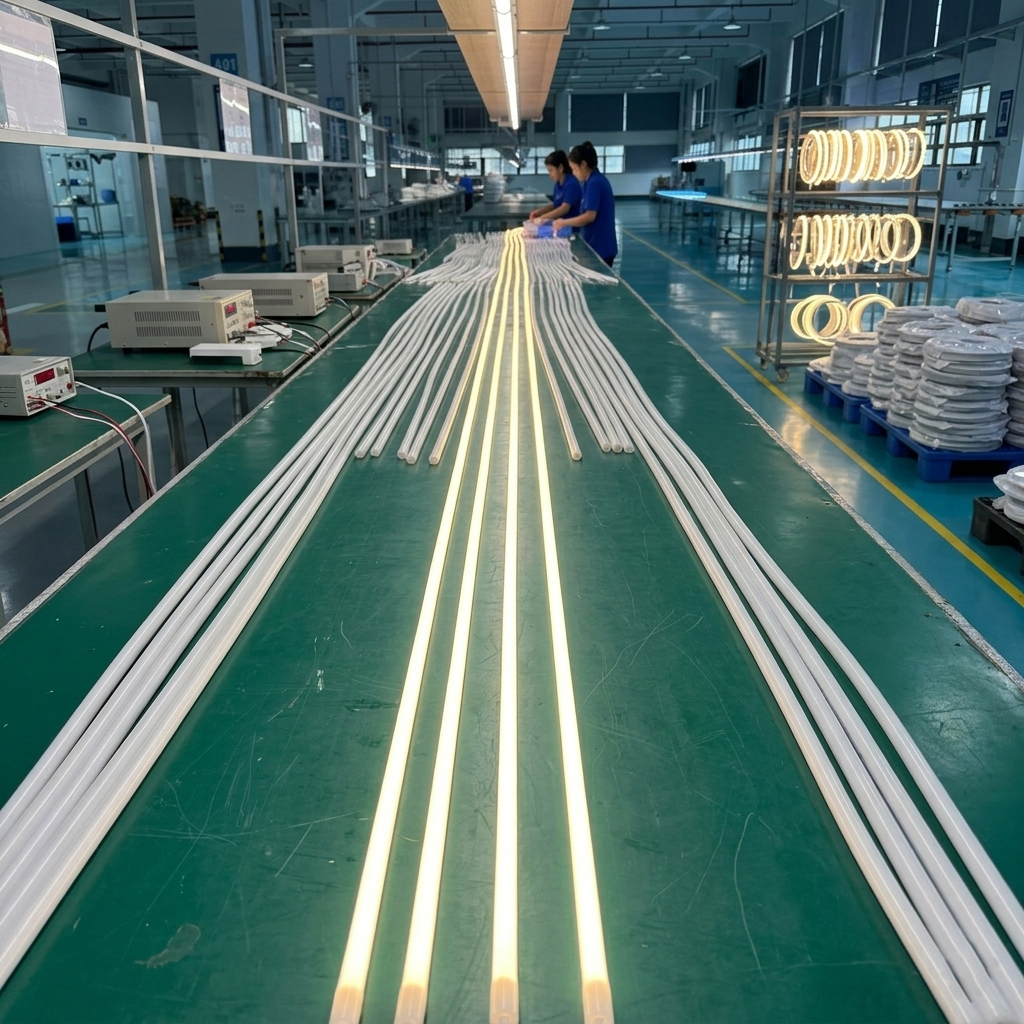
Choosing the wrong type of LED seems like a minor procurement mistake — until you're standing on-site with 3,200 meters of strip light installed and a control system that refuses to cooperate. The two basic types of LEDs aren't just a textbook classification. In a real lighting project, that distinction drives every decision downstream.
The two basic types of LEDs, in the context of architectural and commercial lighting projects, are single-color LEDs and RGB (multicolor) LEDs. Single-color LEDs emit one fixed color or color temperature and are controlled through simple dimming circuits. RGB LEDs contain red, green, and blue chips that combine to produce variable colors and require independent multi-channel control systems.

That distinction sounds clean and simple. In practice, it's where large-scale projects run into serious trouble. The visual similarity between these two product types creates a dangerous illusion — that they're interchangeable. They are not. Let me explain why, and what it costs when teams find out the hard way.
Why Do the Two Types of LEDs Look So Similar?
Procurement teams frequently report that single-color and RGB LED strip lights appear almost identical in the warehouse. This visual similarity is the first source of project risk.
Both product types share nearly the same physical profile. Both are sold on reels, cut to length, installed in aluminum channels, and run on 12V or 24V DC. Specifying only "24V LED strip light, warm white" in a procurement document does not distinguish between them.
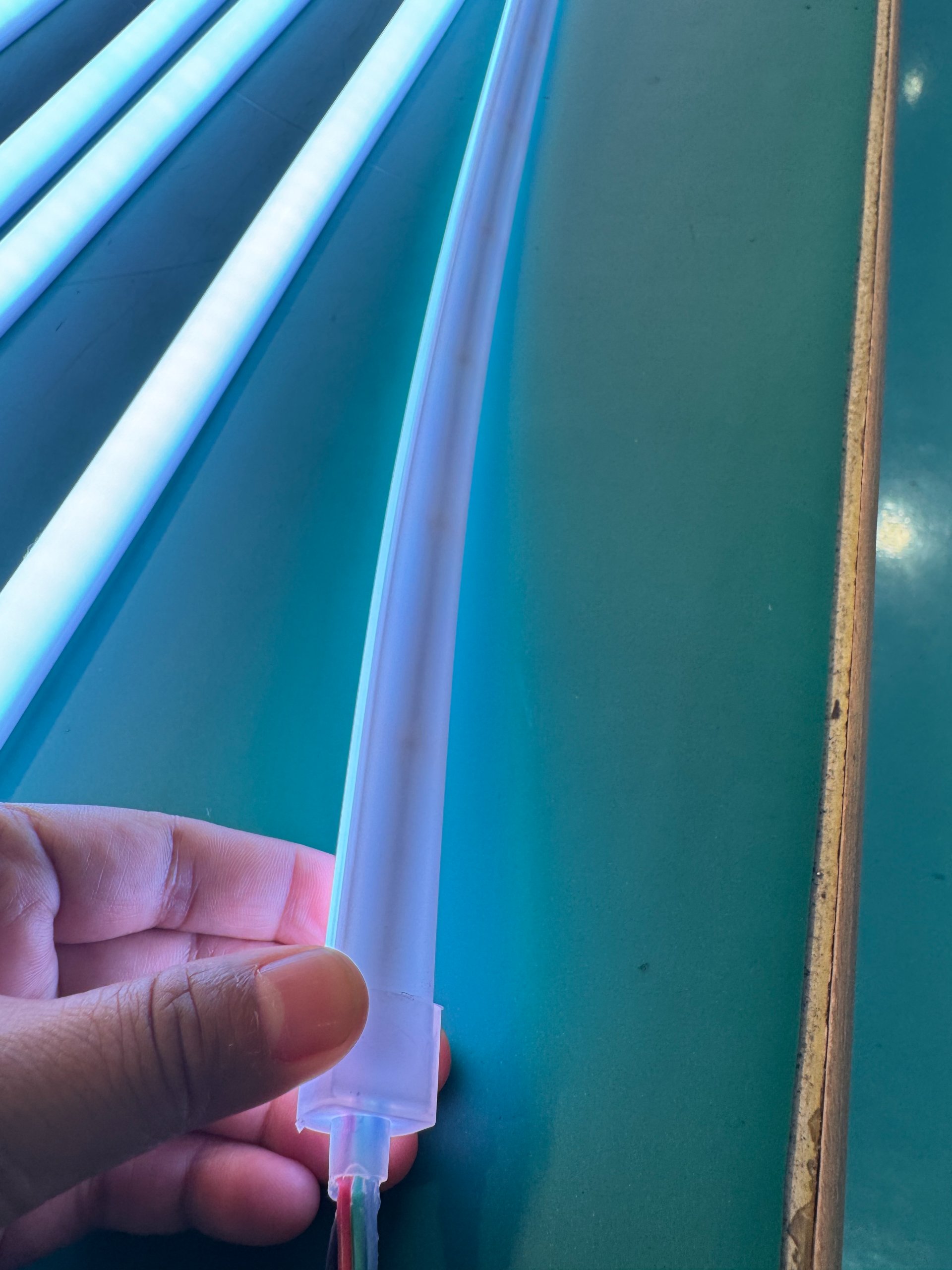
The surface-level resemblance between these two LED types fools even experienced project coordinators. Understanding the internal differences — at the chip, circuit, and system level — is what protects a project.
What's Actually Different Inside the Product?
At the chip level, the distinction is fundamental:
- Single-color LEDs contain one type of emitter — typically a white phosphor-converted chip for warm white, neutral white, or cool white output. The circuit is a single channel. One driver, one dimming signal, one output.
- RGB LEDs contain three separate emitter chips — red, green, and blue — packaged in a single component. Each color requires its own control channel. One RGB LED strip light has three independent electrical paths.
This structural difference has immediate consequences for everything else on the project:
| Parameter | Single-Color LED | RGB LED |
|---|---|---|
| Control channels | 1 | 3 (minimum) |
| Typical controller type | PWM dimmer or DALI driver | RGB controller or DMX decoder |
| Wiring connectors | 2-pin (+ and –) | 4-pin (R, G, B, common) |
| White light source | Direct from white chip | Mixed from R+G+B (lower quality) |
| Suitable applications | Architectural outlines, accent, general illumination | Color-changing facades, entertainment, media architecture |
| Control protocol options | 0–10V, DALI, PWM | DMX512, SPI, proprietary RGB |
The "Same Voltage, Same Product" Fallacy
In my experience reviewing project failures, the most common trigger for downstream problems is a procurement substitution that goes like this:
"The original spec called for 24V single-color warm white. We found a 24V RGB strip that's cheaper, brighter, and available sooner. It can also produce warm white by mixing the channels. Should work fine."
This reasoning is wrong for several reasons:
- RGB-mixed white light is not equivalent to phosphor-converted white light. The color rendering, color consistency, and long-term stability differ significantly.
- The control system was designed for a single-channel signal. Connecting an RGB product to a single-channel dimmer will either light only one color, produce uncontrolled color shifts, or simply malfunction.
- The wiring was sized and routed for a 2-pin circuit. RGB products require additional conductors. Retrofitting the cable run after installation is expensive.
Identical voltage ratings do not equal identical system compatibility. This is a critical boundary that procurement documents must establish explicitly.
What Happens When Projects Confuse the Two Types of LEDs?
The consequences of misidentifying LED types don't appear at installation. They surface at control system commissioning — and by then, the damage is already expensive.
A project that proceeds with the wrong LED type will typically complete physical installation without incident. Strip lights power on. They emit light. The site team reports no problems.
The failure becomes visible only when the control engineer attempts to program scenes, test dimming curves, or activate zone-based switching sequences.
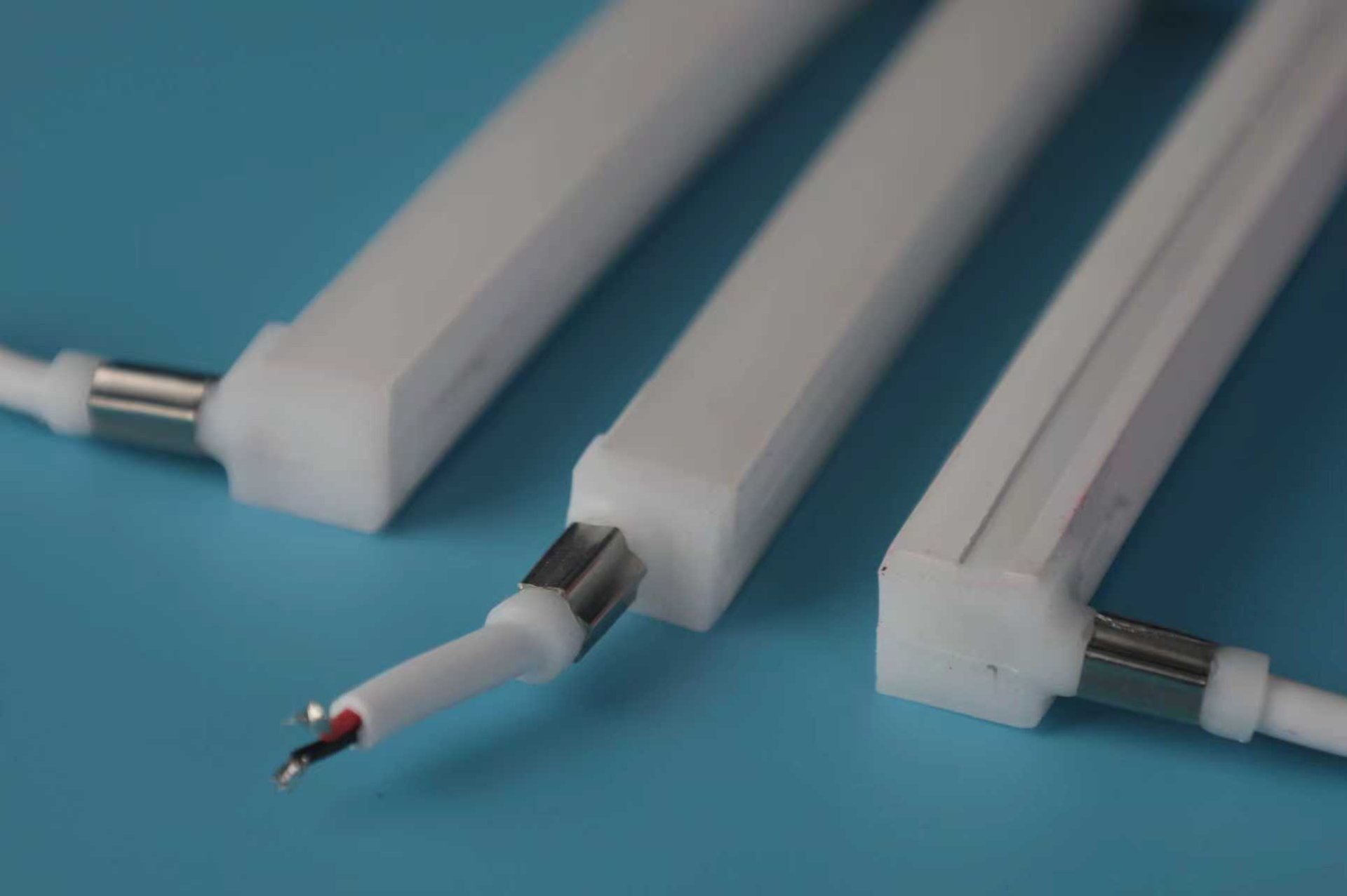
Here is a real project scenario I've analyzed in detail — a large commercial building facade project involving approximately 3,200 meters of LED strip.
Project Background
- Design intent: Continuous warm white architectural outline with festival dimming capability
- Original specification: 24V single-color warm white LED strip light
- Control system: Single-channel PWM dimming, zone-divided across multiple circuit groups
The design team had completed full electrical drawings: cable routing, circuit grouping, controller selection, and programming logic — all based on a single-channel architecture.
Where the Substitution Happened
During procurement, the approved supplier reported a lead time extension. A secondary supplier offered a 24V RGB LED strip light at a lower price with immediate availability.
The procurement coordinator observed that:
- Voltage matched
- Physical dimensions were similar
- The product could display warm white
The substitution was proposed and — because the procurement document only stated "24V LED strip light, warm white" — no explicit technical requirement blocked it.
This was the first document failure.
Why Installation Didn't Catch It
Installation crews followed the original drawings. The RGB strip lights were mounted, connected, and powered. Every strip illuminated. The project team signed off on installation completion.
"The lights are on" is not the same as "the system works."
The failure surfaced at commissioning. The single-channel PWM controllers could not communicate with a three-channel RGB product. Attempting to dim the circuit produced color shifts, channel imbalance, or complete loss of control across sections. Multiple zones could not execute the programmed scene sequences.
The Remediation Options — And Their Costs
At that point, the installed scope included:
- 3,200 meters of strip light, mechanically fixed
- Fully routed cable infrastructure
- Installed power supplies
- Completed control wiring
Option A: Replace all strip lights
- Materials + labor + removal + reinstallation
- Project delay: estimated 3–6 weeks depending on restocking
Option B: Replace the control system
- New RGB-capable controllers, decoders, and gateways
- Reprogram all scene logic for three-channel RGB output
- Revalidate all circuit groupings against new controller channel capacity
- May require additional cabling for RGB signal conductors
Neither option was inexpensive. And neither option was the supplier's fault — the product performed exactly as specified. The product simply wasn't the right product for the designed system.
The Responsibility Dispute That Followed
Every party had a defensible position:
- Procurement: "The product emits warm white light as required."
- Supplier: "The product has no quality defects."
- Installer: "We installed what procurement provided."
- Controls contractor: "The installed product doesn't match the approved design."
- Design firm: "No substitution was authorized through the technical review process."
The owner's question was simpler: Why can't the installed system execute the approved lighting program?
Resolving that question took weeks, involved formal variation orders, and consumed budget that had nothing to do with the original material cost difference.
How Do Successful Projects Handle LED Type Selection?
Projects that avoid this failure class treat LED type selection as a system-level decision, not a product-level decision. The LED type is confirmed first, and everything else is designed around it.
A second building facade project I reviewed faced nearly identical initial conditions — schedule pressure, cost sensitivity, and an ambiguous early specification. The outcome was completely different because the technical lead asked a different set of questions before procurement opened.

Step 1: Define the Actual Color Control Requirement
The team broke the lighting brief into operational modes:
- Daily operation: Fixed warm white, static
- Festival mode: Red, green, blue, and color-mixed effects
- Dynamic mode: Zone-differentiated scene sequences with transition timing
This analysis immediately revealed that the project needed more than simple dimming. It needed independent color channel control. A single-color LED strip was therefore eliminated from consideration before any supplier was contacted.
Step 2: Evaluate Single-Color, RGB, and RGBW
The technical lead then evaluated three product architectures:
Single-Color: Appropriate for the daily warm white mode only. Cannot support festival color or dynamic effects without a parallel infrastructure — effectively doubling the installation.
RGB: Supports color variation and dynamic scenes. However, white light produced by RGB mixing has lower color rendering index (CRI) values and less consistent color temperature than a dedicated white channel. For a commercial facade application with daytime architectural presence, this was a concern.
RGBW: Adds a dedicated white chip to the RGB cluster. This resolves the white light quality issue while retaining full RGB dynamic capability. Requires a four-channel controller and additional wiring, but eliminates the quality compromise on the white output.
The project selected RGBW — not because it was the cheapest option, but because it was the only architecture that met all defined output requirements.
Step 3: Lock the Control System Before Procurement
Once the LED type was confirmed, the team simultaneously specified:
- Controller type and channel count
- DMX512 addressing scheme
- Power supply sizing per zone
- Cable specification (including number of conductors)
- Maximum run length per circuit
- Connector and junction box standards
This became a single locked BOM — LED type, power supply, controller, cable, and accessories — that procurement could not partially substitute without a formal technical review.
Step 4: Conduct a Mock-Up Before Bulk Order
The team built a full working mock-up using actual specified products before issuing the bulk purchase order. The mock-up validated:
- White point and CRI under actual drive conditions
- Color accuracy across R, G, B individual channels
- Dimming linearity and flicker performance
- Dynamic transition smoothness
- Zone isolation and control response time
- Maximum run length against voltage drop measurements
Only after the mock-up passed every criterion did procurement release the full order.
What Should a Specification Document Actually Require?
Most LED project failures I've reviewed trace back to specification documents that are under-defined. The most dangerous document gaps are predictable — and preventable.
Gap 1: "LED Strip Light" Without Type Definition
Any document that specifies only "LED strip light" without defining single-color, RGB, or RGBW has left a substitution door open. The minimum required descriptor is:
24V single-color warm white LED strip light, 3000K, CRI ≥ 90, single-channel PWM dimmable
or
24V RGBW LED strip light, white channel 3000K CRI ≥ 90, four-channel DMX512 compatible
Gap 2: Color Specification Without LED Architecture
Specifying "3000K warm white" describes the output. It does not define how that output is produced. A single-color white strip and an RGB strip set to mix approximately warm white are not equivalent products, and a specification that defines only output color cannot distinguish them.
Gap 3: Voltage Without Control Architecture
"DC 24V" appears in virtually every LED strip specification. It eliminates nothing. Every major LED type — single-color, RGB, RGBW — is available in 24V configurations. A complete specification defines voltage and control channel count and compatible control protocol.
Gap 4: Permitting "Equivalent LED" Without Defining Equivalence
The phrase "equivalent products acceptable" in a procurement document is a substitution authorization without criteria. If equivalent substitution is permitted, the document must specify what parameters define equivalence:
- LED type and chip structure
- Channel count
- Control protocol compatibility
- Color output specification
- Dimming performance
- Physical form factor and connector type
Frequently Asked Questions
What are the two basic types of LEDs in lighting projects?
In commercial and architectural LED lighting, the two basic types are single-color LEDs and RGB (multicolor) LEDs. Single-color LEDs emit one fixed color or color temperature through a single control channel. RGB LEDs combine red, green, and blue chips to produce variable colors through a three-channel control system.
Can an RGB LED strip replace a single-color LED strip if the voltage is the same?
No. Matching voltage does not mean matching control architecture. A single-color strip uses a one-channel dimming circuit. An RGB strip requires a three-channel controller, additional signal wiring, and different programming logic. Substituting one for the other without redesigning the control system will cause commissioning failure.
What is the difference between RGB and RGBW LED strips?
RGB LED strips contain red, green, and blue chips. White is produced by mixing all three channels, which typically yields lower CRI and less consistent color temperature than a dedicated white source. RGBW strips add a fourth white chip, providing both high-quality white output and full RGB color capability — at the cost of a four-channel control requirement.
When should a project use single-color LEDs instead of RGB?
Single-color LEDs are appropriate when the lighting design requires a fixed color temperature, stable long-term white light output, and simple dimming control. Typical applications include architectural outlines, hospitality cove lighting, retail accent lighting, and general commercial illumination where color changing is not required.
What questions should I ask a supplier before specifying LED strip type?
Ask the supplier to confirm: the LED chip type (single-color, RGB, or RGBW), the number of control channels required, the compatible controller and protocol, how white light is generated, the wiring configuration and connector type, and whether the product is compatible with the project's existing or planned control system.
Conclusion
The two basic types of LEDs — single-color and RGB — represent far more than a product catalog distinction. In a large-scale architectural or commercial lighting project, LED type is the starting point for every downstream decision: control system design, wiring infrastructure, power supply sizing, commissioning logic, and acceptance criteria. Treating the two types as interchangeable because they share a voltage rating is the single most reliably expensive mistake in LED project procurement.
The correct decision process runs from lighting requirement to LED type to control system to electrical design to mock-up validation to locked procurement — in that order. If LED type is left ambiguous at the specification stage, the project absorbs that ambiguity as variation cost at commissioning.
If you're specifying LED strip light for a commercial or architectural project and want to confirm product type, control compatibility, and system-level requirements before procurement, contact our technical team. We support buyers, lighting designers, and contractors with product selection guidance, sample validation, and OEM specification services.