
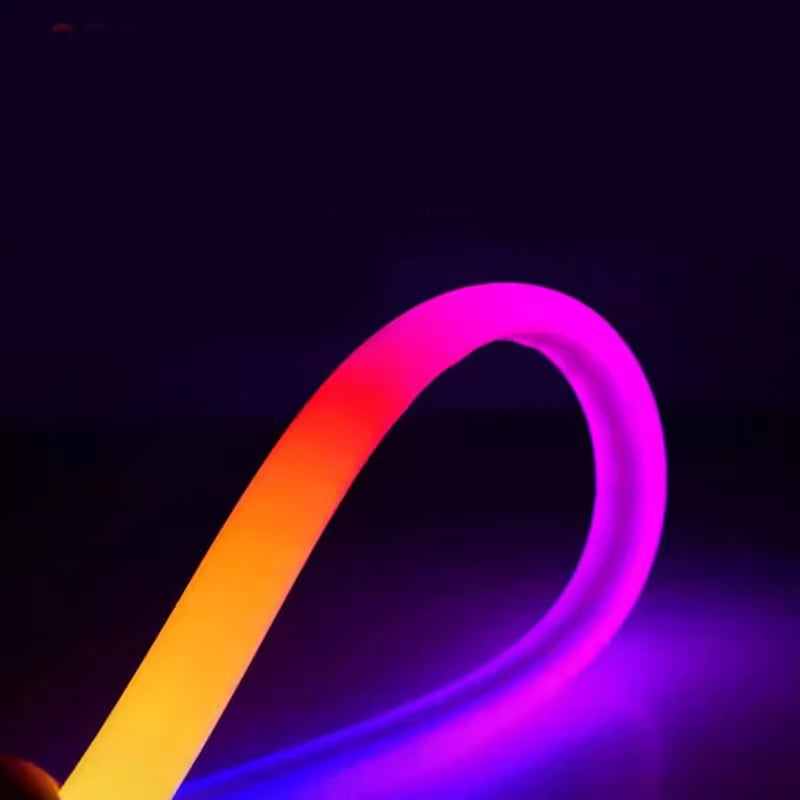
You're browsing product catalogs. You see "360° uniform glow1" and think: perfect for my next project. But here's the uncomfortable truth—most 360° silicone neon flex strips2 are thermal time bombs waiting to fail three months after installation.
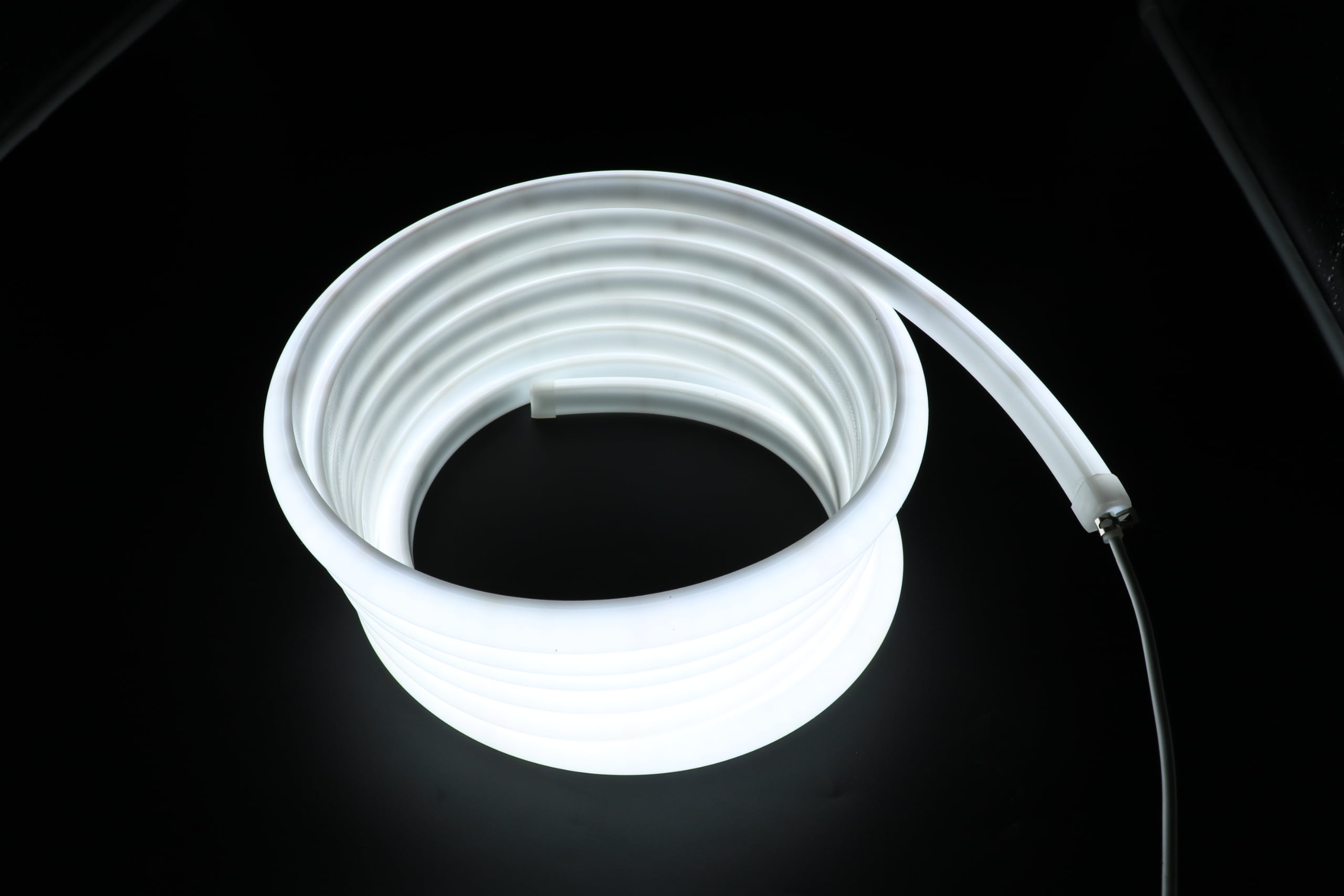
NeonFlex Pro 360 Single Color delivers true omnidirectional illumination, but its success hinges entirely on one invisible factor: heat dissipation architecture3. Without proper thermal management4, that stunning 360° glow becomes a pathway to premature yellowing, light decay, and expensive warranty claims that can destroy your reputation overnight.
I've seen this pattern repeat across dozens of projects. The samples look flawless. The installation goes smoothly. Then reality hits—and it's always the same question: "Why is my premium lighting system already degrading?"
What Makes 360° Lighting Different from Traditional LED Strips?
You might assume 360° neon flex is just another variation of linear lighting. That's a costly misconception that leads to project failures.
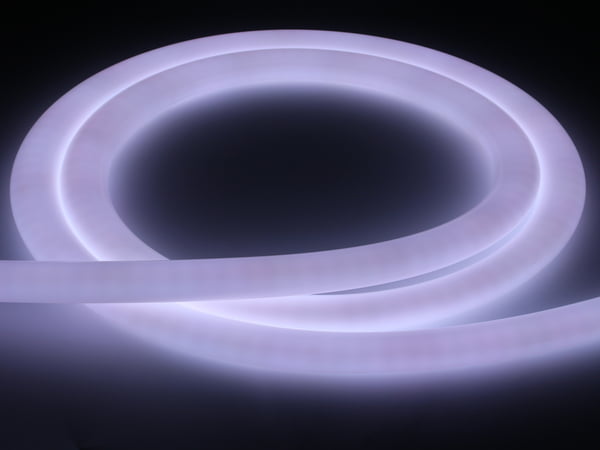
Traditional LED strips emit light from one surface, leaving the backside available for heat escape. NeonFlex Pro 360 wraps LEDs in a complete silicone enclosure, creating a sealed thermal environment where heat has nowhere to go except through the material itself.
Here's what actually happens inside a 360° structure:
Single-sided strips have natural convection paths. The PCB backing acts as a heatsink. Air can circulate freely around non-illuminated surfaces.
Side-emitting strips still maintain partial exposure. At least two surfaces remain accessible for thermal transfer.
But with 360° designs, we've created something fundamentally different. The LED array sits at the core, completely surrounded by silicone. Every watt of electrical power that doesn't convert to light becomes trapped heat.
| Configuration Type | Heat Escape Routes | Thermal Risk Level | Typical Core Temperature |
|---|---|---|---|
| Single-Sided Strip | 3-4 surfaces | Low | 45-55°C |
| Side-View Neon | 2-3 pathways | Medium | 55-65°C |
| 360° Full Enclosure | Radial only | High | 65-85°C+ |
The physics are unforgiving. Standard silicone has a thermal conductivity5 around 0.2 W/m·K—that's roughly 1,000 times worse than aluminum. When you seal LEDs inside this material without engineered heat pathways, you're essentially building an insulated oven.
I've measured junction temperatures6 exceeding 80°C in poorly designed 360° strips running at just 12W/meter. That's not a defect. That's physics meeting inadequate engineering.
Why Do "Premium" 360° Strips Still Fail After Three Months?
This is where the industry's dirty secret emerges. The failure isn't sudden. It's a slow degradation that most clients don't notice until it's too late.
Thermal accumulation in 360° silicone neon creates a cascading failure pattern: elevated LED junction temperature7es](https://siluxa.com/2026/04/14/can-an-8mm-recessed-silicone-led-neon-strip-really-fit-perfectly-without-long-term-issues/)%%%FOOTNOTE_REF_6%%% accelerate phosphor decay8, while sustained heat exposure triggers silicone oxidation9, resulting in visible yellowing and measurable lumen depreciation within 90-120 days of continuous operation.
Let me walk you through a real project autopsy I conducted last year.
A high-end retail installation used what appeared to be premium 360° neon flex. The specifications looked perfect on paper: food-grade silicone, branded LEDs, proper IP68 rating.
Week 1-4: Perfect performance. Uniform glow. Client thrilled.
Week 8-12: Subtle color shift begins. Most people don't notice yet.
Month 4: Obvious yellowing appears in high-temperature zones. Brightness noticeably decreased.
Month 6: Complete replacement required. Total project loss.
The contractor blamed "cheap Chinese materials." But the lab analysis told a different story:
The silicone composition was actually high-quality. The LEDs were legitimate mid-bin components. The problem wasn't material quality—it was thermal design failure.
Here's the breakdown of what really happened:
Phase 1: Heat Entrapment
- LED junction temperature7 stabilized at 78°C (specification limit: 65°C)
- No internal thermal pathway existed
- Heat could only dissipate radially through 8mm of low-conductivity silicone
Phase 2: Accelerated Aging
- Elevated temperatures triggered thermal oxidation in the silicone matrix
- Phosphor coating on LEDs began degrading at exponential rates
- Color temperature shifted from 3000K to 3400K
Phase 3: Visible Failure
- Silicone yellowing became apparent to the naked eye
- Lumen output dropped 25% from initial values
- Non-uniform degradation created visible "hot spots"
The contractor learned an expensive lesson: You can't see thermal management4 in a product photo, but you'll definitely see its absence in your warranty claims.
Most suppliers don't provide junction temperature data. They give you lumen output, color rendering index, and IP ratings—all measured at 25°C ambient in controlled conditions.
But your project doesn't run in a lab. It runs at 35°C summer temperatures, mounted against heat-retaining surfaces, operating 12+ hours daily.
That's when thermal design separates professional solutions from expensive mistakes.
How Do You Actually Verify Thermal Performance Before It's Too Late?
I'm going to give you the exact evaluation framework we use when qualifying 360° neon flex suppliers. This isn't marketing material—it's engineering due diligence.
Effective thermal validation10 requires three non-negotiable verification points: cross-sectional thermal architecture11 documentation, sustained-operation temperature profiling, and material-level thermal modification confirmation.
Verification Point 1: Demand the Real Cross-Section
Don't accept marketing renders. You need actual product cross-sections showing:
- Exact distance from LED die to outer silicone surface
- Presence (or absence) of internal thermal conductors
- PCB substrate material and thickness
- Any embedded heat-spreading elements (copper wire, aluminum core, thermal-conductive fillers)
A proper 360° design should show at least one of these features:
| Thermal Enhancement Method | Effectiveness | Cost Impact | Verification Method |
|---|---|---|---|
| Copper wire mesh embedded | High | +15-25% | Request wire gauge specs |
| Aluminum core extrusion | Very High | +30-40% | Ask for core diameter |
| Thermal-conductive silicone | Medium | +10-15% | Demand thermal conductivity5 data |
| PCB with metal backing | High | +20-30% | Request PCB layer structure |
If the supplier can't provide detailed thermal pathway documentation, you're looking at a standard extrusion with no heat management engineering. That's a project risk you shouldn't accept.
Verification Point 2: Get Real Operating Temperature Data
This is where most buyers fail. They accept photometric data but never ask about thermal performance.
You need to request:
- LED junction temperature7 after 2 hours of continuous operation
- Ambient test conditions (not just "room temperature")
- Power density during testing
- Measurement methodology (infrared camera, thermocouple placement, etc.)
Here's your safety evaluation framework:
≤ 65°C: Professional-grade thermal design. Safe for long-term deployment.
65-80°C: Marginal performance. Acceptable only for low-duty-cycle applications or climate-controlled environments.
≥ 80°C: Thermal failure zone. Expect accelerated degradation regardless of other quality factors.
I've rejected suppliers with otherwise excellent products because they couldn't provide this data. If they're not measuring it, they're not managing it.
Verification Point 3: Understand Silicone Modification, Not Just Purity
The industry loves to advertise "100% food-grade silicone" as if that's the ultimate quality marker. It's not.
For 360° thermal applications, you need functionally modified silicone12 with specific engineering properties:
Thermal conductivity enhancement: Standard silicone: ~0.2 W/m·K. Thermally modified: 0.5-1.0 W/m·K. That's a 3-5x improvement in heat transfer capability.
UV/thermal oxidation resistance: Unmodified silicone12 yellows under combined heat and UV exposure. Professional formulations include hindered amine light stabilizers (HALS) and antioxidant packages.
Long-term stability validation: Ask if the supplier conducts accelerated aging tests. Proper validation involves 1,000+ hours at elevated temperature (85°C) with periodic photometric and colorimetric measurements.
The question isn't "Is it food-grade?" The question is: "What thermal and photochemical modifications have been made to ensure 50,000-hour performance in actual operating conditions?"
Does Installation Method Really Impact Lifespan That Much?
This is the variable that separates experienced contractors from amateurs. Installation technique can literally double your effective product lifespan.
Mounting substrate selection and installation geometry13 directly influence passive heat dissipation14 rates, with aluminum channel mounting reducing LED junction temperature7es](https://siluxa.com/2026/04/14/can-an-8mm-recessed-silicone-led-neon-strip-really-fit-perfectly-without-long-term-issues/)%%%FOOTNOTE_REF_6%%% by 15-20°C compared to suspended installations.
I've conducted side-by-side thermal testing with identical product samples installed three different ways:
Suspended/Free-Hanging Installation
- No conductive heat path
- Relies entirely on convection and radiation
- Measured junction temperature: 82°C
- Projected L70 lifespan15: 25,000 hours
Surface-Mounted on Wood/Plastic
- Minimal conductive benefit
- Slight improvement from contact area
- Measured junction temperature: 76°C
- Projected L70 lifespan15: 35,000 hours
Mounted in Aluminum Channel
- Direct thermal coupling to high-conductivity substrate
- Channel acts as passive heatsink
- Measured junction temperature: 63°C
- Projected L70 lifespan15: 50,000+ hours
The same product. The same power density. The same ambient conditions. Just different mounting approaches—and the thermal performance gap is massive.
Here's what this means for your project planning:
| Installation Context | Recommended Mounting | Expected Performance |
|---|---|---|
| Indoor architectural cove lighting | Aluminum channel preferred | Full rated lifespan achievable |
| Outdoor building outline | Metal backing essential | Requires IP68 + thermal substrate |
| Suspended decorative elements | Use lower power density or accept shorter life | Consider 8W/m instead of 12W/m |
| Signage applications | Direct metal contact whenever possible | Thermal interface material recommended |
The physics are straightforward: aluminum conducts heat roughly 1,000 times better than air. When you create direct thermal coupling between your silicone neon and a metal substrate, you're opening a massive heat escape pathway that simply doesn't exist in suspended installations.
I always tell contractors: your installation method is worth half your thermal budget. Don't waste it.
Conclusion
NeonFlex Pro 360 Single Color isn't just about achieving 360° illumination—it's about managing the thermal consequences of that design choice through engineered heat pathways, modified materials, and intelligent installation practices.
Explore the concept of 360° uniform glow to understand its significance in lighting design. ↩
Find out the advantages of silicone neon flex strips for your lighting needs. ↩
Learn about heat dissipation architecture to ensure longevity in your lighting projects. ↩
Discover the importance of thermal management in enhancing LED performance and lifespan. ↩
Explore thermal conductivity to improve heat management in your lighting solutions. ↩
Discover the significance of junction temperatures for the reliability of LED systems. ↩
Find out how to measure LED junction temperature for better thermal management. ↩
Explore the causes of phosphor decay to maintain the quality of your lighting. ↩
Learn about silicone oxidation to avoid degradation in your lighting installations. ↩
Get insights on thermal validation to ensure the quality of your LED products. ↩
Understand cross-sectional thermal architecture to enhance your lighting design. ↩
Learn about modified silicone to improve the durability of your lighting products. ↩
Understand the impact of installation geometry on the performance of LED systems. ↩
Explore passive heat dissipation techniques to optimize your lighting installations. ↩
Understand L70 lifespan to gauge the longevity of your LED lighting solutions. ↩